Healthcare Vulnerability Assessment and Penetration Testing Services
Identify Security Gaps & Protect Healthcare Systems from Cyberattacks with VAPT Services
Block unauthorized access, halt lateral ransomware movement, and protect patient data using microsegmentation, adaptive IAM, mTLS, and continuous IoMT verification across clinical networks.





















Our Vulnerability Assessment and Penetration Testing Services
Our Vulnerability Assessment and Penetration Testing Services
Advanced Capabilities
Offensive Security Engineered Around Live Clinical Operations
Clinical-Safe Penetration Testing Protocols
Execute rate-limited scans and manual checks scheduled around clinical windows so fragile medical devices and legacy interfaces never crash.
Exploit-Chain & Attack-Path Modeling
Connect isolated low-severity flaws into complete attack graphs to show leadership exactly how adversaries chain bugs to reach ePHI.
Healthcare Interoperability Protocol Fuzzing
Safely test HL7 v2 listeners, FHIR APIs, and DICOM services against malformed payloads, buffer overflows, and authentication bypasses.
Zero False-Positive Manual Verification
Every automated vulnerability finding is manually validated by senior healthcare pen testers before it ever lands on your engineering backlog.
MITRE ATT&CK Healthcare Adversary Emulation
Replicate the exact tactics, techniques, and procedures used by active healthcare ransomware groups to test your real-world defenses.
Purple-Team Detection & SOC Tuning
Work side-by-side with your blue team during live exploit runs to verify whether your SIEM and EDR actually trigger alerts.
Developer-Ready Remediation Guidance
Deliver exact code-level diffs, configuration scripts, and architecture fixes so your developers and sysadmins can patch flaws fast.
Complimentary Re-Testing & Fix Verification
Re-run targeted exploit tests after your team applies patches and issue a clean attestation letter for auditors and underwriters.
Business Outcomes
Business Outcomes That You Can Expect
Case Studies
We’ve successfully implemented a range of solutions. See how healthcare organizations
like yours achieved measurable results with CapMinds.

End-to-End RCM Automation for UiPath Using a Custom EMR
- 100% automation of standard RCM processes
- 50% faster claim turnaround
- Zero errors in claim formatting and submission

Westside Behavioral Care with a Custom EMR Platform
- Centralized EMR with consolidated patient data.
- 100% paperless onboarding process
- 90% automation in scheduling and documentation

UDS Reporting for Ventura County Health Care Agency (VCHCA)
- Automated processing of 100,000+ records
- FHIR validation and HRSA mock submission in 10 weeks
- 100% HRSA compliance
Do You Know Which Vulnerability an Attacker Would Exploit?
Uncover the exact attack paths hiding across your clinical networks, patient portals, and FHIR APIs before ransomware operators find them first.
Who Do We Serve?

Multi-Hospital Health Systems & IDNs

Regional & Community Hospitals

Academic Medical Centers

Specialty Clinics & Ambulatory Surgery Centers

Diagnostic Imaging & Teleradiology Centers

Clinical & Reference Laboratories

Telehealth & Remote Patient Monitoring Providers

Digital Health & Healthcare SaaS Companies

EHR, PACS & Health IT Software Vendors

Medical Device & IoMT Manufacturers

Healthcare Payers & Clearinghouses

Revenue Cycle Management Organizations
Why Organizations Choose CapMinds for Healthcare Cybersecurity Assessment Services
18+ Years in Healthcare Technology
Apply long-standing healthcare experience to workflow decisions, interoperability challenges, operational risks, and modernization planning.

Deep FHIR, HL7 & DICOM Security Specialization
We test healthcare-specific protocols and clinical data schemas that generic corporate penetration testing firms don't know how to read.
100% Verified Findings With Zero Noise
We manually validate every vulnerability and provide clear proof-of-concept evidence so your team never wastes hours chasing false positives.
Remediation Validation & Re-Testing Included
After your engineering team deploys the recommended patches, we conduct targeted re-testing to verify vulnerability closure and issue an updated, audit-ready attestation report.
Dual Executive & Technical Reporting
Receive board-ready risk summaries for leadership alongside step-by-step reproduction guides and compliance mappings for engineers and auditors.
Deep Business-Logic Exploit Hunting
We bypass automated scanners to manually manipulate patient portals and FHIR tokens, catching complex cross-tenant ePHI leaks that automated tools completely miss.

What Our Clients Say
Hear from healthcare leaders who’ve transformed their operations with our services & solution.
What Makes CapMinds a Trusted Healthcare Penetration Testing Partner?
Generic pen testers can crash lab interfaces, trigger biomedical alarms, and bury you in unverified scanner noise. CapMinds builds EHRs, FHIR APIs, PACS archives, and cloud health platforms daily, so we know how to test clinical systems safely. Our manual, engineering-led approach finds the logic flaws and exploit chains automated tools miss, protecting patient data without disrupting care.

HIPAA
COMPLIANCE

ISO 9001:2015
CERTIFIED

GDPR
COMPLIANT
SOC 2 TYPE 2
CERTIFIED

HL7 FHIR
STANDARDS

SNOMED CT
COMPATIBLE

HITRUST
ALIGNED
Technology & Platform Experience
The Standards, Methodologies & Technologies Behind Our Healthcare VAPT Services
Penetration Testing Methodologies & Frameworks

Application & API Security Testing

Network & Infrastructure Assessment
Cloud & Container Security Auditing

Healthcare Protocols & Clinical Platforms Tested

Vulnerability Scoring & Compliance Mapping

Ready to Validate Your Defenses Against Real-World Healthcare Threats?
Stop guessing whether your firewalls, APIs, and cloud workloads can withstand a targeted attack. Partner with CapMinds for clinical-safe vulnerability assessments and manual penetration testing backed by actionable remediation support.
- Clinical-safe network vulnerability assessments
- Manual web and mobile pentesting
- FHIR and healthcare API testing
- Internal and external adversary simulation
- Free post-patch remediation re-testing
Frequently Asked Questions
What is the difference between a vulnerability assessment and a penetration test?
A vulnerability assessment scans your systems to identify and prioritize known configuration gaps and missing patches across your environment. A penetration test goes further by having ethical hackers manually exploit those weaknesses to prove how an attacker could chain them together to access ePHI.
Does HIPAA require hospitals and health tech companies to perform penetration testing?
The HIPAA Security Rule mandates periodic technical evaluations to ensure ePHI controls remain effective, and recent HHS OCR updates explicitly emphasize annual penetration testing and regular vulnerability scanning. HITRUST CSF, SOC 2, and cyber insurance underwriters also strictly require annual third-party pentests.
How often should a healthcare organization conduct vulnerability assessments and penetration tests?
Healthcare organizations should run automated vulnerability assessments at least monthly or quarterly and perform comprehensive manual penetration testing at least once a year. You should also conduct targeted penetration tests whenever you launch a new patient application, FHIR API, or major cloud migration.
Do you provide re-testing after our engineering team patches the vulnerabilities?
Yes. Every CapMinds penetration testing engagement includes complimentary remediation validation within an agreed window after your team applies fixes. Once we verify that the vulnerabilities are closed, we issue an updated attestation report you can share with auditors, partners, and underwriters.
What is the difference between internal and external penetration testing for a hospital?
External penetration testing simulates an unauthenticated hacker on the internet attempting to breach your perimeter via public IPs, web portals, and VPN gateways. Internal penetration testing simulates an attacker who has already bypassed the perimeter, via phishing or a rogue device, trying to escalate privileges and reach EHR databases.
How long does a healthcare vulnerability assessment or penetration test take?
A focused web application, API, or external network penetration test typically takes 2 to 3 weeks from kickoff to final report delivery. Comprehensive enterprise engagements spanning internal networks, wireless facilities, cloud environments, and multiple applications generally run 4 to 6 weeks.
How do you ensure penetration testing does not disrupt live patient care or crash medical devices?
We use clinical-safe rules of engagement that exclude fragile biomedical subnets from aggressive automated scans and throttle packet rates. High-risk application and API exploitation is conducted in staging environments or during pre-approved maintenance windows with real-time IT coordination.
Can you test our FHIR APIs, HL7 interfaces, and patient portals for healthcare-specific flaws?
Yes. Our engineers specialize in healthcare data schemas and test SMART on FHIR endpoints, HL7 listeners, and patient portals for Broken Object Level Authorization (BOLA) and ID enumeration. We verify that an authenticated user or partner app cannot manipulate requests to harvest another patient’s chart.
How do you eliminate false positives from your vulnerability and penetration testing reports?
Unlike low-cost scan-and-dump vendors, our senior penetration testers manually verify every reported finding before finalizing the deliverable. Each vulnerability includes step-by-step reproduction evidence, screenshots, and contextual risk scoring tailored to your specific clinical architecture.
Can you perform penetration testing on cloud-hosted healthcare environments like AWS, Azure, or GCP?
Yes. We assess cloud configurations, IAM roles, storage buckets, Kubernetes clusters, and serverless workloads across AWS, Azure, and Google Cloud. We identify cloud-specific attack paths such as privilege escalation, exposed snapshots, and hybrid VPN misconfigurations that threaten hosted ePHI.
Will we receive an attestation letter we can share with hospital customers and cyber insurers?
Yes. Alongside our confidential technical report and executive summary, we provide an official Letter of Attestation detailing the scope, testing methodology, and remediation status. Digital health vendors and hospitals routinely use this letter to pass customer security reviews and insurance renewals.
How does a VAPT engagement with CapMinds begin?
Every engagement starts with a short scoping call where we review your IP ranges, user roles, API endpoints, cloud accounts, and clinical uptime constraints. We then deliver a clear Rules of Engagement document, testing schedule, and fixed-scope proposal so testing can begin safely and predictably.
Resources
Insights for Healthcare Technology Teams.
How to Build a Disconnected Environment System Using OpenEMR
For the past decade, enterprise healthcare IT operated on a single, unquestioned assumption: the cloud is always reachable. Multi-campus hospital networks, Management Services Organizations, and specialty medical […]
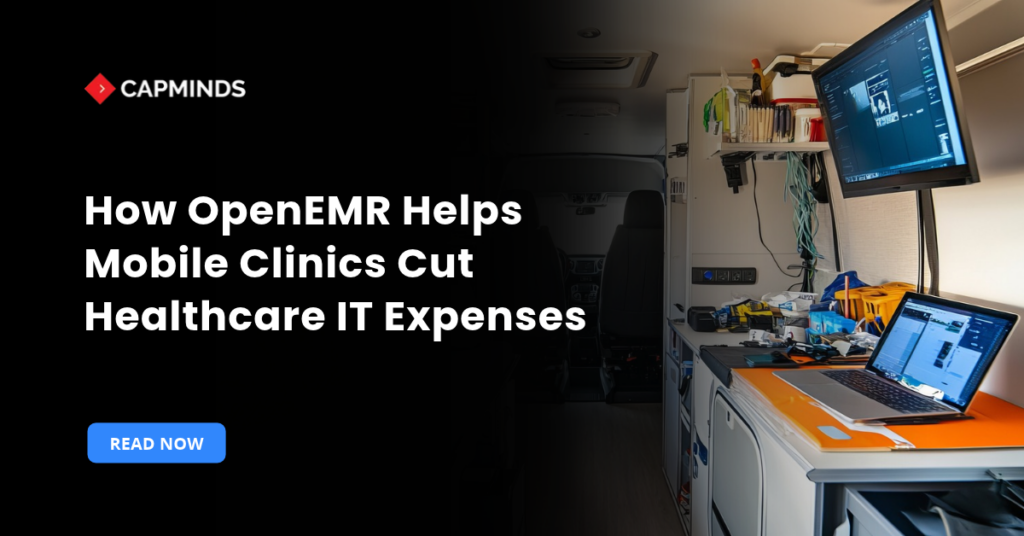
How OpenEMR Helps Mobile Clinics Cut Healthcare IT Expenses
More than 3,600 mobile clinics function in the United States and provide approximately 10 million health care visits annually. As they grow, they face healthcare IT costs, […]
OpenEMR Architecture Roadmap for Mid-Sized Healthcare Organizations
OpenEMR is an open-source EHR/PM system that is ONC-certified and widely used. It offers a web/mobile interface and provides core activities such as patient records, scheduling, prescriptions, […]