FHIR API Managed Services: Monitoring, Versioning, Consent, Security, and Data-Quality Operations
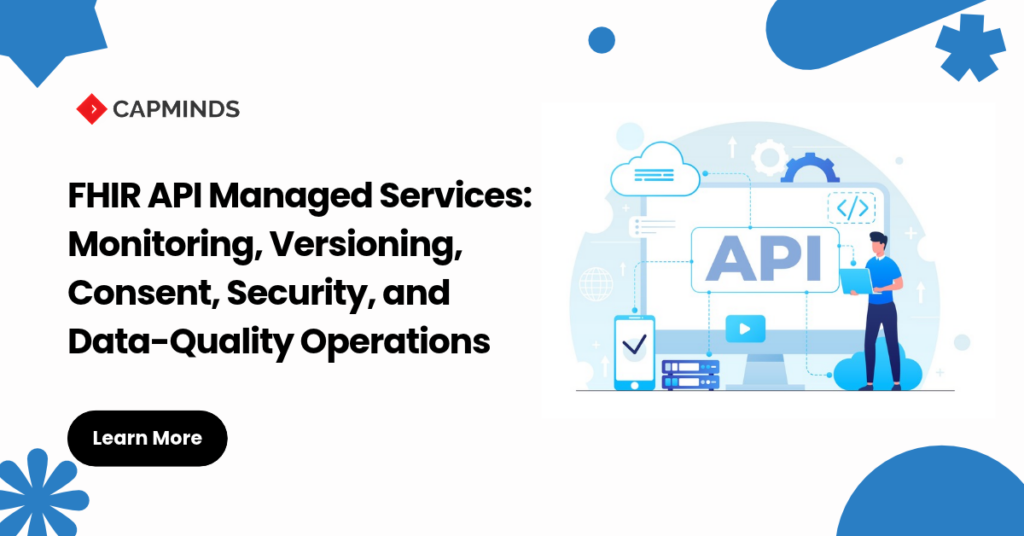
Implementing a FHIR API does not end when the endpoint goes live. Production FHIR environments require continuous monitoring, version management, authorization controls, security auditing, and data-quality validation.
This becomes increasingly important as healthcare organizations operate FHIR APIs for patient access, provider access, payer-to-payer exchange, prior authorization, and other interoperability workflows. CMS, for example, requires impacted payers to implement and maintain specific FHIR APIs, with several API development and enhancement requirements beginning January 1, 2027.
FHIR API managed services address the operational work required to keep these interfaces reliable, secure, conformant, and usable after implementation.
What Are FHIR API Managed Services?
FHIR API managed services are the ongoing technical operations required to maintain and improve production FHIR interfaces.
These services can include:
- API availability and performance monitoring
- FHIR and implementation-guide version management
- OAuth 2.0 and SMART authorization management
- Consent and access-policy operations
- Security and audit monitoring
- FHIR profile and terminology validation
- Data-quality monitoring and remediation
- Regression and conformance testing
The key distinction is that a FHIR API can be available but operationally unhealthy.
An endpoint may return HTTP 200 responses while resources contain incomplete data, clients use outdated profiles, authorization policies behave incorrectly, or downstream consumers encounter recurring validation failures.
Why FHIR API Managed Services Matter
FHIR APIs are increasingly becoming production infrastructure for healthcare data exchange. Their operational requirements extend beyond endpoint development to include standards lifecycle management, authorization, consent enforcement, security monitoring, conformance testing, and ongoing data-quality management.
For healthcare organizations, the challenge is therefore not just building a FHIR API.
It is keeping that API reliable as standards evolve, consumers change, security policies become more complex, and the quality of upstream clinical data varies.
Key Operational Areas of FHIR API Managed Services
1. Monitor FHIR APIs Beyond Endpoint Availability
Basic uptime monitoring only answers whether an API is reachable. Production operations need visibility into what happens during individual FHIR interactions.
Useful operational metrics include:
- HTTP 2xx, 4xx, and 5xx response rates
- API latency by endpoint and operation
- authentication and authorization failures
- validation failures
- throttling and rate-limit events
- batch or transaction failures
- subscription or event-delivery failures
- downstream dependency failures
FHIR provides OperationOutcome for communicating errors, warnings, and informational messages resulting from an operation. It can be returned when RESTful interactions or validation operations fail and can provide detailed diagnostic information about the problem.
For example:
POST /fhir/Patient
Content-Type: application/fhir+json
A failed request may return an OperationOutcome identifying the severity, issue type, diagnostics, or affected location. The managed-service responsibility is not simply to collect these errors.
It is to classify recurring failures, identify their source, establish remediation procedures, and verify that the failure rate decreases after remediation.
2. Manage FHIR Versions Without Breaking API Consumers
FHIR version management involves more than changing an endpoint URL.
An environment may need to manage:
- FHIR release versions
- Implementation Guide versions
- Profile and StructureDefinition changes
- Resource-level versions
- API or service versions maintained by the organization
FHIR R4 maps a resource’s meta.versionId to the HTTP ETag.
A client can use If-Match for version-aware updates, allowing the server to reject an update when another client has already changed the resource. This is commonly described as optimistic locking.
For example:
PUT /Patient/347
If-Match: W/"23"
If the server’s current version does not match the supplied version, the update can fail with 412 Precondition Failed.
However, version-aware behavior depends on the capabilities and configuration of the particular FHIR implementation; it should not be presented as identical behavior across every FHIR server.
A practical version-management process is:
Inventory → Compatibility assessment → Regression testing → Controlled rollout → Consumer migration → Deprecation
This is especially important in U.S. environments. The current US Core 9.0.0 implementation guide is based on FHIR R4 and defines minimum constraints, profiles, terminology, and RESTful interactions.
ONC has also approved US Core 9.0.0 through the 2026 Standards Version Advancement Process.
3. Operationalize Consent and Authorization
FHIR Consent represents a healthcare consumer’s choices to permit or deny specified actions for particular purposes, recipients or roles, and periods of time.
However, the FHIR Consent resource does not define the complete enforcement mechanism. HL7 identifies mechanisms such as OAuth, UMA, XACML, RBAC, and ABAC as possible parts of consent enforcement.
This distinction is critical in production.
A managed FHIR environment may need to coordinate:
- FHIR Consent
- OAuth 2.0
- SMART App Launch
- access scopes
- user and client identity
- organizational authorization policies
- role- or attribute-based access controls
- security labels where applicable
SMART App Launch 2.2.0 uses OAuth-based authorization and defines scopes that represent access to FHIR resources and interactions. For example:
patient/Observation.rs
can request read and search access to Observation resources within the applicable patient context. The granted scope does not independently define the complete authorization policy; access can also depend on the user’s privileges and server-side policies.
Therefore, managed operations should test not only whether a client can obtain a token, but whether the resulting access is appropriate for the intended user, patient, resource, and action.
4. Secure and Audit FHIR API Activity
FHIR is not itself a complete security protocol.
HL7’s security guidance calls for appropriate authentication, authorization, input validation, transport protection, audit logging, and privacy controls around FHIR implementations.
For SMART-enabled APIs, operational security monitoring can include:
- failed authentication attempts
- invalid or expired tokens
- authorization failures
- unexpected scope usage
- abnormal client activity
- configuration changes
- security-relevant API events
FHIR AuditEvent provides a resource for recording events relevant to operations, privacy, security, maintenance, and performance analysis.
Provenance serves a different purpose: it records information about the activity, entities, and agents involved in creating, revising, deleting, or signing a resource.
That distinction is valuable during investigation:
AuditEvent: What security, privacy, or operational event occurred?
Provenance: What activity or agents contributed to this resource?
For systems handling ePHI, these controls should also be evaluated as part of the organization’s HIPAA Security Rule obligations. HHS requires regulated entities to implement appropriate administrative, physical, and technical safeguards for ePHI, including technical safeguards covering access control, audit controls, integrity, authentication, and transmission security.
Implementing FHIR security controls alone should not be described as making an organization “HIPAA compliant”; HIPAA compliance depends on the organization’s broader safeguards, policies, risk management, and regulatory responsibilities.
5. Treat FHIR Data Quality as an Operational Process
FHIR conformance does not automatically mean the underlying healthcare data is complete, accurate, or clinically useful. Data-quality operations should evaluate multiple layers.
Structural Validation
Does the resource conform to the applicable FHIR resource definition?
Profile Conformance
Does it conform to the required StructureDefinition or implementation-guide profile?
Terminology Validation
Are codes valid against the applicable CodeSystem or ValueSet?
Completeness
Are required and applicable Must Support elements populated appropriately?
US Core 9.0.0 explicitly distinguishes Mandatory and Must Support elements and defines expectations for servers and clients processing those elements.
Reference Integrity
Do references to resources such as Patient, Practitioner, Organization, and Encounter resolve correctly?
Business Validation
Does the data make sense for the workflow in which it is being consumed?
FHIR validation operations and OperationOutcome can support automated conformance checking and error reporting.
However, passing FHIR validation should not be treated as proof of clinical-data accuracy. A structurally valid resource can still contain stale, incomplete, duplicated, or semantically inappropriate information.
This is why data quality should be managed through validation rules, exception handling, quality metrics, root-cause analysis, and remediation workflows, rather than through one validation step.
Need Help Managing Production FHIR APIs?
CapMinds helps healthcare organizations implement and manage FHIR-based interoperability environments, including FHIR API integration, SMART on FHIR, validation, version management, security, and ongoing interoperability operations.
Our team can help monitor production interfaces, troubleshoot recurring interoperability failures, and maintain reliable healthcare data exchange as standards and business requirements evolve.