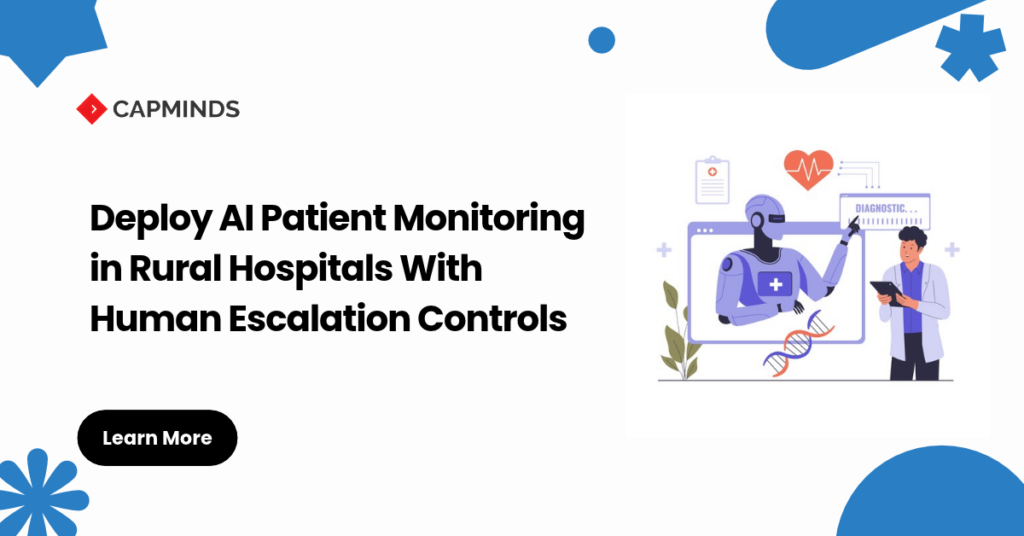
Deploy AI Patient Monitoring in Rural Hospitals With Human Escalation Controls
An AI alert has limited clinical value if nobody owns the response. In a rural hospital, deployment must account for bedside staffing, overnight coverage, connectivity failures, and transfer arrangements. Deployment must connect detection to assessment and documented action.
This guide focuses on inpatient monitoring.
What Is AI Patient Monitoring, and Why Does Escalation Matter?
AI patient monitoring applies predictive models to clinical inputs, such as vital-sign trends, laboratory results, and EHR observations, to flag possible deterioration.
Capabilities depend on validated intended use. Human escalation controls establish responders, deadlines, backup coverage, and clinical documentation.
ASTP/ONC’s SAFER guidance recommends closed-loop communication and escalation of unanswered messages. A delivered notification alone does not demonstrate clinical assessment.
How to Deploy AI Patient Monitoring in Rural Hospitals With Human Escalation Controls
1. Define the Clinical Scope Before Selecting Technology
Specify the action an alert should trigger
Start with one population and one use case, such as adult ward deterioration surveillance. Document required inputs, prediction horizon, exclusions, monitoring hours, and the bedside response.
Name the responsible nurse, backup, covering clinician, and emergency response pathway. Confirm staffed coverage rather than adding alerts to an already full workload. Define who initiates remote consultation or transfer and who retains bedside responsibility.
For home monitoring, specify patient contact procedures and after-hours coverage. HHS describes remote patient monitoring as asynchronous; do not imply continuously attended emergency surveillance unless the service actually provides it.
Verify the product’s regulatory position
Request intended-use documentation, model version, validation evidence, and applicable FDA authorization.
Human review does not automatically make software Non-Device CDS. FDA distinguishes software supporting time-critical decisions from tools that merely display information in time-critical settings. Evaluate the specific function rather than relying on a vendor’s “decision support” label.
2. Validate Clinical Inputs and Data Freshness
Establish acceptance checks
Before enabling predictions, verify:
- Patient and encounter identifiers, including transfers and bed changes.
- Measurement time, receipt time, time zone, and clock synchronization.
- Terminology mappings, units, reference ranges, and device identity.
- Missing, duplicate, corrected, and out-of-order observations.
- Signal-quality indicators and device disconnection status.
For FHIR R4 integrations, use the applicable Observation Vital Signs profiles with LOINC codes and UCUM units. Confirm the model receives the measurement timestamp rather than treating ingestion time as measurement time. FHIR conformance does not guarantee timely delivery.
Define model-specific freshness limits and minimum input requirements.
When those conditions fail, follow the validated missing-data behavior and visibly indicate unavailable or degraded monitoring. Never silently present an old score as current.
Where the EHR uses HL7 v2, validate observation mappings and admission, discharge, and transfer updates. Check device limitations, including pulse-oximetry accuracy differences associated with skin pigmentation.
3. Validate Locally Before Activating Clinical Alerts
Run a controlled silent evaluation
Use a governance-approved silent phase: generate predictions without changing clinical care, while existing monitoring continues. Compare outputs against a predefined clinical reference standard.
Evaluate sensitivity, positive predictive value, calibration, lead time, and alerts per patient-day at the proposed operating threshold. Review relevant subgroups and account for uncertainty when event counts are small.
A 2026 multicenter sepsis-model study found improved discrimination alongside low positive predictive values and substantial alert burden. AUROC alone cannot establish local operational usefulness.
Set acceptance criteria beforehand. Where local events are too few, supplement vendor evidence with regional validation support; short pilots cannot establish clinical effectiveness. IMDRF emphasizes representative data and human–AI evaluation.
4. Configure a Closed-Loop Escalation Protocol
Track clinical response separately from message delivery
For each alert category, configure the following controls:
| Control | Required deployment decision |
| Ownership | Route to the currently assigned responder and named backup. |
| Acknowledgment | Require explicit acceptance; track delivery failures separately. |
| Escalation | Forward unanswered alerts after the clinically approved deadline. |
| Assessment | Record bedside review and escalate overdue assessment even after acknowledgment. |
| Resolution | Document clinical disposition and follow-up responsibility. |
| Handoff | Reassign open alerts and verify coverage during shift changes. |
Set clinical deadlines by acuity and intended use; if staffing cannot meet them, redesign coverage before activation. Display patient location, current observations, trend, data age, and alert reason.
Maintain distinct states for generated, delivered, acknowledged, assessed, and resolved alerts.
Record timestamps, recipients, model version, and disposition. SAFER guidance supports urgency differentiation, acknowledgment capture, and forwarding to alternative clinicians.
Require clinical approval for duplicate-alert suppression, snooze duration, and re-alert conditions. Preserve existing device alarms. Clinicians must escalate concerning symptoms despite low scores and follow emergency procedures immediately when indicated.
5. Test Downtime and Secure the Workflow
Separate technical failures from clinical deterioration. Route sensor, interface, and delivery failures to appropriate support personnel, while notifying clinicians when monitoring coverage is affected.
Drill network and power loss, unavailable recipients, shift changes, and simultaneous alerts. Demonstrate fallback communication and bedside monitoring with night-shift and temporary staff.
After recovery, reconcile queued observations and pending alerts; delayed data must not appear current. SAFER contingency guidance addresses failed interfaces and recovery procedures.
Apply role-based access, appropriate authentication, encryption, audit logging, and applicable business associate agreements. NIST SP 1800-30 provides RPM security examples; HIPAA security compliance also requires organizational risk assessment and safeguards.
6. Pilot, Review, and Control Changes
Authorize one-unit go-live only after data checks, escalation drills, fallback procedures, competency checks, and clinical sign-off pass. Track missed events, actionable alerts, response delays, unresolved alerts, downtime, and workload.
Define stop criteria for unsafe delays, excessive alert burden, and unacceptable missing data. Reassess after model, threshold, device, or interface changes. Retain version history and a tested rollback process; IMDRF emphasizes ongoing monitoring and retraining-risk controls.
Build Reliable Patient Monitoring Workflows With CapMinds
CapMinds helps hospitals connect clinical systems through HL7/FHIR integration, configure workflows, and validate data exchange. For AI monitoring, these capabilities support dependable inputs and documented escalation processes alongside your clinical team.
Discuss your monitoring workflows, integration gaps, and escalation requirements with our team.