Automate Routine Claim-Status Work With AI Agents While Preserving Exception Ownership
What if your revenue cycle team could stop manually checking routine claim statuses without giving up control over the claims that actually require human judgment?
The opportunity is not theoretical. The 2025 CAQH Index, released in February 2026 and based on 2024 administrative activity, estimated that U.S. healthcare avoided $258 billion in administrative costs through electronic transactions and improved data exchange, while identifying another $21 billion opportunity through full automation of manual and partially manual transactions.
Claim status is a good example of why that remaining opportunity exists.
Healthcare organizations already have electronic claim submission, clearinghouses, EHRs, practice management systems, payer portals, and the ASC X12N 276/277 claim-status transaction. Yet revenue cycle teams still spend significant time tracking claim progress, interpreting payer responses, navigating different channels, documenting follow-up, and deciding which claims need intervention.
The problem is not simply a lack of electronic transactions. The harder problem is turning claim-status information into reliable workflow action. That is where AI agents can add another layer of automation.
An AI-enabled workflow can retrieve claim-status information, interpret supported responses, normalize information into an organization’s operational categories, initiate pre-authorized next steps, document the activity, and route exceptions to the appropriate human owner.
The objective is not fully autonomous revenue cycle management.
The objective is controlled automation: let technology handle predictable claim-status work while people retain ownership of exceptions, judgment-intensive cases, and actions outside predefined workflow boundaries.
Why Claim-Status Follow-Up Remains a Revenue Cycle Problem
Claim submission is only one point in the revenue cycle.
After a claim enters the payer workflow, revenue cycle teams need visibility into whether it was received, accepted, rejected, processed, paid, denied, or held for additional information. The organization may also need to determine whether another follow-up action is appropriate and when that action should occur.
CMS recognizes several ways providers can obtain claim-status information, including payer Internet portals, IVR systems, direct data-entry mechanisms, and electronic ASC X12N 276/277 transactions.
For electronic claim status, the 276 is the Health Care Claim Status Request and the 277 is the Health Care Claim Status Response. CMS recommends the electronic process because organizations can automate generation and submission of 276 queries and can potentially automate posting of 277 status information into patient accounts.
Under HIPAA, HHS adopted Version 5010 of ASC X12N 276/277 for health care claim status. CMS also notes that federally mandated operating rules for claim status have applied since January 1, 2013, including requirements intended to provide real-time online access to claim-status information.
So the enterprise problem is not: “We have no electronic claim-status capability.”
It is closer to: “We have electronic claim-status capability, but how do we turn that information into an efficient, governed, end-to-end follow-up workflow?”
That distinction changes how an enterprise should approach AI.
The Claim-Status Automation Gap: 276/277 Is the Foundation, Not the Entire Workflow
A mature claim-status architecture can be thought of as a progression:
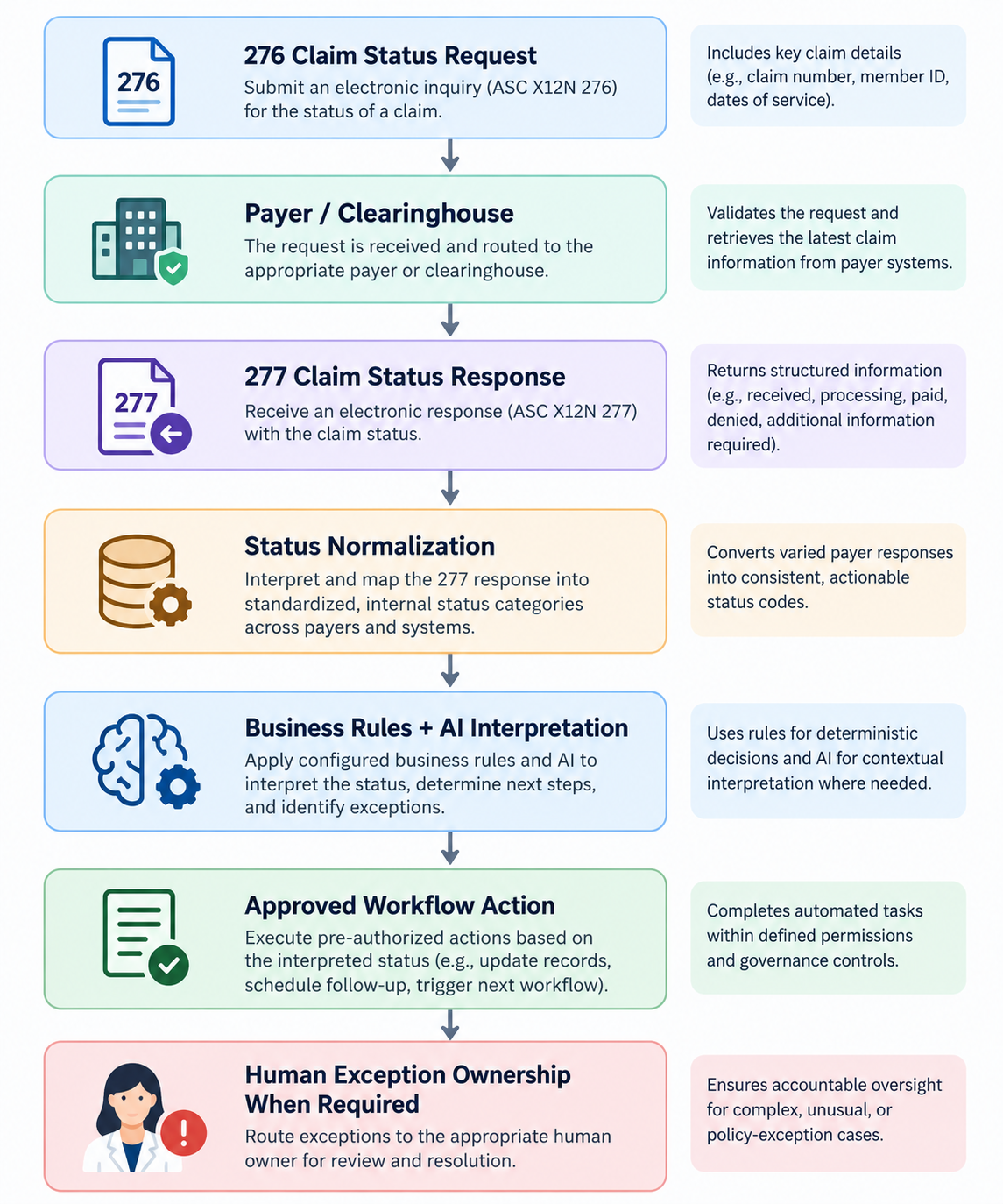
The first part of this flow is already standardized.
The opportunity is what happens after the response arrives.
A 277 response may provide structured claim-status information, but the revenue cycle organization still needs to map that information into its own workflow. A “processing” claim may require no immediate human intervention. A claim with missing information, an unexpected response, or an operational deadline may require investigation.
The system therefore needs to understand more than: “What status did the payer return?”
It needs to determine: “What does this status mean for our workflow, what action is authorized, and does this case fall inside or outside the automation boundary?”
That is where AI-assisted orchestration becomes useful.
What AI Claim-Status Automation Actually Means
AI claim-status automation should not be confused with simply sending electronic 276 transactions.
The electronic transaction provides the standardized exchange mechanism.
The AI and workflow layer can provide interpretation, prioritization, orchestration, documentation, and exception routing around that mechanism.
A governed implementation can:
- Identify claims eligible for automated follow-up.
- Determine when a status inquiry should occur based on configured rules.
- Submit a 276 inquiry through an approved electronic channel.
- Receive and parse the 277 response.
- Normalize the response into the organization’s internal status categories.
- Use approved supplemental channels when the required information is not available through the primary electronic workflow.
- Determine whether the response matches a predefined workflow.
- Execute only pre-authorized routine actions.
- Document the action and supporting information.
- Escalate cases that fall outside defined automation boundaries.
The important distinction is this: AI does not replace the underlying healthcare transaction standard.
It operates above the transaction and workflow layers to help the organization make better use of the information those systems already produce.
Where AI Agents Can Add Value Beyond Basic 276/277 Automation
Electronic claim-status transactions can eliminate many repetitive activities, but enterprise revenue cycle environments contain workflow variability that cannot always be solved through transaction exchange alone.
1. Prioritizing Claims for Follow-Up
A revenue cycle organization may have thousands of claims at different stages of the payment cycle. Treating every claim equally creates unnecessary work.
A governed system can use organizational rules and available claim information to prioritize work based on factors such as claim age, payer, outstanding balance, previous follow-up activity, claim status, service line, or other approved operational criteria.
AI can help interpret and organize the information, but the prioritization policy should belong to the organization. The system should not invent its own financial priorities.
2. Interpreting Claim-Status Information
The same broad operational outcome can appear in different forms across systems and payer workflows. The organization may want to normalize responses into categories such as:
- Accepted and processing
- Pending adjudication
- Paid
- Denied
- Rejected
- Additional information required
- Claim not found
- Status unavailable
- Exception requiring review
The authoritative mapping should be established through business rules, validated mappings, and system testing. AI can assist with interpretation where the information contains language or contextual information that is difficult to classify using deterministic rules alone.
That makes AI a reasoning and interpretation layer, not the source of truth.
3. Coordinating Multiple Follow-Up Channels
CMS documents multiple claim-status mechanisms, including electronic 276/277 transactions, payer portals, IVR systems, and other inquiry mechanisms. That creates an important architecture principle:
Use the most standardized and reliable electronic pathway available first. Where the primary electronic workflow does not provide the information required by the organization, an approved secondary channel may be appropriate. For example:
276/277 → supported API or integration → approved payer portal workflow → human escalation
The exact sequence should depend on payer capabilities, contractual arrangements, technical availability, security requirements, and organizational policy.
AI should not be given unrestricted access to payer systems. Any automated interaction must operate through authorized and governed mechanisms.
4. Automating Documentation
Claim follow-up often creates another administrative task: documenting what happened. A useful automated workflow should capture structured information such as:
- Claim identifier
- Payer
- Date and time of inquiry
- Channel used
- Status received
- Source of information
- Interpretation
- Action taken
- Next follow-up date
- Exception reason
- Human owner, when applicable
This creates an operational record that can be reviewed later. It also makes automation measurable.
The Critical Design Principle: Preserve Exception Ownership
The strongest enterprise AI design is not: “Let the AI handle every claim.” It is: “Let the AI handle predictable work until a defined exception boundary is reached.” Consider a claim that returns a straightforward processing status and falls within established workflow rules.
There may be little value in requiring a staff member to manually repeat the same check. Now consider a claim that:
- produces an unexpected payer response,
- requires additional documentation,
- conflicts with the organization’s expected workflow,
- approaches an important operational deadline,
- contains incomplete information,
- produces inconsistent information across approved channels,
- or requires an action that has not been authorized for automation.
That claim should become an exception. The agent should stop or escalate according to policy. The responsible employee should receive the relevant information needed to investigate and act.
This produces a controlled workflow: AI retrieves → AI interprets → Rules validate → Authorized action executes → Activity is documented → Exception detected → Human reviews → Human decides → Outcome is recorded
The exact human role depends on the exception.
Billing exception may belong to the billing team.
Coding-related issue may require coding review.
Documentation issue may require the appropriate clinical or documentation workflow. Connectivity problems may belong to the RCM technology or integration team. The important principle is that exception ownership is explicit rather than ambiguous.
What an Enterprise AI Claim-Status Architecture Should Look Like
A practical enterprise implementation should separate connectivity, deterministic controls, AI, human oversight, and governance.
1. RCM and EHR Intake Layer
The workflow begins with claims and relevant metadata from the organization’s EHR, practice management system, hospital information system, billing platform, clearinghouse, or RCM platform.
The organization should first define which claims are eligible for automated follow-up. Not every claim needs to enter the same workflow.
2. Rules and Eligibility Layer
This layer establishes deterministic controls. It can define:
- when a claim becomes eligible for follow-up,
- which claims require special handling,
- when the next follow-up should occur.
- which payer channels can be used,
- which actions are permitted,
- which conditions require escalation,
Rules are particularly valuable for predictable decisions because they are easier to test, explain, and audit.
3. Connectivity Layer
The connectivity layer interacts with clearinghouses, payer systems, APIs, or other approved mechanisms. For claim status, ASC X12N 276/277 remains an important standardized transaction path.
The architecture should also be capable of supporting other authorized connectivity mechanisms where required. The objective is not to build a separate automation bot for every payer.
It is to create a reusable integration architecture that can accommodate standardized transactions and payer-specific requirements.
4. Identity, Security, and Governance Layer
Before an AI agent can perform operational work, the organization needs to control what that agent is allowed to access and do. This layer should address:
- identity
- authentication
- authorization
- least-privilege access
- PHI handling
- encryption
- audit logging
- vendor controls
- data retention
- model governance
- action permissions
- escalation policies
The agent should have only the permissions required for its assigned workflow.
5. AI Interpretation and Orchestration Layer
This is where AI can add value. Depending on the workflow, AI may assist with:
- response interpretation,
- classification,
- contextual reasoning,
- information extraction,
- prioritization,
- workflow recommendations,
- exception detection,
- summarization for human reviewers.
NLP can be particularly useful when the system encounters payer language or other information that is not adequately represented by structured transaction fields. But AI should not be used where a deterministic rule already provides a reliable and auditable answer.
A mature architecture combines: Rules + transaction processing + integrations + healthcare workflow automation + AI + human oversight rather than asking a single AI model to control the entire revenue cycle workflow.
6. Exception Management Layer
Exceptions should not simply disappear into another generic work queue. The system should explain:
- What happened?
- What information was received?
- Why was the case escalated?
- What action was attempted?
- What does the system recommend?
- Who owns the next decision?
This gives the human reviewer context instead of forcing them to repeat the entire investigation.
7. Audit and Analytics Layer
Revenue cycle leadership should be able to see:
- eligible claims
- automated inquiries
- automated workflow completions
- exception volume
- exception categories
- manual touches
- follow-up cycle time
- unresolved claim aging
- payer-level performance
- human overrides
- classification accuracy
- automation failures
This is what turns AI automation from a technology experiment into an operational program.
Why AI Should Not Replace Deterministic RCM Rules
Not every decision requires AI. For example: “If a claim reaches the organization’s configured follow-up threshold, initiate the approved status workflow.” That is a deterministic rule.
There is little reason to introduce a language model into that decision. Now consider: “The payer response contains information that does not map cleanly to the organization’s standard workflow categories. Determine the likely category and route the case according to approved escalation rules.”
That may benefit from AI-assisted interpretation. This distinction is important because enterprise healthcare systems need predictable controls.
The strongest architecture is therefore not: AI everywhere. It is: AI where interpretation is useful. Rules where determinism is sufficient. Humans where accountable judgment is required.
Why Electronic Claim Status Does Not Always Eliminate Follow-Up Work
One of the most important considerations for enterprise buyers is that electronic does not automatically mean complete.
Industry research from CAQH has highlighted situations in which providers can receive more useful information through manual processes than through electronic claim-status responses.
That means the problem is not simply whether the organization can send a 276. The question is whether the complete workflow provides enough actionable information to resolve the operational question.
This creates three distinct automation levels:
Level 1: Transaction Automation
276 → 277
Automate the electronic exchange.
Level 2: Workflow Automation
277 → status normalization → rules → work queue/action
Automate predictable operational processing.
Level 3: AI-Assisted Orchestration
Structured + unstructured information → interpretation → authorized action or exception.
Use AI where the workflow requires contextual interpretation. This three-level model gives enterprise leaders a more realistic way to evaluate their automation maturity.
Build AI-Powered Healthcare RCM Workflows With CapMinds
AI claim-status automation is not simply an AI model connected to a payer.
Enterprise implementation requires healthcare interoperability, EHR and RCM integration, transaction processing, workflow engineering, security, governance, exception management, and measurable operational outcomes.
CapMinds helps healthcare organizations design and implement digital health technology solutions across AI, healthcare interoperability, EHR integration, revenue cycle management, HL7/FHIR integration, workflow automation, and more.
The focus is not automation for its own sake.
It is building intelligent healthcare workflows that reduce repetitive operational work while keeping the right people responsible for the decisions that still require human ownership.
Ready to identify where AI can reduce manual claim-status work without removing human control?