Multi-Tenant White-Label EHR Architecture Blueprint: Isolation, Branding, Configuration, Upgrades, and Support
Building a white-label EHR is not simply a matter of replacing the logo, colors, and domain for each healthcare organization.
Once multiple provider organizations operate on the same SaaS platform, the architecture must answer harder questions:
- Can one tenant ever access another tenant’s clinical data?
- How are tenant-specific workflows configured without forking the application?
- Can larger customers receive stronger infrastructure isolation?
- Are FHIR, HL7, billing, laboratory, pharmacy, and third-party integrations tenant-aware?
- Can one tenant’s data be recovered or moved without affecting another?
- Can upgrades be released progressively without maintaining separate EHR versions?
- Can support teams diagnose tenant-specific failures without unrestricted access to PHI?
AWS treats tenant isolation as a foundational SaaS concern.
Microsoft similarly emphasizes that multitenancy does not require every resource to be shared; different tenants or platform components can use different isolation models depending on security, scale, performance, cost, and regulatory requirements.
The architectural objective is therefore:
One governed EHR product lifecycle with controlled tenant variation and configurable isolation, not one custom EHR codebase for every customer.
What Is a Multi-Tenant White-Label EHR?
A multi-tenant white-label EHR is a common healthcare software platform that serves multiple organizations while allowing each tenant to operate with its own:
- users and permissions,
- branding and domains,
- clinical configuration,
- workflows,
- integrations,
- feature entitlements,
- data boundaries,
- deployment and isolation policies.
A tenant may represent a physician group, behavioral health organization, MSO, clinic network, digital health company, health-system affiliate, or reseller. Conceptually:
Tenant
├── Identity & Roles
├── Branding
├── Features
├── Clinical Configuration
├── Workflow Rules
├── Integrations
├── Data Placement
└── Isolation Policy
Tenant context should remain available throughout a request:
Authentication
↓
Tenant Resolution
↓
Authorization
↓
Tenant Configuration
↓
Application Services
↓
Tenant-Scoped Data
Tenant identification and authorization are separate concerns. Microsoft specifically warns that a domain, query parameter, API key, or other tenant identifier should not itself grant access; the application must also validate that the authenticated request is authorized for that tenant.
Understand the Three Architecture Decisions
A multi-tenant EHR becomes easier to design when three decisions are separated.
1. Application Architecture
This determines how the EHR is decomposed technically.
Monolithic Architecture
Clinical, scheduling, billing, reporting, administration, and integration functionality run in one primary deployable application. Advantages:
- lower initial operational complexity,
- simpler transactions,
- easier debugging,
- fewer distributed dependencies.
The challenge appears when individual workloads need different release cycles, failure boundaries, or scaling characteristics.
Modular Monolith
A modular monolith keeps one primary deployment while establishing strong boundaries between domains such as:
- Patient Administration
- Clinical Documentation
- Scheduling
- Revenue Cycle
- Interoperability
- Identity
- Tenant Management
- Audit
For many growing EHR platforms, this can provide a practical balance between maintainability and operational simplicity.
Selective Microservices
Microservices separate appropriate capabilities into independently deployable services. Potential candidates include:
- identity,
- tenant management,
- interoperability,
- notifications,
- document processing,
- reporting,
- audit processing,
- high-volume asynchronous workloads.
Microservices can improve independent scaling and deployment, but also introduce distributed transactions, network dependencies, service versioning, observability requirements, and additional DevOps complexity. Multi-tenancy does not automatically mean microservices.
2. Tenant-Isolation Architecture
This determines which resources tenants share.
Pool Model
Multiple tenants share compute, applications, databases, queues, or storage. Advantages:
- efficient resource utilization,
- lower infrastructure cost,
- centralized operations.
The trade-off is greater dependence on strong logical isolation, capacity controls, and noisy-neighbor protection.
Silo Model
A tenant receives dedicated resources such as its own database, compute environment, network boundary, or full deployment. Advantages:
- stronger resource isolation,
- lower cross-tenant blast radius,
- greater workload independence.
The trade-off is higher infrastructure and lifecycle-management cost.
AWS notes that dedicated tenant stacks can still be SaaS when shared onboarding, identity, deployment, monitoring, metering, analytics, and operations remain centrally governed.
Bridge Model
A bridge model combines pooled and siloed resources. For example:
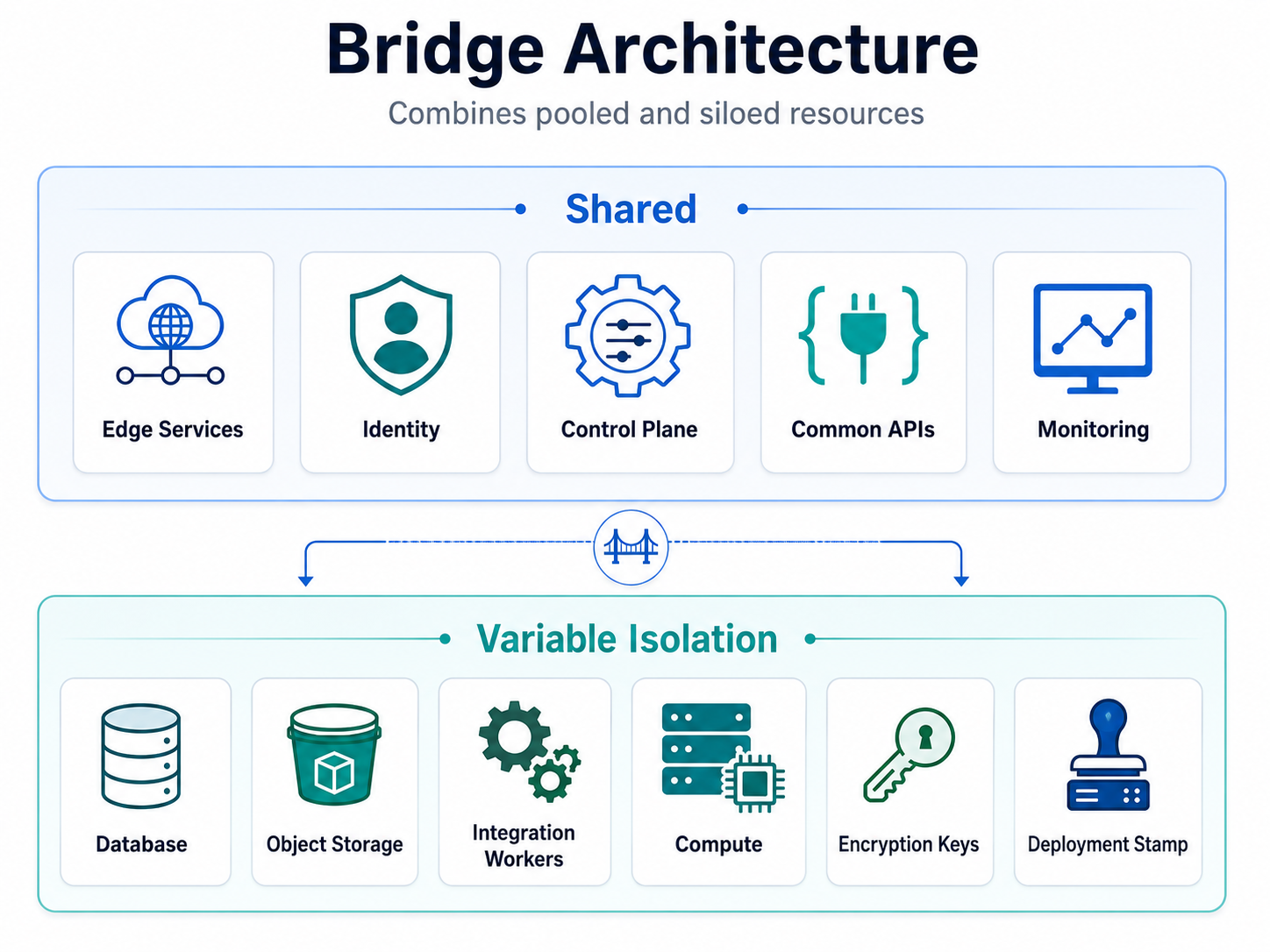 This allows tenant isolation to increase where business, security, workload, or contractual requirements justify it.
3. Event-Driven Architecture
Event-driven architecture is an interaction pattern rather than a tenancy model. Queues or event streams can decouple workloads including:
- HL7 message processing,
- FHIR synchronization,
- document generation,
- notifications,
- claims processing,
- audit processing,
- analytics pipelines.
A modular monolith or microservices architecture can both use event-driven processing.
Which Architecture Should a Multi-Tenant EHR Use?
There is no universal architecture. For many enterprise white-label EHR platforms, a strong reference model is:
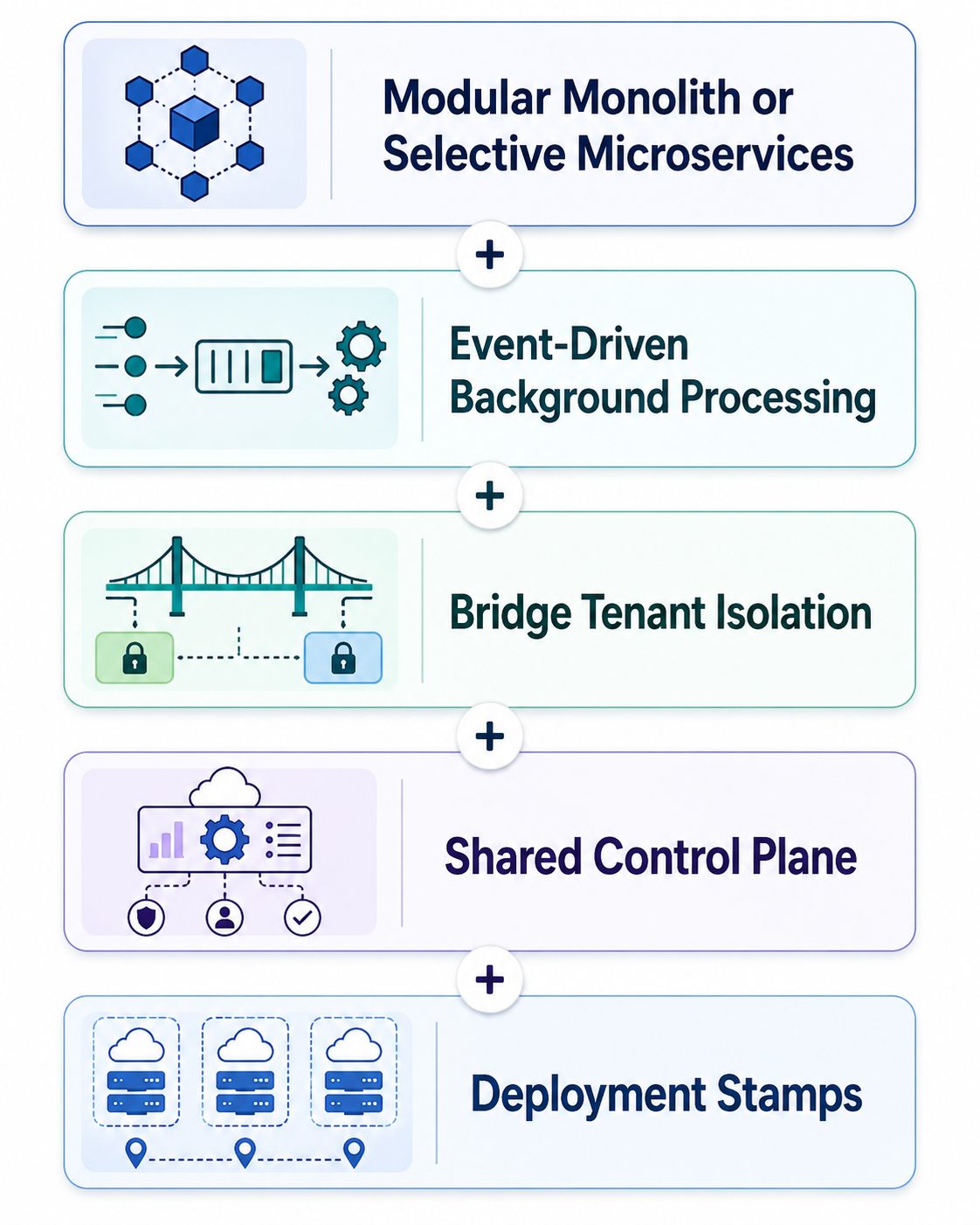
The important capability is progressive isolation.
For example:
Shared Tables
↓
Dedicated Schema
↓
Dedicated Database
↓
Dedicated Compute
↓
Dedicated Deployment Stamp
This is an example isolation path, not a mandatory sequence.
A high-volume health system might move directly to a dedicated stamp, while smaller organizations might remain safely pooled. Azure’s architecture guidance similarly treats tenancy as a spectrum driven by customer isolation, compliance, scale, cost, and performance requirements.
Separate the Tenant Control Plane From the EHR Data Plane
One of the most important architectural boundaries is between tenant lifecycle management and healthcare transaction processing.
Control Plane
The control plane manages:
- tenant catalog and status,
- isolation model,
- region,
- deployment stamp,
- domains,
- identity configuration,
- feature entitlements,
- configuration versions,
- provisioning,
- upgrade rings,
- tenant placement,
- offboarding.
Microsoft describes a multitenant control plane as including a tenant catalog and processes responsible for onboarding, offboarding, infrastructure placement, configuration, and maintenance.
EHR Data Plane
The data plane handles healthcare workloads:
Tenant identity must survive each stage rather than being independently reconstructed by every component.
Enforce Isolation Across the Entire Data Path
Tenant isolation is not only a database concern. A healthcare transaction can cross:
Identity
→ API Gateway
→ Application
→ Cache
→ Database
→ Queue
→ Worker
→ Object Storage
→ Integration Engine
→ Analytics
→ Backup
The tenant boundary therefore needs to be considered across:
- relational databases,
- caches,
- documents and object storage,
- search indexes,
- queues and topics,
- background jobs,
- temporary exports,
- analytics platforms,
- integration credentials,
- telemetry,
- backups.
PostgreSQL RLS Is a Layer, Not the Whole Boundary
For pooled PostgreSQL databases, Row-Level Security can restrict which records database roles may access. However, PostgreSQL explicitly documents that superusers and roles with BYPASSRLS bypass RLS. Table owners normally bypass it as well unless FORCE ROW LEVEL SECURITY is used.
RLS should therefore be combined with:
- tenant-aware authorization,
- least-privilege database roles,
- tenant-scoped queries,
- controlled service identities,
- automated isolation testing,
- audit controls,
- stronger database separation where required.
A dedicated schema also remains logical isolation; it is not equivalent to dedicated physical infrastructure.
What Technology Stack Does a Multi-Tenant EHR Need?
Specific products vary, but the architecture should provide the following capabilities:
| Layer | Required Capability |
| Web/Mobile | Tenant-aware UI and branding |
| Edge | DNS, CDN, TLS, WAF, DDoS controls |
| API | Gateway, authorization, throttling |
| Identity | OIDC/OAuth, federation, MFA, RBAC/ABAC |
| Application | Containers or managed compute |
| Integration | FHIR/HL7 APIs, queues, interface engine |
| Data | Relational DB, cache, object storage |
| Security | IAM, KMS, secrets management |
| Platform | Kubernetes or managed runtime |
| DevOps | CI/CD, Infrastructure as Code |
| Operations | Logs, metrics, traces, SIEM |
Tenant-specific API keys, certificates, clearinghouse credentials, laboratory credentials, signing material, and integration secrets should be managed through an appropriate secrets-management mechanism instead of ordinary application configuration.
Network Layers in a Multi-Tenant EHR
A practical logical network architecture can use five boundaries.
1. Internet Edge
DNS → CDN → WAF → Load Balancer
Handles custom domains, TLS, filtering, and edge protection.
2. API and Identity Boundary
API Gateway
↓
Authentication
↓
Tenant Resolution
↓
Authorization
Tenant and rate-control policies should be applied before requests reach clinical services.
3. Application Network
Clinical, administrative, billing, and integration workloads should communicate through controlled east-west paths.
Kubernetes namespaces provide logical segmentation, but Kubernetes recommends additional controls such as RBAC, NetworkPolicy, ResourceQuota, resource limits, and stronger isolation mechanisms when required. Kubernetes also notes that pods can communicate by default and that NetworkPolicy requires compatible network enforcement.
4. Data Network
PHI-bearing databases, caches, message brokers, and object storage should normally use private connectivity and tightly scoped workload identities.
5. Management and Observability Boundary
CI/CD, production administration, backups, monitoring, and security tooling should be separated from normal application traffic and governed through least privilege.
1. Separate the Tenant Control Plane From the EHR Data Plane
A scalable architecture should distinguish tenant-management functions from healthcare transaction processing.
Control Plane
The control plane manages tenant lifecycle information such as:
- Tenant identity and status
- Isolation model
- Deployment stamp or region
- Custom domains
- Identity-provider configuration
- Feature entitlements
- Branding versions
- Configuration versions
- Upgrade rings
- Provisioning and offboarding state
Microsoft identifies tenant provisioning, configuration, placement, resource allocation, maintenance, and related lifecycle operations as control-plane responsibilities in multitenant systems.
EHR Data Plane
The data plane processes actual healthcare workloads, including:
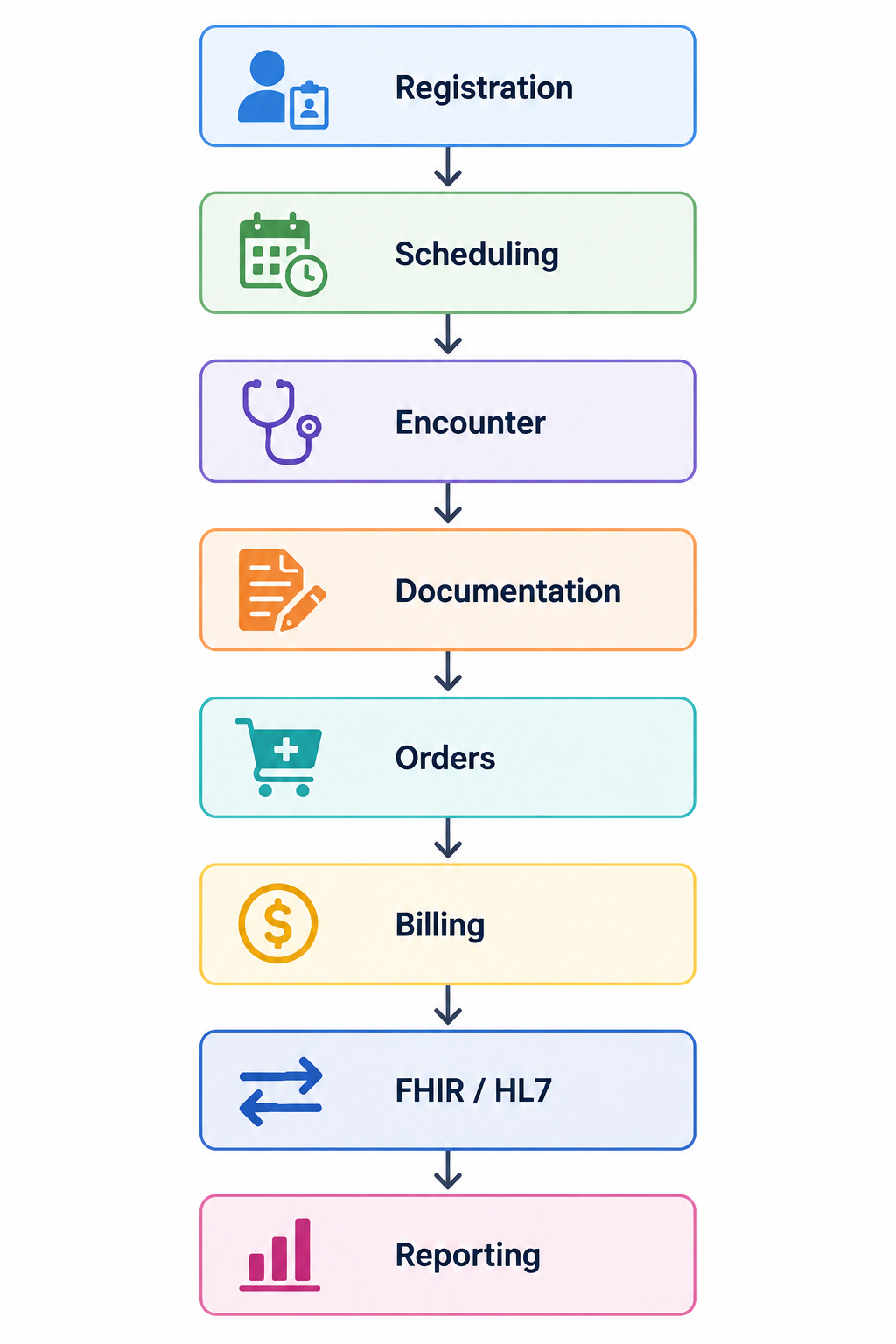
Scheduling → Registration → Encounters → Clinical Documentation → Orders → Billing → FHIR/HL7 → Patient Engagement → Reporting
Tenant identity must remain available throughout these workflows rather than being reconstructed independently by each service.
AWS specifically recommends binding user identity to tenant identity and making tenant context a first-class construct available across application layers.
2. Enforce Tenant Isolation Across the Entire Data Path
One of the most dangerous architectural mistakes is treating tenant isolation as only a database problem.
A real EHR transaction can move through: Identity → API Gateway → Application Service → Cache → Database → Queue → Worker → Object Storage → Integration Engine → Analytics → Backup
The tenant boundary must survive every step.
Isolation controls may therefore be required across:
- Relational databases
- Object and document storage
- Redis or application caches
- Search indexes
- Message queues and topics
- Background workers
- Temporary exports
- Analytics warehouses
- Integration credentials
- Logs and telemetry
- Backups and restore processes
Client-supplied tenant IDs should not independently determine authorization.
Tenant identity should originate from trusted authentication and authorization context and be validated at tenant-sensitive boundaries.
PostgreSQL Row-Level Security Is Defense-in-Depth, Not the Entire Boundary
For pooled PostgreSQL databases, Row-Level Security can restrict which records a database role may select or modify. PostgreSQL supports policies for operations including SELECT, INSERT, UPDATE, and DELETE.
However, RLS alone should never be described as complete tenant isolation.
PostgreSQL explicitly documents that superusers and roles with BYPASSRLS bypass row-level security policies. Table owners normally bypass RLS as well unless FORCE ROW LEVEL SECURITY is applied.
Production isolation should therefore combine database controls with application authorization, least-privilege database roles, identity controls, testing, and infrastructure boundaries.
Kubernetes Requires Multiple Isolation Controls
A Kubernetes namespace is useful for organizing tenant workloads, but it is not a complete security boundary.
Kubernetes recommends combining multitenancy mechanisms such as RBAC, NetworkPolicy, Pod Security controls, resource governance, and workload isolation. NetworkPolicy controls permitted network flows, while ResourceQuota can prevent one namespace from consuming excessive shared resources.
For higher-risk tenants, dedicated clusters or deployment stamps may be appropriate instead of relying solely on logical separation.
3. Treat Branding as Configuration, Not Custom Source Code
White-label branding should normally be loaded from tenant-scoped configuration rather than hardcoded customer conditions. Typical brand configuration includes:
- Logo and favicon
- Color and typography tokens
- Custom domain
- Portal labels
- Email templates
- Support information
- Approved patient-facing terminology
Avoid patterns such as:
Customer A → Custom application branch
As customer-specific conditions accumulate inside core code, regression testing and upgrades become increasingly difficult.
A healthier model is:
- Brand variation → configuration
- Product availability → feature entitlement
- Workflow variation → governed workflow configuration
- Exceptional requirements → supported extension mechanism
This keeps tenant differences separate from the core product lifecycle.
4. Build a Versioned Configuration Hierarchy
EHR behavior varies by organization, location, specialty, payer model, and user role.
A useful configuration hierarchy can resemble:
Platform Default → Deployment/Tier → Tenant → Location → Permitted User Preference
Every important configuration item should have an owner, validation rule, effective value, version, and change history.
Microsoft’s multitenant guidance specifically distinguishes global configuration from tenant-specific configuration and supports patterns in which settings apply globally, by deployment stamp, or by tenant.
Sensitive values such as API credentials, signing keys, clearinghouse credentials, and interface secrets should be managed using an appropriate secrets-management system rather than ordinary application configuration.
5. Extend Tenant Isolation Into Healthcare Integrations
The application database can be perfectly isolated while an interface still sends data to the wrong organization.
Tenant context must therefore extend into:
- FHIR endpoints
- SMART on FHIR applications
- HL7 interfaces
- Laboratory connections
- Pharmacy services
- Clearinghouses
- Payment processors
- Webhooks
- External APIs
- Interface-engine routes
The current published SMART App Launch specification uses OAuth 2.0-based authorization patterns and scopes for FHIR resources, identity, and launch context.
Importantly, SMART does not define the organization’s underlying access-control policy; that policy remains the responsibility of the implementing system.
A white-label EHR therefore still needs tenant-aware authorization and routing around SMART/FHIR authorization.
6. Engineer Upgrades Around One Product Lifecycle
Multitenancy loses much of its operational value when every tenant requires an independent code release.
Maintain one governed code line and control tenant differences through configuration, feature entitlements, migration versions, and supported extensions.
A production rollout may progress through:
Internal Validation → Non-Production → Pilot Tenants → Selected Tenant Cohort → Broad Release
Microsoft identifies deployment stamps, feature flags, and deployment rings as common multitenant update strategies. Deployment stamps can also isolate groups of tenants and support incremental rollout.
Database migrations should favor backward-compatible changes where practical so old and new application versions can coexist during rollout.
Rollback planning must also consider database schemas, configurations, interfaces, and queued transactions. Rolling back only the application image may not restore a consistent EHR state.
7. Make Support, Logging, and Audit Tenant-Aware
Operational telemetry should allow support teams to identify which tenant, deployment, release, and integration experienced an error.
Useful metadata can include:
- Tenant ID
- Deployment stamp
- Application version
- Configuration version
- Integration identifier
- Correlation ID
But debugging telemetry should not become an uncontrolled PHI repository.
Clinical and security auditing should also be distinguished from general application logging.
FHIR provides the AuditEvent resource for security- and privacy-relevant events, including information describing who acted, what occurred, where it occurred, and why.
Support access should follow least privilege and provide appropriate administrative auditing rather than relying on unrestricted shared administrator accounts.
8. Design Tenant-Aware Backup, Recovery, and Offboarding
Backup architecture cannot stop at “the database is backed up.” For multitenant EHRs, teams must determine whether they can:
- Recover a failed shared service
- Restore tenant-specific information
- Validate restored tenant permissions
- Reconnect tenant interfaces
- Recover configuration versions
- Prevent restored data from crossing tenant boundaries
The current HIPAA Security Rule requires regulated entities to protect the confidentiality, integrity, and availability of ePHI and includes contingency-planning obligations. HHS also emphasizes that the Security Rule is technology-neutral rather than prescribing one architecture.
Tenant offboarding requires the same architectural discipline.
The platform should coordinate:
Data Export → Access Revocation → Integration Shutdown → Credential Revocation → Retention Decision → Return/Destruction → Tenant Deactivation
HHS cloud guidance states that, where applicable, a BAA must require return or destruction of PHI at termination where feasible.
Cloud providers that create, receive, maintain, or transmit ePHI on behalf of a covered entity or business associate can themselves be business associates, making appropriate BAAs important in the cloud architecture.
2026 regulatory note: HHS states that the existing HIPAA Security Rule remains the rule currently in effect. Proposed cybersecurity modifications, including stronger requirements around encryption, MFA, network segmentation, vulnerability testing, and backup/recovery controls, remain proposed rather than final requirements as of August 2026.
Multi-Tenant EHR Onboarding Blueprint
A repeatable onboarding process should typically cover:
- Register the tenant and determine its isolation policy.
- Identify regulatory, residency, SLA, RTO, and RPO requirements.
- Assign the appropriate region and deployment stamp.
- Provision data and compute resources.
- Configure identity, SSO, roles, and permissions.
- Apply branding and approved configuration versions.
- Provision tenant-specific credentials and secrets.
- Configure FHIR, HL7, billing, lab, pharmacy, and other integrations.
- Validate cross-tenant authorization boundaries.
- Test clinical and financial workflows.
- Validate logging, auditing, monitoring, backup, and recovery.
- Record application, schema, integration, and configuration versions.
- Activate the tenant through the governed release process.
Common Multi-Tenant EHR Architecture Failure Patterns
Watch for these warning signs:
- tenant filtering only in the UI,
- customer-specific source-code branches,
- RLS treated as the entire isolation model,
- background jobs without trusted tenant context,
- shared integration credentials across unrelated tenants,
- unversioned tenant configuration,
- clinical configuration embedded in branding code,
- integrations without tenant-aware routing,
- no tenant placement or rebalancing strategy,
- all-tenant releases without progressive rollout,
- no automated cross-tenant negative tests,
- logging unnecessary PHI,
- unrestricted support administrator accounts,
- backups with no tenant-aware recovery model,
- undefined tenant RTO/RPO,
- manual offboarding without controlled data disposition.
Each one increases operational coupling until onboarding another customer begins to resemble maintaining another standalone EHR.
The Core Multi-Tenant Architecture Principle
The strongest multi-tenant white-label EHR is not the platform that shares the most infrastructure. It is the platform that can increase tenant isolation without fragmenting the product.
A mature architecture should be able to support pooled and increasingly isolated tenants while preserving:
- one governed product lifecycle,
- common onboarding,
- configuration governance,
- interoperability,
- security policies,
- progressive upgrades,
- tenant-aware monitoring,
- recovery processes,
- support operations.
That requires tenant context, control-plane automation, configurable isolation, tenant-aware data paths, secure integrations, scalable compute, network controls, deployment stamps, progressive releases, continuous isolation testing, and tenant-aware recovery to be designed together.
Build a Scalable White-Label EHR Architecture With CapMinds
A sustainable white-label EHR requires more than multitenant application development. It combines healthcare SaaS architecture, tenant isolation, cloud engineering, interoperability, identity management, DevOps, security, configuration governance, migration, and production support.
CapMinds’ EHR development and healthcare technology services can support:
- Multi-tenant and hybrid-isolation EHR architecture
- Custom and white-label EHR development
- Tenant provisioning and configuration architecture
- FHIR, SMART on FHIR, HL7, API, lab, pharmacy, and payer integration
- Healthcare cloud and DevOps engineering
- CI/CD and controlled upgrade architecture
- Tenant-aware monitoring and support
- EHR migration and onboarding
- Backup, disaster recovery, and managed EHR services
- Healthcare security and interoperability modernization
If your current white-label strategy depends on cloned environments, tenant-specific application branches, or manual customer configuration, the architecture can become progressively harder to upgrade and support.
Talk to CapMinds about designing a white-label EHR platform that can scale across customers without scaling technical debt at the same rate.