Modular EHR Architecture: Extend Core EMRs with FHIR APIs
A modular EHR design includes lightweight, specialized modules that communicate via APIs wrapped around a legacy core EMR. By avoiding the high costs and difficulties of a full EHR replacement, this strategy allows healthcare organizations to add new features without totally redesigning the system. Our analysis shows that top-ranked articles emphasize “Lego‑block” composability, FHIR/SMART support, and real-world use cases.
This blog outlines what modular EHRs are, how they work, why they matter, and how to implement them, with definitions, tables, diagrams, and data from leading sources.
What is Modular EHR Architecture?
A central EMR is enhanced by separate, plug-in components in a modular EHR design. While additional capabilities are housed in cloud-based modules, the fundamental EMR is still in place.
Each module is purpose-built and communicates with the core via standard interfaces. In practice, this looks like adding “Lego block” modules, you can plug in or upgrade one function at a time without rebuilding the whole system. This lets hospitals and clinics extend capabilities around the existing EHR.
How Does a Modular EHR Architecture Work?
Modular EHRs use an API-driven, layered design. The core EMR handles fundamental data and workflows, while an interface engine or API gateway routes data to each add-on service.
For example, a telehealth module might pull patient demographics from the EMR via a FHIR “Patient” resource, schedule a video visit, and then write back encounter notes via an HL7 message. Each module runs as a separate service but shares a unified clinical data model. In essence, a middleware layer translates between the core EMR and modules. This decoupling means frontend or backend changes in a module do not break the core; updates are isolated to that component.
HL7/FHIR Data

Writes Data

Writes Data

Writes Data

Writes Data

Core EMR System

API/Interface Engine

Telehealth Module

Lab Integration Module

Patient Portal Module

Analytics Module
A modular EHR uses a central interface engine with HL7/FHIR communication to stack specialized modules around the current EMR.
Why Use a Modular Extension Instead of Full Replacement?
Full EHR replacements are very costly and disruptive. Large health systems spend well over $100 million to rip and replace an enterprise EMR. By contrast, a modular approach adds features incrementally. Organizations can roll out one module at a time, preserving existing workflows and data.
This avoids big-bang cutovers. Clinicians keep using the familiar core EMR while new capabilities drop in around it. The result is fewer training headaches, less downtime, and reduced risk to patient care. Hybrid models are a common example of this strategy.
Benefits of Modular EHR Architecture
Modular EHRs speed innovation and align with real workflows. Each plug-in can be built for a specific purpose without bloating the core system. Key benefits include:
- Faster time-to-value,
- Scalability (add resources per module), and
- Best-of-breed flexibility.
For instance, telehealth volumes increased by almost 38× during COVID-19, yet monolithic EHRs lacked flexible support. Without a complete EHR redesign, a modular telehealth plugin might be quickly implemented.
Other advantages: improved interoperability, lower cost of ownership, and targeted specialty support. In practice, this “best-of-breed ecosystem” means hospitals can run niche solutions on the side, while the core EMR remains the single source of patient truth.
Cost of Modular EHR Extension
Generally, incremental upgrades cost much less upfront than replacing an entire system. You avoid a single giant license fee and expensive multi-year implementation project. Instead, you invest module by module. Over time, you pay only for what you use: avoid buying unused features.
For many organizations, this means lower total cost of ownership. For example, if you only need a telehealth scheduler, you don’t pay for a whole new patient registration system. Modernization without full replacement “avoids these minefields” of expense and risk. In sum, modular extension defers capex and spreads costs, often making IT budgets more predictable.
High-value Use Cases
1. Integrating Telehealth and EMRs
- Automatically generate telehealth appointments from existing scheduling tables.
- Embed WebRTC or third-party video links into the encounter screen.
- Sync encounter notes and CPT codes into the EMR for billing.
2. Lab Data Exchange
- Real-time HL7 ORU communications from external reference laboratories.
- FHIR subscriptions that automatically fill results and highlight crucial values.
3. Telehealth Billing Systems
- Utilize a pre-visit micro-app to record patient-entered vitals, consent, and copayment.
- Verify telehealth modifiers and place-of-service codes automatically (95, GT).
4. Virtual Care Workflow
- Chronic-care displays that collect weight and blood pressure data from linked devices.
- Patient-generated questionnaires emerged in clinicians’ inboxes.
5. Connected Care Platforms
- Push discharge summaries to skilled-nursing EHRs via Direct messaging.
- Obtain ADT feeds from community HIEs to close referral loops.
These modules foster a best-of-breed ecosystem, allowing specialist clinics to implement niche solutions while maintaining the enterprise EMR that serves as the foundation for enterprise reporting and compliance.
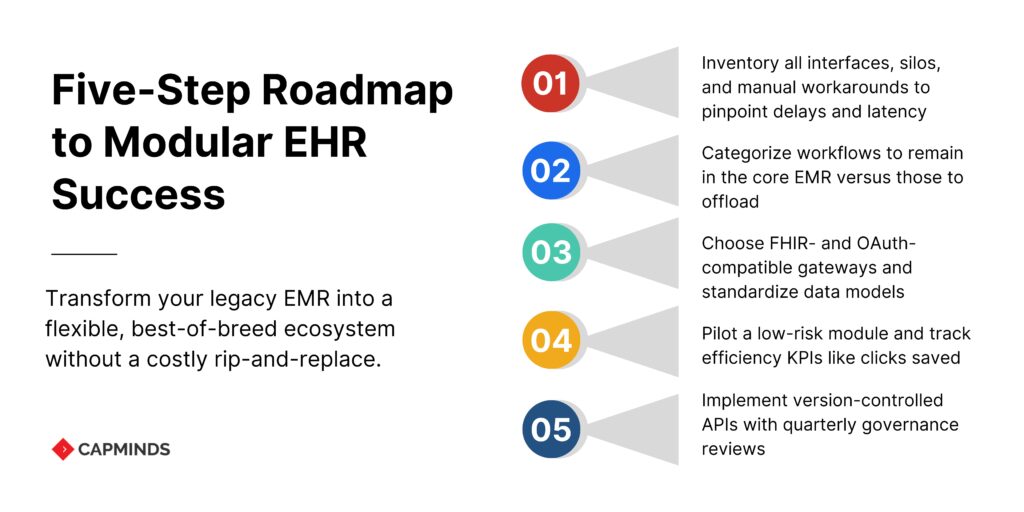
Five-Step Roadmap to Implementing a Modular Strategy
1. Map your Current State
- This includes inventory interfaces, data silos, and manual workarounds.
- Catalog issues include telemedicine scheduling delays, test result latency, and reimbursement rejections.
2. Define an “Innovation Perimeter.”
Determine which workflows will stay in the EMR (meds administration, ADT) and which may be outsourced (patient interaction, specialized documentation).
3. Design a Reference Architecture
- Select interface engines and API gateways that support FHIR R4, OAuth 2.0, and SMART for FHIR scopes.
- Standardize data models for demographics, orders, outcomes, and claims to make mapping easier.
4. Pilot Quick-Win Modules
- Start with a low-risk domain, such as a lab result viewer for outpatient treatment or a telehealth visit capture for behavioral health.
- Keep an eye on KPIs like patient no-show rates, claim first-pass yield, and clinician clicks saved.
5. Scale and Govern
- Conduct automated regression testing and create version-controlled API catalogs.
- Establish a governance board with members from clinical operations, IT security, and compliance to evaluate new modules on a quarterly basis.
In addition to gaining funding for subsequent rounds, a staged, metrics-driven deployment increases CEO trust.
Platforms with Modular Design and SLAs
| Platform / Vendor | Architecture Type | SLA (uptime) & Terms | FHIR/SMART Support | Deployment Model (Cloud/On-Prem) | Public SLA Source / Note |
| Oystehr | Headless GraphQL + Microservices | 99.99% uptime SLA (Kubernetes-based) | FHIR R4 (bidirectional), HL7v2/v3 | Cloud (Kubernetes) | Oyster docs (99.99% uptime) |
| Canvas Medical | API-first (SDK and Hooks) | Unspecified (status page shows ~100%) | Supports 37 FHIR resources | Cloud (SaaS) | Canvas status (100% up) [documentation pending] |
| Healthie | API-first Telehealth/EHR Platform | 99.99% uptime SLA | FHIR-compatible APIs | Cloud | Healthie SLA (99.99%)* |
| athenahealth | Cloud-based Modular EHR Services | 99.7% uptime SLA | SMART/FHIR APIs available | Cloud | athenahealth xMatters case study |
| Oracle Cerner | Enterprise EHR (becoming cloud-native) | 99.9% uptime commitment | FHIR/HL7 (via Ignite API) | Cloud/Hybrid | Congressional requirement (99.9%) |
| Epic | Monolithic (some open APIs) | Not publicly specified | FHIR APIs (varies by module) | Primarily On-Premises | SLA unspecified (Epic Millennium) |
Vendor Selection Checklist
1. FHIR R4 and HL7 v2 Support
Modern care coordination relies on fluid data sharing; therefore, every add-on must be fluent in both FHIR and classic HL7. Request that the vendor demonstrate real-world interoperability by performing a live pull of vitals using FHIR “Observation” resources.
2. Scalability & Guaranteed Uptime
Transaction volumes can rise by up to ten times over normal during seasonal peaks and telemedicine spikes. Verify that the contract ensures at least 99.9% availability backed by service-credit SLAs and that the platform’s architecture auto-scales. Instead of marketing presentations, ask for verified proof and monthly uptime data.
3. Security and HIPAA Readiness
Every additional module increases your threat surface. Check SOC 2 Type II attestation, end-to-end encryption, and thorough Business Associate Agreements that include all subprocessors. Have the vendor go over a recent penetration test report to assess their security maturity.
4. Pricing Options are Modular and Transparent
The goal of a modular approach is to prevent all-or-nothing lock-ins. Make sure you can license just the parts you need now and add more later without having to pay extra. To estimate the entire cost of ownership over five years, ask for line-item pricing.
5. Clinician-Centered UX
Even the finest APIs will fail if the front end is frustrating for users. Check click pathways, mobile responsiveness, and customization choices. A realistic litmus test. How many clicks are required from encounter start to note sign-off? Shorter pathways are associated with increased adoption and less burnout.
Common Pitfalls (and How to Avoid Them)
| PitFall | Prevention Topic |
| API Sprawl – dozens of custom endpoints | Adopt an API gateway with versioning and throttling policies |
| Shadow IT Procurements | Enforce a governance board and security review checklist |
| Data-Model Mismatch | Mandate canonical FHIR resources, with transformation rules in middleware |
| Vendor Lock-In | Prefer open-standards connectors and data-export clauses in contracts |
| Over-Customization | Configure modules via metadata wherever possible; avoid hard-coding |
Related: Replacing Legacy EHRs with OpenEMR: A Step-by-Step Transition Blueprint
Accelerate Your Modular EHR Journey with CapMinds
Modernizing a monolithic EMR doesn’t have to drain budgets or disrupt care. CapMinds transforms legacy platforms into agile, interoperable ecosystems, exactly what your clinicians and patients need today.
Why partner with CapMinds?
- Modular EHR Architecture – We design, build, and deploy cloud-ready microservices that bolt seamlessly onto your core EMR.
- Core EMR Optimization – Fine-tune existing workflows, data models, and interfaces to maximize uptime and clinical efficiency.
- FHIR & HL7 Integration – Implement enterprise-grade API gateways and interface engines for real-time lab, telehealth, and device data exchange.
- Telehealth-Ready UX – Embed video visits, automated coding, and remote patient monitoring into one intuitive clinician screen.
- Security & Compliance – End-to-end SOC 2-certified development, HIPAA-ready hosting, and continuous penetration testing keep data safe.
From strategic roadmap through go-live support, CapMinds delivers the expertise, accelerators, and governance frameworks that keep modernization projects on time and under budget.
Let’s turn your EMR into a future-proof care platform. Schedule a free discovery call today.
Frequently Asked Questions
What problems do modular EHRs solve?
Legacy EMRs frequently struggle to swiftly adjust to new requirements like legislation, telemedicine, and AI. You can add new features without having to wait months for an all-in-one vendor upgrade thanks to modular extensions. This solves immediate needs while the core stays stable.
How is data shared between modules and the core EMR?
Data flows through an integration layer. Modules share patient data using FHIR/HL7. A lab results module might, for instance, receive HL7 ORU messages from a reference lab, translate them into FHIR resources, and then transmit them to the EHR. On the other hand, SMART-on-FHIR queries can be used by a patient portal module to retrieve data. All modules adhere to a common data dictionary to keep records consistent.
Are modular add-ons CER certified?
Since they are not standalone EHRs, they are typically not used collectively. The entire solution must still adhere to ONC/Cures Act interoperability regulations, and each module must be HIPAA compliant. By mandating module providers to support essential security and standards in their contracts, organizations may guarantee compliance.
What’s the typical timeline for rolling out modules?
It depends on complexity. A small module can be live in weeks once APIs are in place. A more involved integration might take months of development and testing. In our five-step plan, pilot modules are “quick wins” to build momentum. Each module’s launch is staged so clinical users can adapt gradually.
Can any EMR be extended in this way?
Most modern EMRs have APIs or interfaces that allow extension. Cloud-native and even older on-prem EHRs expose HL7 messaging and increasingly FHIR endpoints. The remaining challenge is mapping data models. Newer core systems all offer FHIR/SMART APIs now, enabling modular add-ons. A custom or open-source EHR may be even easier since they are designed for extensibility.