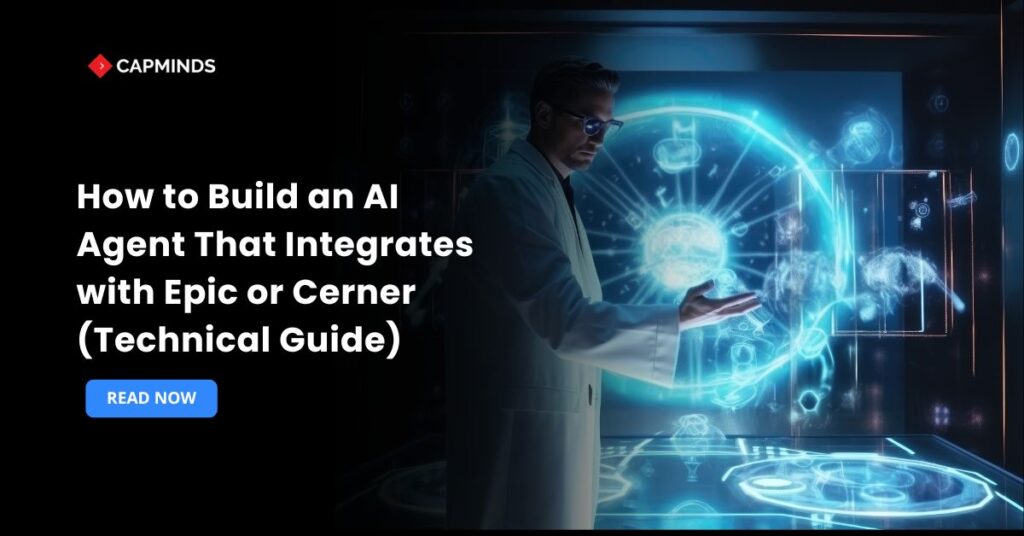
How to Build an AI Agent That Integrates with Epic or Cerner (Technical Guide)
Healthcare leaders are increasingly exploring AI “agents”, intelligent assistants that automate tasks or provide decision support, embedded directly into Electronic Health Records. Epic and Cerner (now Oracle Health) dominate the hospital EHR market, so building an AI agent for these platforms can dramatically boost clinical, administrative, and patient-facing workflows. Both Epic and Cerner strongly support interoperability standards like HL7 FHIR, enabling third-party apps to connect via REST APIs.
Indeed, Epic’s developer portal emphasizes that any FHIR-compatible app can exchange data with an Epic system using standardized US Core datasets. In practice, this means your AI agent can use SMART-on-FHIR and related APIs to securely fetch or update patient data in Epic or Cerner. It’s worth noting that integration is often the biggest hurdle in practice, a survey found “70% of hospitals report integration as the top barrier to adopting automation tools”, so understanding each platform’s requirements upfront is crucial.
Understanding the Epic and Cerner Platforms
Epic and Cerner each have large install bases, but they differ in architecture and tools. Epic provides the App Orchard/Showroom program for developers, where you register apps and obtain credentials. Its FHIR APIs follow the SMART-on-FHIR specification with a strict OAuth2 “launch” workflow. Cerner’s Open Developer Experience likewise lets you register SMART apps and access FHIR resources. Both vendors supply sandbox environments simulating real clinical workflows – for example, Epic’s FHIR sandbox and Cerner’s Code Console, so you can test data access and UI launches safely.
Each platform enforces security protocols: you must authenticate with OAuth2 and handle short-lived tokens/refresh tokens. You’ll define scopes and work within rate limits. Epic and Cerner may include custom requirements, for example, Epic’s token requests must include an exact audit matching the FHIR base URL, so careful review of each API’s docs is key. In addition, consider HL7 v2 feeds or custom interfaces if you need real-time messaging that FHIR cannot handle directly.
Key Integration Standards
Most modern EHR integration uses FHIR and REST APIs. FHIR defines resources like Patient, Observation, Appointment, Condition, etc., that your agent can query or update via HTTPS calls. SMART-on-FHIR adds a profile for authorization and EHR launch context.
- In Epic, for example, an app launch will carry a patient context so your AI agent knows which chart to operate on. Epic’s developer site details this SMART launch flow in depth.
- In Cerner, a similar SMART launch is handled via a “well-known” OAuth configuration, but the end result is the same: your agent uses OAuth2 to get a bearer token and then calls FHIR endpoints.
You may also leverage bulk FHIR for large data extracts. For instance, Epic’s FHIR API includes a Bulk Data Access interface to download many patient records for analytics. The Epic documentation lists a “FHIR Bulk Data Access Tutorial” as a resource. Using this, an agent can periodically pull entire populations of data for machine learning or reporting, rather than individual reads.
HL7 standards beyond FHIR still matter in many hospitals. As one commentator noted, “Think of HL7 as email, FHIR as WhatsApp, and REST as the internet highway”, each is a way to move data, but FHIR is rapidly becoming the lingua franca for new apps. Your agent should be prepared to speak all three: use FHIR/REST for modern EHR data, HL7 v2 or IHE interfaces where needed, and even proprietary APIs. In practice, an agent will often ingest data from a mix of sources: FHIR endpoints, HL7 interfaces, databases or flat files, and even spreadsheets. The goal is to aggregate these inputs into structured data your AI can act on, without ripping out existing infrastructure.
Types of Healthcare AI Agents and Use Cases
AI agents in healthcare come in many flavors. For example, clinical decision support agents might analyze lab trends or medical history to flag at-risk patients. Diagnostic imaging agents use deep learning models to interpret X‑rays, MRIs or pathology slides, these would connect to PACS or radiology reports rather than the EHR directly, but could feed results back into the chart.
Administrative agents help with scheduling, coding, billing and other non-clinical tasks. Patient-facing chatbots can handle appointment reminders, symptom triage, or even mental health check-ins. Epic itself showed at its 2025 user group some of its own agents: “Art” (a clinician assistant for visit prep), “Emmie” (a patient-facing MyChart chatbot), and “Penny” (a billing/coding aide). These illustrate the range: from appointment scheduling (via FHIR’s Appointment resource) to automated documentation (auto-drafting notes or summaries) to patient communication (sending messages or education through MyChart).
Key agent functions might include:
- Appointment Management: Querying Epic’s Appointment FHIR APIs ($book, $find) to propose or schedule slots, or sending reminders via the patient portal.
- Patient Outreach/Chat: Acting through Epic’s MyChart or a Cerner portal to answer questions, deliver lab results, or check on therapy adherence. For example, Epic’s MyChart agent can use AI to auto-draft message replies for providers.
- Clinical Documentation: Using speech-to-text or LLMs to generate progress notes from encounter data. For instance, Oracle Health’s Clinical AI Agent “streamlines workflows such as charting and documentation” by embedding AI into the EHR interface.
- Decision Support & Alerts: FHIR-based agents can fetch patient vitals, labs, and diagnoses to compute risk scores or care gaps, then inject recommendations via CDS Hooks or in-basket tasks. As Epic’s VP noted, agents might “help with pre-visit prep by chatting with patients… helping schedule tasks, and creating an easy-to-read summary”.
- Monitoring & Predictive Alerts: Ingesting remote monitoring/wearable data (via patient-uploaded FHIR resources or third-party APIs) to flag issues like arrhythmias or glucose spikes, and notify care teams.
- Revenue Cycle/Billing: Using AI to code encounters or draft claim appeals. Oracle’s solution touts automated medication and order management, and Epic is exploring bots for coding assistance and “Explain My Bill” chatbots.
No matter the function, the integration approach is similar: your agent app uses the EHR API to get relevant data (schedule slots, patient chart, etc.), runs its AI logic, then either writes back results (e.g. posting an Appointment booking or a note) or alerts a user.
Getting Started: Developer Registration and Setup
Before coding, register your application with the vendor. For Epic, sign up on Epic’s App Orchard/Showroom. Registering yields a client ID/secret and lets you specify redirect URIs, scopes (e.g. launch, openid, and specific FHIR read/write scopes), and the allowed launch contexts. Similarly, in Cerner’s Code Console, create a new SMART-on-FHIR app (you’ll fill in launch URI, redirect URI, FHIR version, and scopes). In both cases, use the sandbox URLs during development. Keep these credentials secure and configure OAuth2 in your app to handle the SMART launch.
Set up a development environment (cloud or on-prem) with tools like Postman or a SMART-on-FHIR client library (for example, Cerner provides a JavaScript fhir-client library) to test API calls. Populate your dev sandbox with sample patients. Epic’s site notes that you should define the minimal scopes needed to reduce risk and comply with least-privilege principles. Plan early for data security (see HIPAA below) and choose a scalable architecture (e.g. containerized microservices, serverless functions, or a secure cloud service).
Building the Agent: Technical Steps
Define Use Case & Data Needs
Start by specifying exactly what the agent will do (e.g. “auto-schedule follow-up appointments” or “summarize patient history into a note”).
- List which FHIR resources are needed (Patient demographics, Appointment, Condition, Observation, etc.) and
- Whether you need write permissions (e.g. to create an Appointment or Task).
If your function spans multiple areas (clinical + billing, for instance), plan for multiple data paths.
Authenticate with OAuth2
Implement the SMART launch flow: when the app is launched from Epic/Cerner (e.g. via a button in the EHR or a deep link), the system will redirect to your launch.html URL with a launch code.
Exchange that (along with your client ID/secret and redirect URI) at the token endpoint to get an access token. Cerner’s tutorial provides sample code for this registration and token request. Store the token securely and refresh it as needed. Remember to handle the aud and launch parameters that these platforms require for security.
Query and Map EHR Data
With the access token, call FHIR endpoints.
- For example, GET Patient/{{id}} to retrieve demographics, or GET Appointment?patient={{id}} to see existing bookings.
- When designing the AI logic, map local codes (Epic IDs, LOINC/SNOMED codes, etc.) to your model’s inputs.
- Data often need transformation: Epic and Cerner may use different coding systems or data structures, so build translation layers.
Be prepared to handle multiple FHIR versions (Cerner might respond in DSTU2 vs Epic R4) and vendor-specific extensions. For large data needs, use the Bulk Data export (FHIR $export) to pull entire records or population data for analysis.
Implement AI/ML or LLM Logic
This is where your model runs. You might call a cloud service (Azure OpenAI, Google Cloud Healthcare AI, etc.) or run your own ML model. Ensure PHI is protected: if using an external LLM (like GPT-4), do so via a HIPAA-compliant pipeline. You may choose to train models on de-identified datasets or use built-in APIs (Microsoft’s Nuance DAX or Azure OpenAI) that Epic supports under cover.
For tasks like natural language summarization or chatbot responses, you might use a fine-tuned LLM; for numeric prediction (e.g. sepsis risk), a statistical model. The key is that the agent logic takes EHR data as input and produces actionable outputs (text, flags, new appointments, etc.).
Write Data Back or Alert
After processing, push results where needed. For example, to schedule an appointment on behalf of a patient, call POST /Appointment/$book with the desired slot and patient context.
- To generate documentation, your agent might create a FHIR DocumentReference or Binary resource containing the draft note (or even write to the patient’s record via Epic’s in-basket APIs).
- If it’s purely an advisory, you could use CDS Hooks or in-app notifications: for instance, trigger an Epic “Best Practice Advisory” via the CDS Hooks FHIR endpoint, or send a secure message to the provider’s inbox.
- All write operations must respect user roles and require proper scope (always use the minimal privileges needed).
Integrate with the EHR UI
Decide how clinicians or patients will interact. Many SMART apps launch in the EHR context (Epic Hyperspace or MyChart, Cerner Millennium), embedding your interface as a tab or popup. In Epic, you can configure a SMART app launch context so that clicking a button in Hyperspace opens your agent app with the patient in context.
For patient portals, your app can launch within MyChart or Cerner’s HealtheLife by using the “standalone patient access” flow. Ensure the UI is intuitive and fits into workflows – e.g. a scheduling bot might chat in MyChart Messaging, while a documentation assistant could embed notes in the visit documentation pane.
Test in Sandbox & Iterate
Use Epic’s and Cerner’s sandbox/test EHR instances for rigorous testing. Populate realistic test patients and run through clinical scenarios. Thorough testing with clinicians is critical: Epic provides sandboxes that simulate workflows so developers can “ensure data flows correctly between the app and Epic”.
Gather feedback from doctors and admins to refine the UI and logic. Watch for edge cases: EHR sandboxes often differ slightly from production (old data formats, limits), so test on as-real data as possible. Validate that your outputs are accurate and that no patient information leaks occur.
Deploy and Maintain
Once validated, deploy your agent. Host it on a secure HIPAA-compliant cloud or on-prem server with audit logging and encryption at rest and in transit. Ensure you have SLAs and monitoring.
Plan for updates: both Epic and Cerner regularly update their APIs and may deprecate older endpoints. Implement automated tests to catch API changes. Also embed monitoring alerts: for example, if the FHIR token fails or a call error occurs, your system should log it and notify IT.
Security and Compliance
Healthcare AI must be HIPAA-compliant. Encrypt all PHI in transit and at rest. Use audit trails for data access and changes. Implement strict access controls: only authorized users or processes can call your agent. Cerner and Epic both require partner apps to follow robust security protocols. For example, Epic advises rigorous encryption and audit logging; Cerner’s sandbox (Code Console) expects you to manage tokens securely. If your agent uses external AI services, ensure they have HIPAA Business Associate Agreements. In short, “security and compliance are non-negotiable”.
Also consider patient consent: if your agent uses patient-generated data (wearables, personal health apps) or sensitive categories, it may need explicit opt-in. Design your app to respect privacy: only use data necessary for its function, and allow opt-out or data masking where appropriate.
Best Practices and Long-Term Success
Building an AI agent is just the beginning. Successful deployment means continuous improvement. Epic advises establishing feedback loops: monitor how clinicians use your app, track metrics like time saved or error reduction, and iterate on the model or interface. Since EHR standards and workflows evolve, plan regular updates: stay engaged with Epic’s and Oracle’s developer communities (user groups, forums, conferences) for changes. For example, Epic’s recent “agentic AI” initiatives suggest future hooks for more autonomous workflows.
Finally, involve stakeholders early. IT staff, clinicians, and administrators should all understand the agent’s role. Provide training materials or simulations. An intelligently designed AI agent can quickly become indispensable, but only if users trust its accuracy and usefulness. By following the technical steps above and adhering to healthcare regulations, your team can deliver an AI assistant that truly augments care – keeping systems “intact” while letting staff focus on patients.
AI–EHR Integration Services by CapMinds
Building an AI agent for Epic or Cerner is not just a development exercise, it is a systems integration service that demands deep healthcare IT expertise.
CapMinds delivers end-to-end AI–EHR Integration Services that help hospitals and digital health vendors move from concept to production with confidence.
Our services are designed to operationalize AI agents safely inside Epic and Cerner environments while meeting interoperability, security, and compliance requirements.
Our associated services include:
- Epic App Orchard & Cerner SMART-on-FHIR integration services
- HL7 v2, FHIR R4, Bulk FHIR, CDS Hooks, and API enablement
- AI agent architecture, LLM orchestration, and ML pipeline design
- HIPAA-compliant cloud deployment (AWS, Azure, GCP)
- OAuth2, SMART launch, audit logging, and security hardening
- Clinical workflow automation, revenue cycle AI, and patient engagement solutions
- Testing, sandbox validation, production rollout, and ongoing optimization
Whether you are building a clinical assistant, an administrative bot, or patient-facing AI agent, CapMinds provides complete digital health technology services, and more, to ensure scalable, compliant, and real-world-ready implementations.