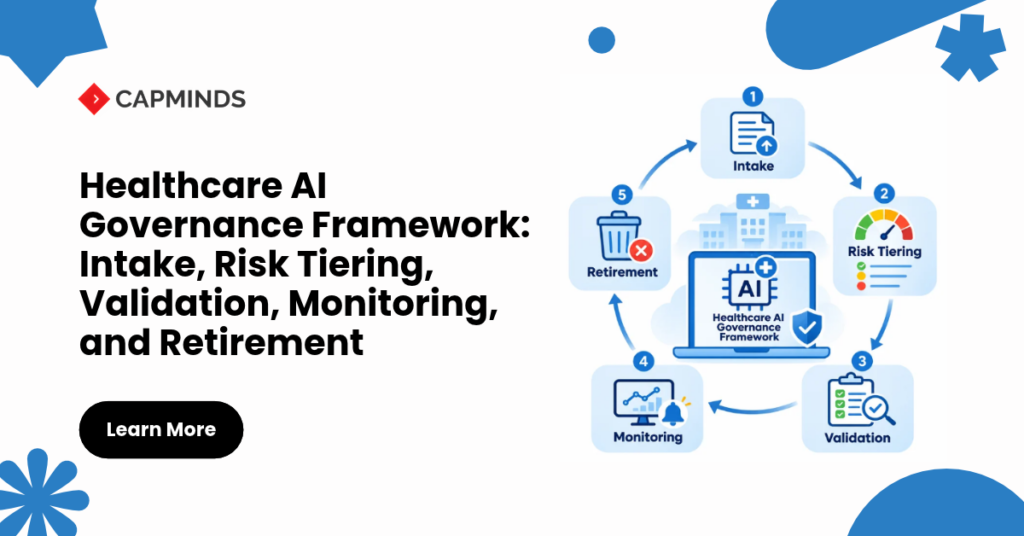
Healthcare AI Governance Framework: Intake, Risk Tiering, Validation, Monitoring, and Retirement
Most healthcare AI governance fails because hospital leadership treats it as a SharePoint policy exercise rather than an enforceable MLOps and EHR runtime control plane. When a laboratory information system upgrade alters troponin assay reference ranges or an ambient clinical scribe hallucinates a medication history, paper committees cannot stop degraded predictions or fabricated clinical notes from corrupting the patient chart.
Engineering a production-grade Healthcare AI Governance Framework requires embedding automated technical gates across both discriminative machine learning and generative AI pipelines throughout five lifecycle stages.
A 5-Stage Framework for Engineering the Healthcare AI MLOps Pipeline
1. Intake and Architectural Triage
Technical intake must reject any model before security review if it lacks an ONC HTI-1 (45 CFR 170.315(b)(11)) Decision Support Intervention source attribute manifest. Before granting sandbox access, the architecture board must audit four hard runtime constraints:
- Feature Lineage and Ingestion: Map required inputs to specific HL7v2 segments (such as OBX-5 for lab values) or FHIR R4 resources (Observation, Condition, MedicationRequest) to verify local coding completeness and unit standardization.
- Predictive Compute Topology: Determine whether discriminative inference executes inside Epic Nebula, runs on local virtual private cloud (VPC) Kubernetes clusters, or transits an external vendor endpoint.
- Generative AI Egress Guardrails: For LLMs powering ambient voice scribes, retrieval-augmented generation (RAG) chart summarization, or In Basket draft replies, mandate Zero-Data-Retention (ZDR) Business Associate Agreements (BAAs), PHI token-redaction gateways, and prompt-injection firewalls.
- EHR Ceremonies and Rate Limits: Benchmark payload serialization and token latency against synchronous CDS Hooks (patient-view, order-select), FHIR R4 transactional APIs, and Epic Interconnect or Oracle Health Millennium throttling limits during peak clinical rounding hours (07:00 to 10:00 local time).
2. Quantitative Risk Tiering
Risk classification binds clinical autonomy, failure severity, and regulatory pathways under FDA Software as a Medical Device (SaMD) and CMS Interoperability and Prior Authorization Final Rule (CMS-4201-F) mandates directly to operational SLAs.
| Risk Tier | Clinical Autonomy | Max Latency | Audit Cadence | Regulatory Pathway |
| Tier 1 | Non-clinical operational | 5000 ms batch | 90 days | Non-Device |
| Tier 2 | Human-in-the-loop CDS | 500 ms sync | 30 days | Non-Device CDS / CMS-4201-F |
| Tier 3 | Autonomous or diagnostic | 150 ms real-time | 7 days continuous | FDA SaMD Class II/III |
Tier 1 is restricted strictly to non-clinical operational workflows such as appointment no-show prediction, bed turnover routing, and supply chain par-level forecasting.
Tier 2 governs human-in-the-loop clinical and financial models, including sepsis or readmission risk scoring, clinical documentation integrity, ambient scribes, and prior authorization drafting.
Prior authorization and utilization management tools must never be classified as Tier 1; under CMS-4201-F and state laws such as California SB 1120, algorithmic medical necessity determinations require licensed clinical review, and LLM-drafted payer submissions risk hallucinating clinical history.
To prevent cognitive overload and automation bias in Tier 2 workflows, never render raw mathematical SHAP log-odds plots inside active EHR alerts. Display timestamped physiological drivers directly inside the Best Practice Advisory (BPA) card (for example, Lactate 4.2 mmol/L at 08:14, MAP 58 mmHg at 08:30) while housing mathematical feature weights, training cohort demographics, and out-of-sample validation metrics inside an on-demand ONC HTI-1 Model Facts nutrition label linked from the alert.
Tier 3 models (autonomous diabetic retinopathy screening, stroke triage notifications) mandate redundant failover nodes, immutable audit trails, and FDA-cleared Predetermined Change Control Plans.
3. Pre-Deployment Validation and Shadow Mode
Vendor-reported AUROC metrics trained on external academic cohorts rarely survive local ICD-10 billing variations, missing social determinants of health fields, and regional demographic skews. Every Tier 2 and Tier 3 model must complete a 30-to-90-day prospective shadow deployment before clinical activation.
In shadow mode, Rhapsody or Mirth Connect duplicates live HL7v2 ADT and ORU streams or triggers asynchronous CDS Hooks to the inference service while suppressing BPA presentation in the clinician workspace. Because true clinical outcomes never exist at the millisecond of inference, validation architectures must write real-time predictions to an append-only log and join them asynchronously against adjudicated enterprise data warehouse (Epic Clarity, Caboodle, or Snowflake) outcomes after final discharge coding.
-- 1. Real-time immutable shadow inference log (written at CDS Hook execution)
CREATE TABLE ai_governance.shadow_inference_log (

    prediction_id UUID PRIMARY KEY,

    model_version VARCHAR(32) NOT NULL,

    encounter_csn VARCHAR(64) NOT NULL,

    omb_race_code VARCHAR(16) NOT NULL,

    payer_category VARCHAR(32) NOT NULL,

    feature_payload_hash CHAR(64) NOT NULL,

    predicted_prob NUMERIC(5,4) NOT NULL,

    inference_latency_ms INTEGER NOT NULL,

    inferred_at TIMESTAMPTZ DEFAULT CURRENT_TIMESTAMP

);

-- 2. Subgroup calibration & false-negative parity audit (joined post-discharge against adjudicated outcomes)

SELECT

    i.omb_race_code,

    i.payer_category,

    COUNT(*) AS cohort_size,

    AVG(POWER(i.predicted_prob - o.sepsis_3_confirmed, 2)) AS brier_score,

    SUM(CASE WHEN i.predicted_prob < 0.65 AND o.sepsis_3_confirmed = 1 THEN 1 ELSE 0 END)::FLOAT

        / NULLIF(SUM(o.sepsis_3_confirmed), 0) AS false_negative_rate

FROM ai_governance.shadow_inference_log i

INNER JOIN edw_clinical.adjudicated_outcomes o

    ON i.encounter_csn = o.encounter_csn

WHERE i.model_version = 'sepsis_v2.4.1'

  AND o.coding_status = 'FINAL_BILLED'

GROUP BY i.omb_race_code, i.payer_category

HAVING COUNT(*) >= 100;
Discriminative models fail validation if subgroup Brier scores diverge by more than 0.05 across OMB race, ethnicity, or payer strata, or if sensitivity drops below the pre-registered clinical floor. We validate generative AI models across stratified shadow encounters using the Physician Documentation Quality Instrument (PDQI-9), clinical omission rates, and automated hallucination checks against source FHIR resources.
4. Production Monitoring, Drift, and Circuit Breakers
Once promoted to production, governance relies on automated runtime telemetry across both predictive and generative pipelines:
- Discriminative Covariate Drift: Compute the weekly Population Stability Index (PSI) across top model features to catch upstream schema or analyzer shifts:
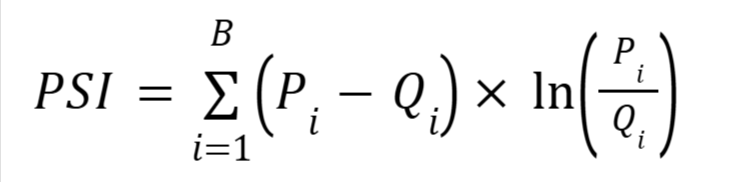
Where Pi is the empirical feature proportion in bin i during production, and Qi is the shadow validation baseline proportion. A PSI greater than 0.25 triggers an immediate PagerDuty alert to the MLOps team. For Tier 3 FDA SaMD models, any local weight recalibration or retraining must execute strictly within the boundaries of the model’s FDA-approved Predetermined Change Control Plan (PCCP) to avoid triggering a new 510(k) submission.
- Generative Telemetry: Track semantic embedding cosine drift alongside clinician edit-distance ratios, calculating the character-level Levenshtein distance between raw LLM drafts and final physician-signed notes to quantify real-world clinical utility.
- Stateful API Circuit Breakers: Never sever a degraded CDS Hooks route with an HTTP 503 or 404 response, which causes Epic Hyperspace or Oracle Health Millennium to log continuous interface exceptions and display timeout banners to clinicians. When 14-day rolling positive predictive value (PPV) drops 10% below baseline or clinician override rates exceed 85%, trip the API gateway into a stateful mock responder that returns HTTP 200 OK with a valid empty payload ({“cards”: []}) in under 5 ms, or falls back to deterministic EHR SmartText macros.
5. Model Retirement and Medico-Legal Decommissioning
Decommissioning a clinical AI model is a medico-legal workflow requiring strict artifact preservation for malpractice defense and regulatory discovery.
- Unbind EHR Ceremony Logic: Decouple the model’s output from active order sets, predictive columns, and BPA rules, routing clinical workflows back to deterministic fallback criteria (such as standard qSOFA logic).
- Archive Immutable Inference Envelopes: Saving an OCI container image digest alone cannot prove what a model evaluated if the patient’s underlying EHR data was subsequently amended or merged. Archive cryptographically signed JSON Inference Envelopes, containing the exact point-in-time input feature payload, model version hash, raw output score or generated text, rendered EHR card, and clinician override or signature timestamp, alongside container digests and model weights in Write Once, Read Many (WORM) storage (AWS S3 Object Lock in compliance mode) for 7 to 10 years per state medical record statutes.
- Revoke Credentials and Update Registry: Terminate SMART-on-FHIR client IDs, revoke OAuth2 service account tokens in the identity provider, and update the model’s lifecycle status to retired in the enterprise ONC HTI-1 DSI registry.
Architect Your Healthcare AI Control Plane with CapMinds
Move governance from policy binders into production code. CapMinds engineers ONC HTI-1-compliant AI infrastructure, integrating FHIR R4 pipelines, CDS Hooks, shadow validation schemas, and automated drift circuit breakers. Book an architectural consultation with CapMinds to harden your clinical AI lifecycle today.