Designing an EHR Application Support Model With L1, L2, and L3 Coverage
Standard ITIL support frameworks fail in healthcare because they equate blast radius with user count. In an enterprise SaaS environment, one user experiencing a failed transaction is a low-priority ticket; in an acute care hospital, a single anesthesiologist blocked from recording intraoperative vitals or an ICU pharmacist unable to verify an intravenous heparin order is a life-safety event.
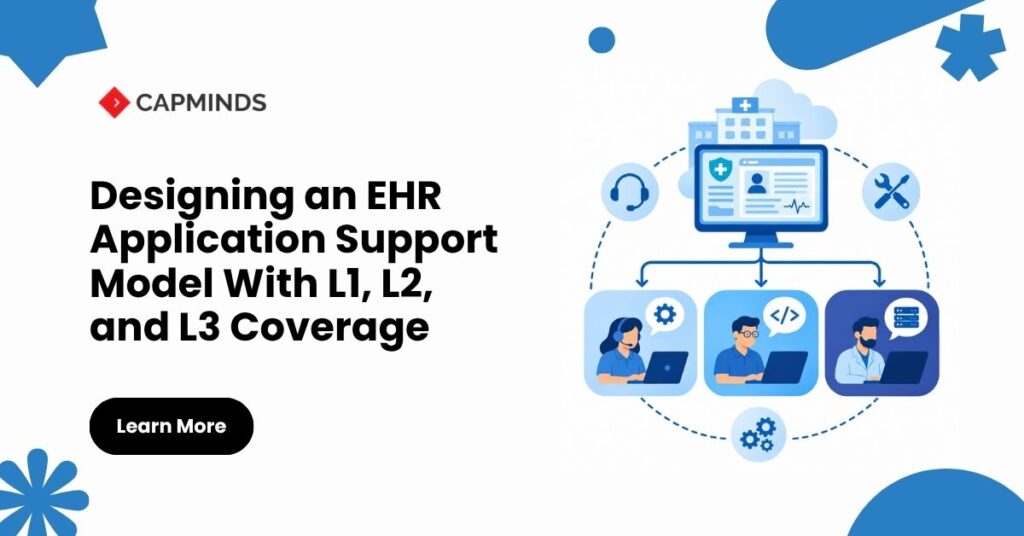
Designing a resilient L1, L2, and L3 application support model for an EHR ecosystem requires engineering around clinical acuity, data integrity, and regulatory access boundaries rather than call-center ticket volume.
The Clinical Acuity Triage Matrix
Traditional service desks route tickets based on how many endpoints are offline. An EHR support model must route incidents by evaluating the affected clinical pathway, the reversibility of the workflow blockage, and the regulatory exposure of underlying data corruption.
| Severity Tier | Clinical Impact | Initial SLA | Escalation Trigger | Primary Owner |
| P1 Critical | Care delivery halted | 5 minutes | Immediate warm handoff | L2 and L3 Swarm |
| P2 High | Workaround required | 15 minutes | Unresolved at 30 minutes | L2B and L2A |
| P3 Moderate | Single non-urgent user | 60 minutes | Unresolved at 4 hours | L1 and L1.5 |
| P4 Low | Cosmetic or BI delay | 24 hours | Breach at 72 hours | L2A Batch and BI |
A P1 incident bypasses L1 queue residence entirely. If an Automated Dispensing Cabinet interface drops HL7 v2.x RDE pharmacy messages, or if the ED track board freezes during ambulance triage, the alerting pipeline must page L2 and L3 engineers simultaneously via automated webhook integration. P2 incidents cover degraded states where a safe clinical workaround exists, giving L2 a hard 30-minute window to restore service before invoking L3 intervention.
When a P1 outage exceeds 30 minutes, the Incident Commander must trigger Business Continuity Access (such as Epic BCA or Oracle Health 724 Access), activating local read-only workstations wired to emergency power at nursing stations to print downtime Medication Administration Records. During recovery, L2 must throttle outbound interface queues to prevent a rebound message storm from double-dispensing medications already administered on paper.
Engineering Tier Boundaries and RBAC Architecture
Ambiguous responsibility between support tiers causes ticket ping-pong and inflates Mean Time to Resolution. High-performing health systems interpose a clinical informatics layer (L1.5) and split L2 between module build and middleware engineering, operating within Role-Based Access Control (RBAC) perimeters enforced by Privileged Access Management tooling.
L1 and L1.5: Service Desk and Clinical Informatics
L1 analysts handle high-volume, deterministic issues using pre-validated runbooks with zero write access to production clinical databases. Over 40% of reported EHR defects are actually workflow misunderstandings, which are intercepted by an L1.5 tier of nurse and pharmacist informaticists.
- Session State: L1 resolves hung Citrix ICA/HDX or VMware Horizon Blast sessions, clearing orphaned roaming profiles and resetting stale client session tokens.
- Identity Access: Analysts troubleshoot Imprivata badge-tap Single Sign-On failures, Active Directory lockouts, and basic Epic EMP-to-SER or Cerner Prsnl template links.
- Print Spoolers: L1 manages CUPS and Windows print spooler failures affecting Zebra specimen labelers and wristband printers by verifying static IP and session mappings.
- Workflow Triage: L1.5 informaticists intercept clinical usability errors, such as hard-stop cosign blocks, preventing false defects from draining L2 engineering cycles.
L2A: Clinical Application Build Analysts
L2A analysts hold vendor module certifications (such as Epic Willow, Beaker, and Grand Central, or Oracle Health PharmNet and PathNet) and manage configuration logic within non-production environments before migrating changes to production.
- Master Files: L2A fixes broken Order Transmittal rules, misfiring BestPractice Advisories, and Charge Router drops caused by misconfigured procedure master files.
- Session Diagnostics: Analysts use Epic Session Information Reports or Cerner Discern Visual Developer to identify which profile or security class is blocking a clinician.
L2B: Enterprise Integration and API Engineers
L2B owns the interoperability perimeter across Infor Cloverleaf, Lyniate Rhapsody, InterSystems HealthConnect, or Mirth Connect, alongside Epic Bridges error work queues and read-only production database replicas.
- Socket Management: Engineers monitor MLLP sockets, TCP/IP port bindings, Epic Bridges error work queues, and Infor Cloverleaf SMAT files to isolate dropped acknowledgments.
- Terminology Mapping: L2B resolves Application Reject and Error NACKs from unmapped LOINC codes, missing PV1 NPIs, or FHIR R4 bundles failing OAuth2 gateway scopes.
L3: Core EHR Architects, DBAs, and Vendor Escalation
L3 resolves systemic infrastructure bottlenecks, database corruption, and code-level defects. Production access is governed by Just-In-Time PAM checkouts via CyberArk or HashiCorp Vault, logging every keystroke to an immutable audit trail.
- Database Optimization: DBAs resolve global lock contention in InterSystems IRIS, Oracle RAC cache fusion bottlenecks, or PostgreSQL write-ahead log replication lag.
- Cloud Orchestration: Architects debug Kubernetes pod evictions, Istio service mesh mTLS handshake failures, and memory leaks inside Clinical Decision Support microservices.
- Vendor Remediation: L3 coordinates with vendor engineering to validate and deploy emergency hotfixes, custom MUMPS routines, or schema patches in staging before production.
Cross-Tier Escalation Runbooks: Code-Level Mechanics
An effective support model defines exact technical artifacts that must accompany a ticket as it moves up the stack. Passing a ticket from L1 to L2 or L3 without diagnostic telemetry is an operational failure.
Scenario 1: Poison Pill HL7 Message Blocking an Orders Queue
When a clinician reports that laboratory results are not populating in the inpatient chart, L1 verifies that the user holds the required security class and that the issue affects multiple patients, escalating to L2B within 10 minutes.
L2B inspects the outbound lab channel, checking the Infor Cloverleaf Saved Message Architecture Tool database, Epic Bridges workqueue, or Mirth Connect queue and identifies a backup behind a malformed ORU_R01 message containing an unescaped ampersand in OBX-5 or an oversized Base64 pathology PDF exceeding the MLLP buffer limit. In a Mirth Connect environment backed by PostgreSQL, L2B queries the datastore to isolate the offending message ID and error state:
    m.id AS message_id,

    mm.id AS connector_id,

    mm.connector_name,

    mm.status,

    mm.send_attempts,

    mm.response_date,

    mc.content AS error_detail

FROM d_m6 m

JOIN d_mm6 mm ON m.id = mm.message_id

LEFT JOIN d_mc6 mc ON mm.message_id = mc.message_id

    AND mm.id = mc.metadata_id

    AND mc.content_type = 13

WHERE mm.status IN ('E', 'Q')

  AND m.received_date >= NOW() - INTERVAL '2 hours'

ORDER BY m.received_date ASC

LIMIT 25;
If L2B determines that the downstream EHR listener is dropping the TCP connection before emitting a NACK, L2B places the poison message on hold, flushes the FIFO queue for subsequent messages, and escalates to L3 to adjust the Java Virtual Machine (JVM) heap allocation and MLLP receive buffer size on the core listener container.
Scenario 2: Database Lock Contention During Shift Handoff
At 07:00 shift change, hundreds of nurses simultaneously load patient lists and flowsheet rows, spiking EHR response times past 12 seconds. L1 recognizes a widespread latency spike via Real User Monitoring (RUM) dashboards and opens a P1 bridge with L2 and L3. L2 verifies that Citrix storefront CPU utilization and API gateway throughput are nominal, isolating the bottleneck to the persistence layer.
Tier-1 Acute EHRs: In an Epic environment, L3 inspects InterSystems IRIS/Caché global buffer contention via LOCKTAB and SS utilities, discovering an unoptimized, multi-month Reporting Workbench query running directly against the primary transactional Chronicles database instead of routing to a read-only Shadow Server (or executing overnight against the batch-extracted Epic Clarity relational database). In an Oracle Health (Cerner Millennium) environment, L3 queries GVLOCK and GVSESSION on Oracle RAC to terminate a custom Cerner Command Language script performing full table scans on the ORDERS and CLINICAL_EVENT tables without index hints.
Cloud-Native EHRs: In microservice-backed EHR architectures and FHIR persistence layers running on PostgreSQL or Amazon Aurora, L3 checks out emergency DBA credentials and queries the lock table to isolate blocking transactions:
    blocked_locks.pid AS blocked_pid,

    blocked_activity.usename AS blocked_user,

    blocking_locks.pid AS blocking_pid,

    blocking_activity.usename AS blocking_user,

    AGE(NOW(), blocking_activity.query_start) AS blocking_duration,

    LEFT(blocking_activity.query, 120) AS blocking_statement

FROM pg_catalog.pg_locks blocked_locks

JOIN pg_catalog.pg_stat_activity blocked_activity

    ON blocked_activity.pid = blocked_locks.pid

JOIN pg_catalog.pg_locks blocking_locks

    ON blocking_locks.locktype = blocked_locks.locktype

    AND blocking_locks.database IS NOT DISTINCT FROM blocked_locks.database

    AND blocking_locks.relation IS NOT DISTINCT FROM blocked_locks.relation

    AND blocking_locks.pid != blocked_locks.pid

JOIN pg_catalog.pg_stat_activity blocking_activity

    ON blocking_activity.pid = blocking_locks.pid

WHERE NOT blocked_locks.granted;
L3 terminates the offending backend process, restores sub-second clinical charting latency, and configures connection-level resource governor groups so reporting accounts cannot acquire locks on transactional schemas.
Container Orchestration and Cloud-Native Bottlenecks
Modern EHR architectures rely on containerized microservices for FHIR APIs, patient portals, and ambient AI documentation sidecars. Support models that treat Kubernetes clusters as black-box infrastructure leave L2 and L3 blind to three production failure modes:
- Storage Eviction: Verbose debug logging on a FHIR validation container can fill node storage under /var/lib/kubelet/pods before FluentBit flushes to Splunk, evicting clinical pods.
- Pool Starvation: When Horizontal Pod Autoscalers spin up 40 microservice replicas at peak hours, uncoordinated HikariCP pools exhaust database limits without PgBouncer.
- Mesh mTLS Skew: Expired Istio sidecar certificates silently drop gRPC requests between the EHR monolith and external CDS Hooks services, hiding critical drug-allergy alerts.
HIPAA-Compliant Telemetry and Automated Remediation
Giving L2 and L3 engineers deep transaction visibility without exposing Protected Health Information in third-party observability platforms (Datadog, New Relic, Elastic) is a strict regulatory boundary. Attempting to regex-scrub individual HL7 fields like PID-5 (Patient Name) and PID-19 (SSN) in flight violates HIPAA Safe Harbor (45 CFR 164.514) because it leaves Medical Record Numbers in PID-3, dates of birth in PID-7, addresses in PID-11, and unstructured clinical notes in OBX-5 exposed in log indices.
Instead of partial redaction, L3 architects must configure OpenTelemetry Collector pipelines at the cluster ingress layer to extract non-PHI routing metadata (MSH-10 Message Control ID, MSH-9 Event Type, MSH-4 Sending Facility, and HTTP status codes) into searchable log attributes, while purging the clinical payload body before logs leave the HIPAA boundary:
processors:

  transform/purge_phi_payload:

    error_mode: ignore

    log_statements:

      - context: log

        statements:

          # Extract non-PHI HL7 MSH-9 (Message Type) and MSH-10 (Message Control ID) into safe searchable attributes

          - merge_maps(attributes, ExtractPatterns(body, "^MSH\\|[^\\|]*\\|[^\\|]*\\|(?P<sending_app>[^\\|]*)\\|(?P<sending_fac>[^\\|]*)\\|[^\\|]*\\|[^\\|]*\\|[^\\|]*\\|(?P<msg_type>[^\\|]*)\\|(?P<msg_control_id>[^\\|]*)"), "insert") where IsMatch(body, "^MSH\\|")
# Completely purge the raw HL7/FHIR clinical body before shipping to external APM
– set(body, “[PHI_PAYLOAD_PURGED_USE_MSH10_IN_SMAT_VAULT]”) where IsMatch(body, “^(MSH|PID|OBX)\\|”) or IsMatch(body, “\”resourceType\”\\s*:\\s*\”(Patient|Observation|MedicationRequest)\””)
When an interface fails, L2B alerts on the extracted message control ID in Datadog, then queries that exact ID inside the on-premises, BAA-covered interface engine vault (such as Cloverleaf SMAT or Mirth’s encrypted database) to inspect the clinical payload safely.
With sanitized telemetry in place, engineering leadership must enforce a hard boundary around automated remediation. Runbook automation via Rundeck or PagerDuty Process Automation should aggressively handle stateless recovery such as restarting hung MLLP listener sockets, clearing stale Citrix session locks, or rotating dead Kubernetes pods. Conversely, any action involving stateful mutation, including replaying out-of-sequence ADT A08 patient update messages, merging duplicate MRNs, or purging stuck medication orders, must require explicit L2A clinical analyst validation and dual-signature L3 execution to prevent silent patient chart corruption.
Architect a Resilient EHR Support Ecosystem With CapMinds
Prevent clinical downtime and eliminate interface bottlenecks with CapMinds’ enterprise EHR application support and managed interoperability services. Our HL7 v2, FHIR R4, and EHR-certified engineers deliver 24/7 L1–L3 coverage, HIPAA-compliant observability, and rapid incident remediation. Contact CapMinds today to schedule a technical architecture assessment.