Building Real-Time Clinical Alerts with FHIR Webhooks and Event-Driven Architecture
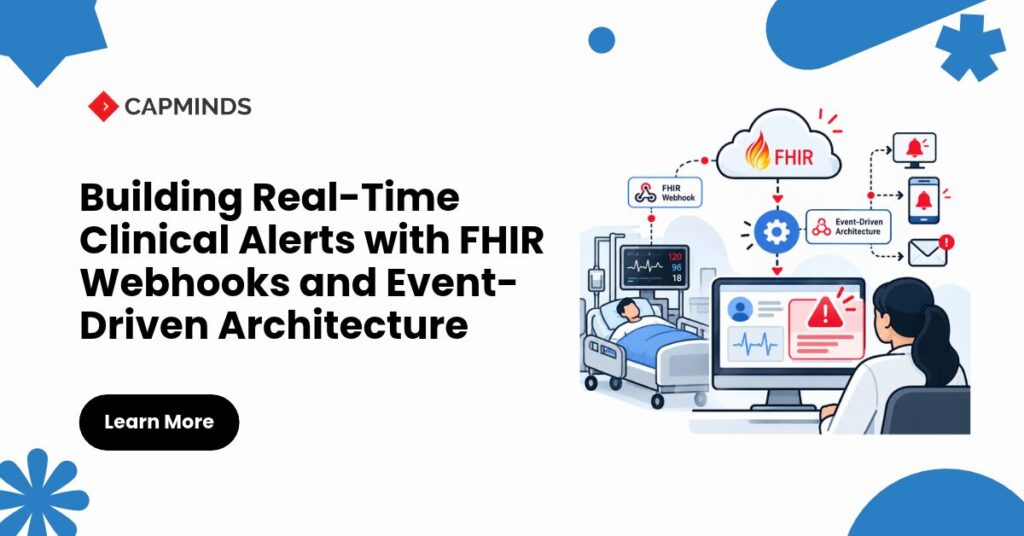
Enterprise clinical alerting pipelines fail when architects rely on synchronous webhook dispatchers or application-level dual-writes (committing to a database and firing an HTTP call or Kafka producer in the same thread). This guarantees silent event loss during network partitions or JVM garbage collection pauses.
Achieving sub-second clinical decision support with zero lost events and HIPAA/42 CFR Part 2 compliance requires database-level event extraction, deterministic stream partitioning, UCUM-normalized clinical reasoning, and multi-stage alert fatigue suppression.
1. Ingestion Topologies: Transactional Outbox vs. GCP (fhir-pubsub)
Production FHIR servers must never dispatch webhooks directly from HTTP worker threads. Event extraction requires database Change Data Capture (CDC) or a managed event bus.
| Architectural Dimension | Self-Hosted PostgreSQL + Debezium Outbox | Managed Google Cloud Healthcare API (fhir-pubsub) |
| Atomicity Mechanism | Local ACID transaction writes to both the resource table and fhir_outbox_events | Internal Cloud Spanner transaction coupled with Cloud Pub/Sub publisher |
| Ordering Guarantee | Strict per-partition ordering when keyed by Patient/{id} compartment | Best-effort unless Pub/Sub ordering keys are explicitly layered downstream |
| Payload Size Ceiling | Governed by Kafka max.message.bytes (configurable beyond 10 MB) | Hard 1 MB limit for FULL_RESOURCE; automatically degrades to NAME_ONLY |
PostgreSQL WAL & Debezium Outbox Router
A server persistence interceptor writes the mutated resource and an outbox record within the same database transaction. To prevent Kafka partition hot-spotting, compartment-aware partition key resolution must be enforced:
- If the resource belongs to the Patient Compartment (e.g., Observation.subject, Encounter.subject), set aggregateid to the canonical Patient/{id}.
- If outside the Patient compartment, fall back to {ResourceType}/{Resource.id}.
Configure PostgreSQL with wal_level = logical and deploy Debezium with the EventRouter Single Message Transform. Include a dedicated debezium_heartbeat table to prevent WAL disk exhaustion during idle periods:
SQL
CREATE TABLE public.fhir_outbox_events (
    id UUID PRIMARY KEY DEFAULT gen_random_uuid(),
    aggregatetype VARCHAR(64) NOT NULL,
    aggregateid VARCHAR(128) NOT NULL, -- Patient/{id} or ResourceType/{id}
    type VARCHAR(128) NOT NULL,
    resource_id VARCHAR(64) NOT NULL,
    version_id INTEGER NOT NULL,
    security_labels VARCHAR(256) DEFAULT 'N',
    tracingspancontext VARCHAR(512),
    payload JSONB NOT NULL,
    created_at TIMESTAMPTZ NOT NULL DEFAULT clock_timestamp()
);
GCP Healthcare API & 1 MB Degradation Trap
When using Google Cloud Healthcare API (fhir-pubsub), setting payloadType to FULL_RESOURCE introduces a silent failure mode. If a resource exceeds 1 MB (e.g., PDFs in DiagnosticReport or waveforms in Observation), GCP silently degrades the message to NAME_ONLY, sets the body to a plain-text URI, and populates attributes[“big_resource”] = “true”.
Downstream consumers must inspect message attributes and execute an authenticated GET {resource_uri}/_history/{versionId} to hydrate the payload before stream evaluation.
2. FHIR Subscriptions (R5, R4, and R5 Backport IG)
FHIR R4 native search-string subscriptions lack notification metadata and gap detection. Production architectures must use FHIR R5 Topic-Based Subscriptions (SubscriptionTopic, Subscription, SubscriptionStatus) or the Subscriptions R5 Backport IG for R4 servers.
JSON
{
"resourceType": "SubscriptionTopic",
"url": "http://hospitalsystem.org/fhir/SubscriptionTopic/critical-lab-observation",
"resourceTrigger": [{
"resource": "Observation",
"supportedInteraction": ["create", "update"],
"queryCriteria": {
"previous": "status:not=final,amended",
"current": "status=final,amended&category=laboratory",
"requireBoth": true
}
}]
}
Gap Detection & Recovery ($events)
Every webhook notification carries a sequential notificationEvent.eventNumber. Consumers track the last processed event number in Redis/PostgreSQL.
If a gap is detected (e.g., receiving event 1042 after 1040), the consumer invokes the $events operation (GET /fhir/Subscription/{id}/$events?eventsSinceNumber=1041) to replay missed notifications. If no traffic occurs within heartbeatPeriod, an empty heartbeat is dispatched; if missed, the consumer polls $status.
3. Broker Internals: Kafka 4.x & RabbitMQ Quorum Queues
- Apache Kafka 4.x + Kafka Streams: Use KRaft mode with acks=all, min.insync.replicas=2, and processing.guarantees=exactly_once_v2. To prevent OOMKilled container crashes caused by RocksDB off-heap memory allocations, bind a custom RocksDBConfigSetter sharing an explicit LRUCache and WriteBufferManager.
- RabbitMQ Quorum Queues: Use Raft-backed quorum queues with x-delivery-limit: 5 and a Dead Letter Exchange (dlx) for poison-pill isolation. Producers must enforce asynchronous Publisher Confirms (basic.ack) to guarantee persistence before webhook dispatch.
4. Standardized Envelopes & OpenTelemetry
- CloudEvents 1.0: Wrap notifications in the CloudEvents specification using binary content mode (payload remains pure application/fhir+json while routing metadata travels as ce-* HTTP/Kafka headers).
- OpenTelemetry Messaging Semantics: Propagate W3C traceparent headers from the database outbox through Kafka headers into the webhook payload. Consumer processes must attach to producer spans via Span Links rather than strict parent-child nesting to measure queue lag accurately.
5. Clinical Data Integrity: Validation & UCUM Normalization
- High-Throughput Validation: Do not invoke synchronous $validate over HTTP. Embed HAPI FHIR FhirInstanceValidator in-memory with pre-compiled StructureDefinition snapshots and a cached terminology service (Caffeine/Redis) for LOINC and SNOMED codes.
- UCUM Normalization & Stoichiometry: Validate units against unitsofmeasure.org. For mass-to-substance concentration conversions (e.g., mg/dL to mmol/L for creatinine), apply stoichiometric molecular weight factors before rule evaluation:
mmol/L=mg/dLx10/MolecularWeight(g/mol)
- ObservationDefinition: Resolve critical thresholds dynamically using ObservationDefinition.qualifiedInterval filtered by patient age, biological sex, and assay context rather than hardcoding values.
6. Clinical Reasoning, CDS Hooks 2.0, & Alert Fatigue Engineering
- CQL Execution: Compile HL7 CQL clinical logic to ELM JSON at build time. Bind the execution engine directly to the local RocksDB state store for sub-10ms evaluation.
- CDS Hooks 2.0: Bridge asynchronous events to synchronous EHR workflows (patient-view, order-select). The CDS service reads pre-computed state from RocksDB and returns actionable cards[] with pre-built FHIR suggestion mutations (suggestions[].actions[]) and mandatory override reasons.
- Alert Fatigue Mitigation (AHRQ): Enforce four suppression gates before emitting alerts:
- Stateful Cooldown Windows (e.g., 8-hour suppression for identical sepsis triggers).
- Order-in-Flight Lookahead (suppress alerts if a matching therapy order was placed after specimen collection).
- Care Context Exclusion (automatically suppress physiological deterioration alerts for comfort-care / palliative patients).
- Automated Feedback Loops (POST /cds-services/{id}/feedback) to recalibrate rules exceeding a 70% clinician override rate.
7. Closed-Loop Clinical Workflows (CommunicationRequest & Task)
Delivering a webhook is not enough. Every critical alert must instantiate a two-resource FHIR state machine:
- CommunicationRequest: Directs transmission over messaging gateways (Halo, PagerDuty, Epic Chat).
- Task: Represents the trackable clinical obligation (status = requested, priority = stat, linked via restriction.period.end timer).
If unacknowledged within 5 minutes, a Kafka Streams punctuated timer automatically updates Task.businessStatus to escalated-tier-2 and reassigns ownership to the attending physician.
8. Zero-Trust Security & 42 CFR Part 2 Compliance
- SMART Backend Services & mTLS: Enforce mutual TLS 1.3 and OAuth 2.0 client credentials using signed asymmetric JWT assertions (RS384/ES384, max 5-min exp, unique jti) verified against a public JWKS endpoint.
- Webhook Signatures & Replay Protection: Sign the raw body and timestamp using HMAC-SHA256 in X-FHIR-Webhook-Signature. Reject requests where abs(now – timestamp) > 300s and cache ce-id in Redis for 10 minutes to block replay attacks.
- SSRF Defense: Configure HTTP webhook dispatchers with a custom DNS resolver that intercepts outgoing socket connections and blocks loopback, private RFC 1918, link-local, and CGNAT IP ranges.
- 42 CFR Part 2 Security Interceptor: Inspect Resource.meta.security[] tags (R, V, ETH, PSY). If a subscriber lacks clearance for sensitive substance use or psychiatric records, the dispatcher dynamically downgrades the payload from full-resource to id-only, forcing an authenticated, audit-logged fetch.
Architecting Clinical-Grade Event Streams? Let’s Build It Right.
Building high-throughput, zero-loss clinical alerting pipelines requires more than standard pub/sub wrappers; it demands rigorous database-tier event extraction, deterministic partition keying, sub-millisecond UCUM normalization, and ironclad 42 CFR Part 2 and HIPAA security controls.
Whether you are migrating off legacy polling architectures, implementing FHIR R5/R4 Backport Subscriptions, or scaling Kafka Streams for real-time decision support, our Principal FHIR Architects and HealthTech Systems Engineers can help you design, harden, and deploy production-grade infrastructure.