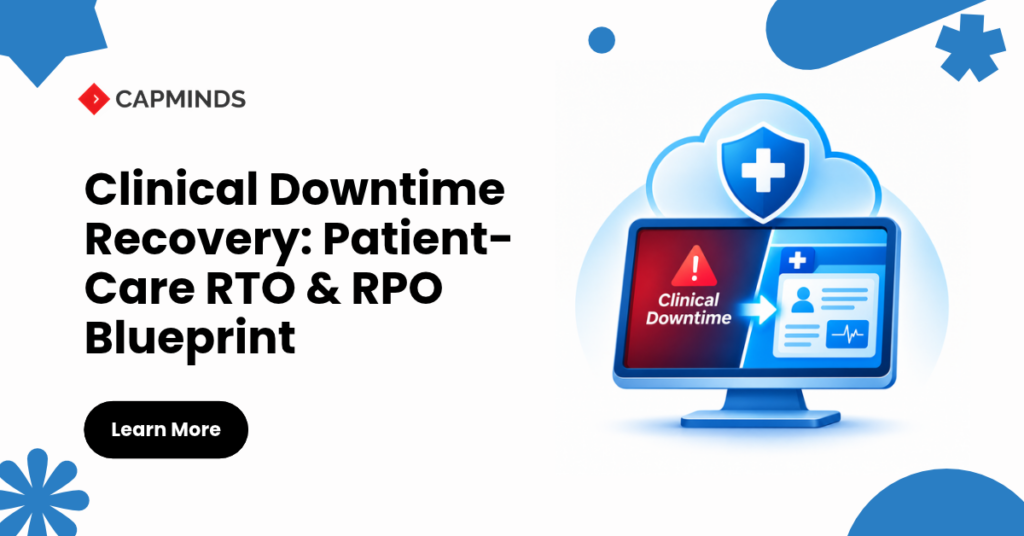
Clinical Downtime Recovery: How to Design RTO and RPO Around Patient Care, Not Generic Infrastructure SLAs
Most hospital disaster recovery architectures are engineered to satisfy auditors and protect balance sheets, not keep intensive care units alive.
Infrastructure teams routinely present boards with 99.99% cloud availability SLAs, four-hour virtual machine recovery targets, and compliance mappings to federal baselines, such as
- HHS Office for Civil Rights’ proposed HIPAA Security Rule overhaul (90 FR 898, RIN 0945-AA22), which outlines a 72-hour Restoration Time Objective (45 CFR 164.308(a)(13)(ii)(D)(1)),
- A 48-hour Recovery Point Objective for retrievable ePHI (45 CFR 164.312(i)(2)(i)), and
- Documented monthly restore testing (45 CFR 164.312(i)(2)(iv)).
Although HHS moved that rulemaking to its Long-Term Actions agenda with a projected final action of July 2027, treating 72-hour/48-hour ceilings as operational targets is clinically indefensible.
In acute care, those numbers represent a legal compliance floor, not a bedside survival threshold.
Losing 48 hours of charting erases vasopressor titrations, blood product transfusions, and anticoagulation administrations across multiple shifts. Empirical evidence confirms that patient harm scales with workflow coupling, not hypervisor uptime:
- Ancillary Systems Drive Safety Incidents: An empirical analysis of EHR downtime patient safety event reports found that 48.7% involved laboratory workflows and 14.5% involved medication administration, showing that Lab Information Systems and pharmacy pipelines cannot sit in lower recovery tiers.
- Surgical Friction Hits Immediately: In a Mayo Clinic matched cohort of 4,103 surgical patients undergoing intraoperative EHR downtimes lasting over 60 minutes, operating room duration increased 1.1x and postoperative length of stay increased 1.04x. Crucially, trend analysis showed no linear dose-response with duration and no statistically significant increase in 30-day mortality, meaning operational drag degrades care the moment clinical workflows fracture.
- Diagnostic Denial-of-Care Kills: The June 2024 Synnovis pathology ransomware attack in the UK crippled a third-party diagnostic dependency rather than a core EHR; June 2025 NHS Trust disclosures linked the outage to 170 documented patient harm incidents, one confirmed fatality, and 1,710 postponed elective procedures. More broadly, a September 2026 systematic review across 59 studies and 184 patient reports cataloged 316 documented patient-level harms tied to healthcare cyberattacks.
- Regional Trauma Spillover: Extended outages destabilize neighboring health systems. A four-week ransomware attack analyzed by Dameff et al. forced ambulance diversions, spiking EMS arrivals and degrading emergency department throughput at adjacent, uninfected trauma and stroke centers.
Beyond Hypervisor Uptime: Clinical Recovery Time Actual
An InterSystems IRIS database node or PostgreSQL primary returning HTTP 200 tells a Chief Medical Information Officer nothing about whether an ICU nurse can scan a Barcode Medication Administration dose or receive a critical potassium panic value.
Hospital architects must abandon VM-boot RTO and engineer against Clinical Recovery Time Actual:
cRTA = T_detect + T_contain + T_identity + T_data_restore + T_queue_drain + T_clinical_verify
Standard DR tests benchmark only T_data_restore, hydrating a SAN snapshot or failing over a standby node. In real hospital incidents, T_data_restore frequently represents less than 25% of the clinical outage:
- T_identity: Clean-room Active Directory restoration, double KRBTGT resets, ADCS/PKI certificate validation, DNS, and Imprivata SSO brokers must be proven clean before any clinician authenticates.
- T_queue_drain: Interface engines (Cloverleaf, Rhapsody, Mirth Connect) accumulate tens of thousands of queued HL7 v2 messages (ADT, ORM, ORU, RAS). Unsequenced replay corrupts longitudinal charts.
- T_clinical_verify: Per the 2025 ASTP/ONC SAFER Guide for Contingency Planning and AHRQ research, infrastructure uptime is meaningless until clinicians verify an end-to-end transaction, placing a test CPOE order, confirming allergy Clinical Decision Support fires, verifying pharmacy routing, and confirming dispensing availability at an Automated Dispensing Cabinet (ADC).
Architects must classify functional downtime as a Tier 1 failure.
When storage IOPS saturate, or database lock contention pushes EHR screen refresh latency past 10 seconds, monitoring dashboards stay green while clinicians abandon the EHR for unverified paper workarounds.
Four Architectural Failure Modes That Break Hospital DR Plans
1. Shared-Fate Identity and the BCA Nuance Trap
Many health systems assume on-premises Business Continuity Access solves cyber survivability. During active ransomware containment, BCA splits into two distinct failure modes:
- BCA Web and central sync servers fail immediately once incident responders sever internal VLANs or isolate compromised Domain Controllers, freezing clinical reports and causing bedside RPO to decay every minute.
- Hardened BCA PCs hold local encrypted snapshots and support break-glass authentication, so they do not always go dark instantly when AD drops. However, residing on corporate VLANs leaves them progressively stale during multi-day outages and exposed to lateral encryption or automated EDR isolation.
Remediation: Decouple read-only continuity from corporate AD using an out-of-band Cloud Read-Only Isolated Recovery Environment built on pull-only replication initiated from inside the vault, an active-warm independent Identity Provider, and dedicated LTE/5G or Starlink uplinks feeding ED, ICU, OR, Pharmacy, and Blood Bank downtime kiosks.
2. The Synchronous RPO Paradox and FinOps Discipline
Synchronous database mirroring, such as InterSystems IRIS Mirroring (synchronous or asynchronous journal replication over TLS/TCP between Mirror Primary and Mirror Backup coordinated by an Arbiter running ISCAgent on default port 2188, where Enterprise Cache Protocol only redirects app-server caching traffic via MirrorConnection=1), Oracle Data Guard Maximum Protection, or SQL Server Always On, protects strictly against hardware or site loss.
Against ransomware or destructive scripts, it guarantees zero-millisecond corruption propagation. Remediation: Implement a Dual-Plane RPO Architecture:
- Plane A (Operational HA): Synchronous or near-synchronous replication (≤ 60 seconds operational RPO) across local availability zones or metro dark fiber.
- Plane B (Cyber-Immutable Vault): Asynchronous, WORM-locked WAL/journal shipping to AWS S3 Object Lock (Compliance Mode) or hardware air-gapped vaults targeting 15–60-minute cyber RPO, gated by clean-room entropy scanning before promotion.
- FinOps Trade-Off: Hospital systems operating on 1%–3% margins cannot justify active-active multi-region EHR writes, which add cross-region commit latency while doubling licensing and storage spend. Pairing Warm-Standby recovery with a Hot Out-of-Band Cloud Read-Only IRE captures the highest-acuity bedside safety gains at a fraction of active-active licensing and replication cost.
3. Hosted and SaaS EHR Failure Boundaries
For health systems running on Epic Hosting or Oracle Cloud Infrastructure, vendor SLAs stop at cloud ingress. The primary failure domain remains local:
- Dual-carrier WAN/SD-WAN egress,
- On-premises AD and Imprivata SSO brokers,
- Clinical Wi-Fi serving BCMA scanners,
- Local interface engines,
- LIS analyzers,
- Pyxis/Omnicell cabinets, and
- Bedside IoMT devices.
Without dual-path local egress and local identity resilience, a hosted hospital goes completely blind while the vendor reports 100% uptime.
4. Kubernetes Recovery Bottlenecks, mTLS Expiry, and IoMT Buffers
Hospitals running FHIR R4 facades, SMART on FHIR apps, and CDS Hooks microservices on Kubernetes hit four specific recovery bottlenecks:
- Image-Pull vs. Storage Throttling: Prevent container registry saturation during mass pod rescheduling by maintaining a pre-warmed, air-gapped regional registry mirror. Separately, mitigate cloud CSI AttachVolume API throttling using strict Kubernetes PriorityClass tiers and pre-warmed standby node pools so Tier 1A CDS and FHIR pods mount before analytics workloads.
- mTLS Certificate Expiration: Multi-day cyber containment expires short-lived SPIFFE/SPIRE or cert-manager leaf certificates across Istio/Linkerd meshes, silently breaking pod-to-pod FHIR traffic even when deployments report Ready 1/1. Pre-stage an offline root/intermediate CA rotation runbook in the IRE and force automated workload trust-bundle re-attestation before opening ingress.
- BCMA Thundering Herds: Simultaneous reconnection of thousands of BCMA scanners and HL7 gateways saturates PgBouncer or Oracle connection pools. Enforce transaction-mode pooling, API gateway rate limiting, and staged VLAN admission control, reconnecting ED, ICU, OR, and Pharmacy before ambulatory clinics.
- IoMT Memory Overwrites: Bedside monitors, telemetry stations, and smart infusion pumps hold finite local ring buffers. Clinical Engineering/HTM must prioritize gateway buffer extraction before local memory wraps and permanently destroys physiologic RPO.
Acuity-Based Tiering for Minimum Viable Clinical Operations
Major hospital cyberattacks average 30 days to full enterprise restoration.
Rather than pursuing monolithic recovery, engineer Minimum Viable Clinical Operations, splitting Operational RTO from Cyber Clean-Room RTO so dependency math remains exact:
| Clinical Acuity Tier | Core Systems & Workflows | Ops / Cyber RPO | Ops RTO (Hardware/Site) | Cyber Clean-Room RTO | Clinical Safety Justification |
| Pre-Staged Cloud IRE | Active-Warm Independent IdP, Read-Only EHR, LTE/Starlink Kiosks | ≤ 15 min (Pull) | Always Warm | 15–30 min (Read-Only Active) | Decoupled from corporate AD; instant allergy, med, and problem-list visibility at T+0. |
| Tier 0: Trust & Plumbing | Clean AD/IdP, DNS, PKI/ADCS, Imprivata SSO, Interface Engines, EMPI | ≤ 5 min / ≤ 1 hr | 15 min – 1 hr | 1–2 hrs | Hard prerequisite for all R/W restoration; zero apps function without clean identity, PKI, and routing. |
| Tier 1A: Meds & Safety | eMAR/BCMA, Pharmacy/ADC Interfaces, Active Allergy/CDS Engine | ≤ 1 min / ≤ 15 min | 15–60 min | 2–4 hrs (Post-Tier 0) | Missing automated allergy/drug-drug CDS triggers lethal high-alert med errors (ISMP). |
| Tier 1B: Lab & Blood | Core LIS, Blood Bank, Acute PACS Cache, ED Trackboard | ≤ 5 min / ≤ 30 min | 30–60 min | 2–4 hrs (Post-Tier 0) | Lab drives 48.7% of downtime safety events (Larsen et al.); pathology outages cause direct mortality. |
| Tier 2A: Core Clinical R/W | Core EHR (CPOE/Notes), Periop/Anesthesia, Clinical Messaging | ≤ 15 min / ≤ 60 min | 1–4 hrs | 4–12 hrs | Intraoperative outages over 60 min degrade OR efficiency; paper bridges fail past 12 hours. |
| Tier 2B: RCM Continuity | Front-End Eligibility, Prior Authorization, Registration Feeds | ≤ 1 hr / ≤ 12 hrs | 4–24 hrs | 12–24 hrs | Prevents uncompensated care backlogs and cash-flow collapse without starving acute units. |
| Tier 3: Archives | Historical VNA (over 90d priors), EDW, Retrospective Billing, ERP | ≤ 24 hrs / ≤ 24 hrs | 24–72 hrs | 48–72+ hrs | Aligns with HIPAA 72-hour floor; safely deferrable during acute stabilization. |
Audit every Tier 1A and 1B dependency graph to eliminate tier inversion, ensuring no Tier 1A BCMA workflow blocks synchronously on a Tier 3 Master Data Management lookup or external cloud formulary API across a severed egress link.
Engineering Uptime: Bitemporal Reconciliation and Queue Draining
Frontline clinician interviews during EHR downtimes highlighted interdepartmental transparency in 65.5% of communication-theme mentions and specimen labeling gaps in 45% of specimen-theme mentions, confirming why re-entering uptime is frequently more hazardous than downtime itself.
Per ECRI and Joint Commission requirements, stage offline records in an audit-ready bitemporal ledger that separates clinical effective time from system entry time. Use UCUM units ([iU] for insulin/heparin, meq for potassium, ug for norepinephrine) rather than hardcoded milligrams, allow nullable encounter_csn for new downtime ED/Trauma arrivals carrying temporary IDs, and solve both deduplication failure modes:
- Transport Retries: Compute canonical_payload_sha256 over normalized clinical fields stripped of volatile headers (MSH-7, MSH-10) so HL7 retries never duplicate rows.
- Cross-Channel Clinical Duplicates: Index (patient_mrn, rxnorm_code, dose_value, dose_unit_ucum, clinical_effective_ts) so reconciliation workers flag matching ADC overrides and paper MAR back-charts within a ±20-minute tolerance window for pharmacist verification.
CREATE TABLE clinical_downtime_reconciliation_ledger (

    reconciliation_id         UUID PRIMARY KEY DEFAULT gen_random_uuid(),

    downtime_incident_id      VARCHAR(64) NOT NULL,

    patient_mrn               VARCHAR(64) NOT NULL,

    encounter_csn             VARCHAR(64),           -- Nullable for new ED/Trauma arrivals pre-ADT merge

    downtime_temp_id          VARCHAR(64),           -- Temporary downtime ID (e.g., DT-XXXX)

    source_channel            VARCHAR(32) NOT NULL CHECK (

                                  source_channel IN (

                                      'PAPER_MAR_BACKCHART', 'ADC_OVERRIDE_LOG',

                                      'LIS_ANALYZER_BUFFER', 'IOMT_GATEWAY_CACHE'

                                  )

                              ),

    placer_order_number       VARCHAR(128),          -- HL7 ORC-2 / FHIR Identifier

    filler_order_number       VARCHAR(128),          -- HL7 ORC-3

    rxnorm_code               VARCHAR(32),

    dose_value                NUMERIC(12,4),

    dose_unit_ucum            VARCHAR(16),           -- UCUM: [iU], meq, ug, mg

    clinical_effective_ts     TIMESTAMPTZ NOT NULL,  -- Bedside time (HL7 RXA-3/OBR-7; FHIR effectiveDateTime)

    system_recorded_ts        TIMESTAMPTZ NOT NULL DEFAULT NOW(),

    suppress_downstream_rx    BOOLEAN NOT NULL DEFAULT TRUE, -- Blocks fresh OMP^O09/RDE^O11 dispenses

    canonical_payload_sha256  CHAR(64) NOT NULL,     -- Hash stripped of MSH-7/MSH-10 transport headers

    reconciliation_status     VARCHAR(32) NOT NULL DEFAULT 'CAPTURED_OFFLINE',

    verified_by_clinician     VARCHAR(64),

    raw_payload               JSONB NOT NULL,        -- Forensic audit & replay source


    CONSTRAINT chk_encounter_or_temp_id

        CHECK (encounter_csn IS NOT NULL OR downtime_temp_id IS NOT NULL),

    CONSTRAINT uq_transport_idempotency

        UNIQUE (source_channel, canonical_payload_sha256)

);

 CREATE INDEX idx_recon_cross_channel_med_match

    ON clinical_downtime_reconciliation_ledger (

        patient_mrn, rxnorm_code, dose_value, dose_unit_ucum, clinical_effective_ts

    )

    WHERE rxnorm_code IS NOT NULL;
Drain interface engine queues in four gated stages:
- Identity (ADT / EMPI): Replay ADT^A01/A02/A04/A08/A40 ordered by COALESCE(EVN-6, PV1-44/45, EVN-2, MSH-7), prioritizing clinical occurrence (EVN-6) over back-entry recorded time (EVN-2) so delayed charting never replays a discharge ahead of a transfer. Merge temporary downtime IDs into the EMPI before releasing clinical payloads.
- Diagnostics (ORU^R01 / MDM): Release buffered lab, blood bank, and imaging results after Stage 1 validates encounters; route orphans to clinician exception queues.
- Pharmacy & ADC: Post back-charted administrations as historical RAS^O17 / eMAR commits with suppress_downstream_rx = TRUE so they update active drug timelines without firing fresh OMP^O09, RDE^O11, or RDS^O13 dispense orders.
- Live CPOE & CDS: Reopen outbound ORM^O01/OMP^O09 order feeds once CDS Hooks P99 latency holds under 500 ms across ICU, ED, NICU, and Oncology.
Operationalizing Clinical Validation
Replace IT tabletops with quarterly cold-start IRE drills timing full cRTA, starting from an isolated vault with zero pre-warmed AD and ending when a bedside clinician verifies allergies and labs via break-glass IdP.
Conduct unannounced Sunday 2:00 AM unit drills to surface thin-staffing failures in manual Positive Patient Identification and specimen labeling, gate failovers with synthetic FHIR MedicationRequest/HL7 ORM^O01 drug-allergy canaries, and enforce CIO–CMIO–CNO co-governance over tier ceilings and extended-outage back-charting cutoffs.
Schedule a Clinical Dependency and MVCO Architecture Review with CapMinds
CapMinds helps hospital CIOs, systems architects, and HealthTech leaders replace generic infrastructure SLAs with validated clinical continuity architectures.
Book a Clinical Dependency and MVCO Architecture Review to audit tier inversions, build isolated cloud recovery environments, engineer bitemporal HL7 and FHIR reconciliation pipelines, and benchmark your actual clinical recovery time today.