Automate Registry Abstraction With NLP While Preserving Clinical Validation and Oversight
Clinical registries depend on precise data extracted from patient records, but much of that information remains buried in pathology reports, operative notes, radiology reports, discharge summaries, and other narrative documentation.
Manual abstraction can be resource-intensive because registrars must locate relevant information, interpret clinical context, apply registry-specific definitions, and convert findings into standardized fields. AHRQ notes that differences in how abstractors interpret the same clinical documentation can introduce registry errors and recommends standardized definitions, training, test abstractions, inter-rater reliability, and re-abstraction as data-quality controls.
Natural language processing can automate portions of this process. But the objective should not be to turn an NLP prediction directly into a final registry value.
A production architecture should instead use NLP to identify and structure candidate information, then apply terminology and consistency checks, preserve source evidence, and route appropriate cases through clinical validation.
The practical model is: Define → Extract → Map → Validate → Review → Submit → Monitor. This approach can reduce manual workload without removing clinical accountability.
What Is NLP-Based Registry Abstraction?
Registry abstraction converts information in patient records into the structured fields required by a clinical registry. For example, a cancer registry may require:
- Primary site
- Histology
- Laterality
- Tumor characteristics
- Diagnosis date
- Grade
- Stage
- Treatment information
Some information may already exist in structured EHR resources. Other information may only appear in narrative text. Healthcare NLP can process that narrative information using techniques such as:
- Named entity recognition (NER)
- Dictionary and terminology matching
- Rule-based extraction
- Text classification
- Relation extraction
- Negation detection
- Temporal extraction
- Machine-learning models
- Large language model (LLM)-based extraction
CDC provides a real-world example. Its National Program of Cancer Registries uses both dictionary-based and statistical NLP approaches to process pathology reports.
CDC’s eMaRC Plus uses text mining to identify fields including histology, primary site, behavior, laterality, and grade, and allows users to override automated decisions. That last capability is important: automation and human correction can coexist in the same registry workflow.
Why Registry NLP Needs More Than an Extraction Model
The core problem is not simply recognizing a clinical term.
Consider: “No evidence of metastatic disease.”
A keyword-based system can detect:
metastatic disease
but the registry interpretation should not be:
metastatic disease = present
The system needs to understand negation.
Other examples create similar problems:
“History of breast cancer.”
“Mother had breast cancer.”
“Findings are suspicious for metastatic disease.”
“If pathology confirms malignancy…”
These represent historical context, family history, uncertainty, and conditional language, not necessarily a confirmed current registry finding.
The same problem occurs with copied-forward notes, conflicting documents, multiple lesions, different dates, and clinical terms that have different meanings depending on document sections.
Therefore, clinical NLP should be treated as an evidence-extraction layer, not an unquestioned source of truth.
Architecture: Separate Extraction From Validation
A production registry abstraction architecture should separate the NLP layer from the final registry decision.
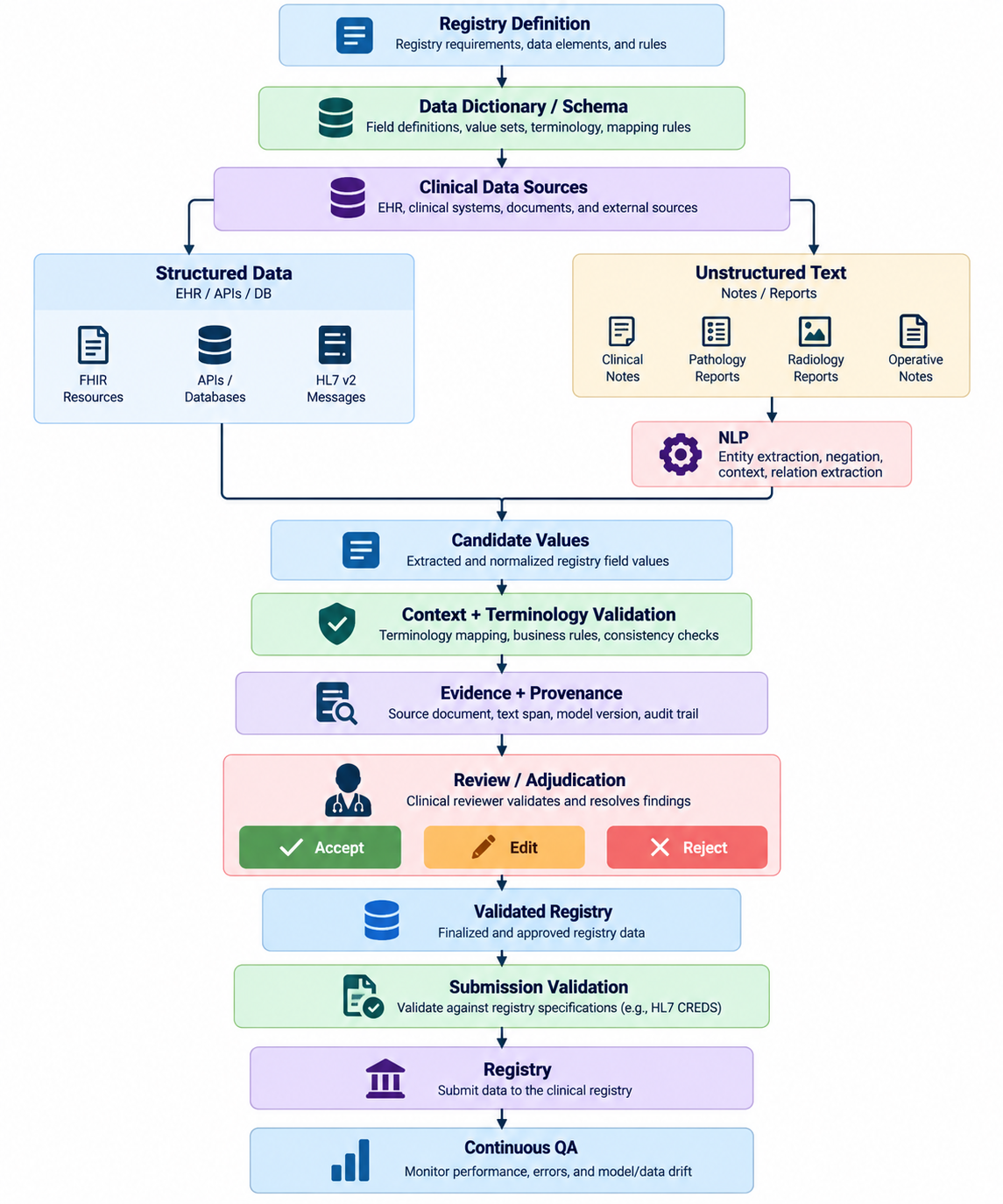
HL7’s Protocols for Clinical Registry Extraction and Data Submission (CREDS) provides a standards-based framework for defining registry data, mapping it to standardized artifacts, retrieving data from multiple sources, transforming it into registry submissions, and validating those submissions.
CREDS should not be interpreted as prescribing a particular NLP architecture. Instead, it provides the registry interoperability and submission framework around which an NLP layer can be implemented.
Step 1: Start With the Registry Data Dictionary
Do not start by selecting an NLP model. Start with the registry’s data requirements. For every registry element, define:
| Element | Example |
| Registry field | Laterality |
| Definition | Side associated with the primary tumor |
| Source | Pathology / operative documentation |
| Value set | Registry-approved terminology |
| Extraction method | NLP + rules |
| Validation | Terminology + consistency checks |
| Review requirement | Based on ambiguity/risk |
| Evidence | Source document + text span |
A registry data dictionary should contain the operational definition and coding instructions for each field.
AHRQ specifically recommends documenting abstraction and coding instructions in the registry data dictionary and emphasizes standardized definitions because natural-language ambiguity can cause different abstractors to extract different information from the same source.
HL7 CREDS takes a similar data-model approach. Its logical model represents data-element names, identifiers, types, terminology, and cardinality, and can map those elements to FHIR, CDA, and HL7 Version 2 artifacts.
Why this matters
A model can correctly identify: “right axillary lymph nodes”
but that does not automatically tell the registry which field should receive the value, which coding system applies, or whether the finding satisfies the registry’s definition.
The registry specification controls the interpretation.
Step 2: Map Each Registry Field to Its Data Sources
Registry information can originate from multiple systems. A source map might look like:
Registry Field
|
+—- FHIR Patient
+—- FHIR Condition
+—- FHIR Observation
+—- FHIR Procedure
+—- FHIR DiagnosticReport
+—- HL7 v2 messages
+—- CDA documents
+—- Pathology reports
+—- Operative notes
+—- Radiology reports
+—- Clinical notes
Use structured information where it is available and reliable. Use NLP where relevant information exists primarily in narrative documentation.
CREDS specifically addresses retrieving registry data from multiple sources and mapping registry logical-model elements to FHIR, CDA, and HL7 V2 artifacts.
This distinction prevents an organization from applying NLP unnecessarily to information that already exists as structured data.
Step 3: Build a Hybrid NLP Pipeline
A production system should not assume that one model should perform every task. A practical pipeline is:
Document Ingestion
|
Document / Section Classification
|
Clinical Sentence Segmentation
|
Entity Extraction
|
Negation + Temporality
|
Relation Extraction
|
Terminology Normalization
|
Registry Field Mapping
|
Candidate Registry Value
Different techniques can be used for different problems.
Rules and regular expressions
Useful for deterministic patterns such as:
- dates
- structured identifiers
- predictable measurements
Dictionaries and terminology matching
Useful when registry terminology is known and controlled.
Named entity recognition
Useful for identifying clinical concepts such as:
- diagnoses
- procedures
- anatomical sites
- findings
- medications
Relation extraction
Useful when the system must determine relationships such as:
Tumor → laterality → right
Tumor → site → breast
Node → status → positive
Context processing
Negation, temporality, uncertainty, section context, and historical information should be processed before a candidate value is considered registry-ready.
CDC’s current registry NLP implementation demonstrates the continued use of both dictionary-based and statistical NLP approaches rather than relying on one universal technique.
Step 4: Preserve the Evidence Behind Every Extracted Value
Do not store only:
nodal_status = positive
Store the evidence required to understand how the candidate value was generated. For example:
{
  "field": "nodal_status",
  "value": "positive",
  "source": "pathology_report_2026_08_14",
  "evidence_span": "2 of 14 right axillary lymph nodes are positive",
  "model_version": "registry-nlp-3.2",
  "status": "pending_review"
}
The exact schema will depend on the implementation. The important design principle is: Registry field → value → source → evidence → processing version → validation status
DeepPhe-CR provides a strong example of this computer-assisted approach. It was designed as an NLP service that integrates with cancer registry abstraction tools and workflows, allowing NLP-derived information to support registrars rather than operating as an isolated extraction system.
Evidence provenance also makes error investigation possible.
If a reviewer changes:
Laterality = Right
to:
Laterality = Left
the system should retain the source evidence and adjudication history rather than simply overwriting the original output.
Step 5: Detect Clinical NLP Failure Modes
A production registry NLP system needs explicit handling for common clinical-language failure modes.
Negation
“No evidence of metastatic disease.” Do not interpret the presence of the phrase “metastatic disease” as confirmation.
Historical information
“History of colon cancer.”
Determine whether the registry definition considers the historical condition relevant to the current case.
Family history
“Father had prostate cancer.”
Do not assign the family member’s diagnosis to the patient.
Uncertainty
“Findings are suspicious for malignancy.” Suspicion is not necessarily equivalent to a confirmed diagnosis.
Conditional statements
“If pathology confirms malignancy…”
The statement describes a condition, not necessarily a confirmed finding.
Multiple entities
“Left breast lesion and right axillary node.” The system must preserve the relationship between entities instead of collapsing them into a single finding.
Temporal context
“Prior biopsy in 2023 showed…”
A historical observation should not automatically become a current event.
Conflicting sources
Clinical Note: Left-sided lesion
Pathology: Right-sided lesion
The system should flag the discrepancy according to registry-specific rules rather than silently choosing one. These cases are precisely why extraction performance alone is not enough to establish registry-data quality.
Step 6: Add Deterministic Validation
After NLP generates candidate values, run validation rules before final registry submission.
1. Terminology validation
Confirm that the extracted code or value belongs to the registry-approved value set.
2. Structural validation
Check:
- required fields
- data types
- cardinality
- valid formats
3. Temporal validation
Check relationships between relevant dates.
Diagnosis Date <= Treatment Date
This is only an illustrative rule. The actual relationship must come from the registry specification.
4. Cross-field validation
Detect contradictions.
Laterality = Right
Primary Site = Left-sided structure
The system should flag the case rather than automatically changing either value.
5. Registry submission validation
CREDS explicitly defines a Validate Registry Submission transaction in which the Registry Submission Consumer validates a registry submission. The CREDS architecture also permits automatic and/or manual validation according to organizational policy.
That creates an important distinction:
NLP validation ≠ registry submission validation.
Both may be required.
Step 7: Build a Clinical Reference Standard Before Measuring the Model
A model cannot be meaningfully evaluated without a trustworthy reference standard. Create a representative dataset containing the document types and clinical variation expected in production. Then establish reference abstractions using trained reviewers and documented registry definitions. A strong process is:
Sample Records
|
Abstraction Guidelines
|
Independent Review
|
Disagreement Resolution
|
Adjudicated Reference Set
|
Train / Development / Test Sets
|
Model Evaluation
AHRQ recommends standardized training, test charts, inter-rater reliability, and re-abstraction as part of registry data-quality processes.
DeepPhe-CR similarly used established registry abstraction workflows and validation processes to develop its NLP services.
The reference standard should be representative of the intended production environment rather than consisting only of clean, easily classified examples.
Step 8: Measure More Than Overall Accuracy
A production evaluation should include multiple dimensions.
NLP-level metrics
Depending on the task:
- Precision
- Recall/sensitivity
- Specificity
- F1 score
- Positive predictive value
- Negative predictive value
Registry-level evaluation
Measure:
- Field-level agreement
- Patient-level agreement
- Record-level completeness
- Error rate
- Manual correction rate
Human abstraction quality
Measure:
- Inter-rater agreement
- Intra-rater agreement where appropriate
- Adjudication rate
External validation
Test the system on data outside the development environment where feasible, such as:
- another facility
- another laboratory
- another documentation template
- another time period
- another patient population
The reason is simple: an NLP model can perform well on its development distribution and behave differently when clinical documentation changes.
The 2026 literature on NLP for clinical-registry population continues to identify generalizability and variation in clinical text and registry data elements as important challenges.
Step 9: Do Not Treat Model Confidence as Proof of Correctness
A model might return:
{
  "value": "positive",
  "confidence": 0.94
}
That number should not automatically be interpreted as: “There is a 94% probability that the registry value is correct.” Model confidence and calibrated probability are not interchangeable.
If confidence thresholds are used to determine whether a case is automatically processed or routed to review, those thresholds should be evaluated against held-out clinical data and calibrated where appropriate.
A safer routing architecture is:
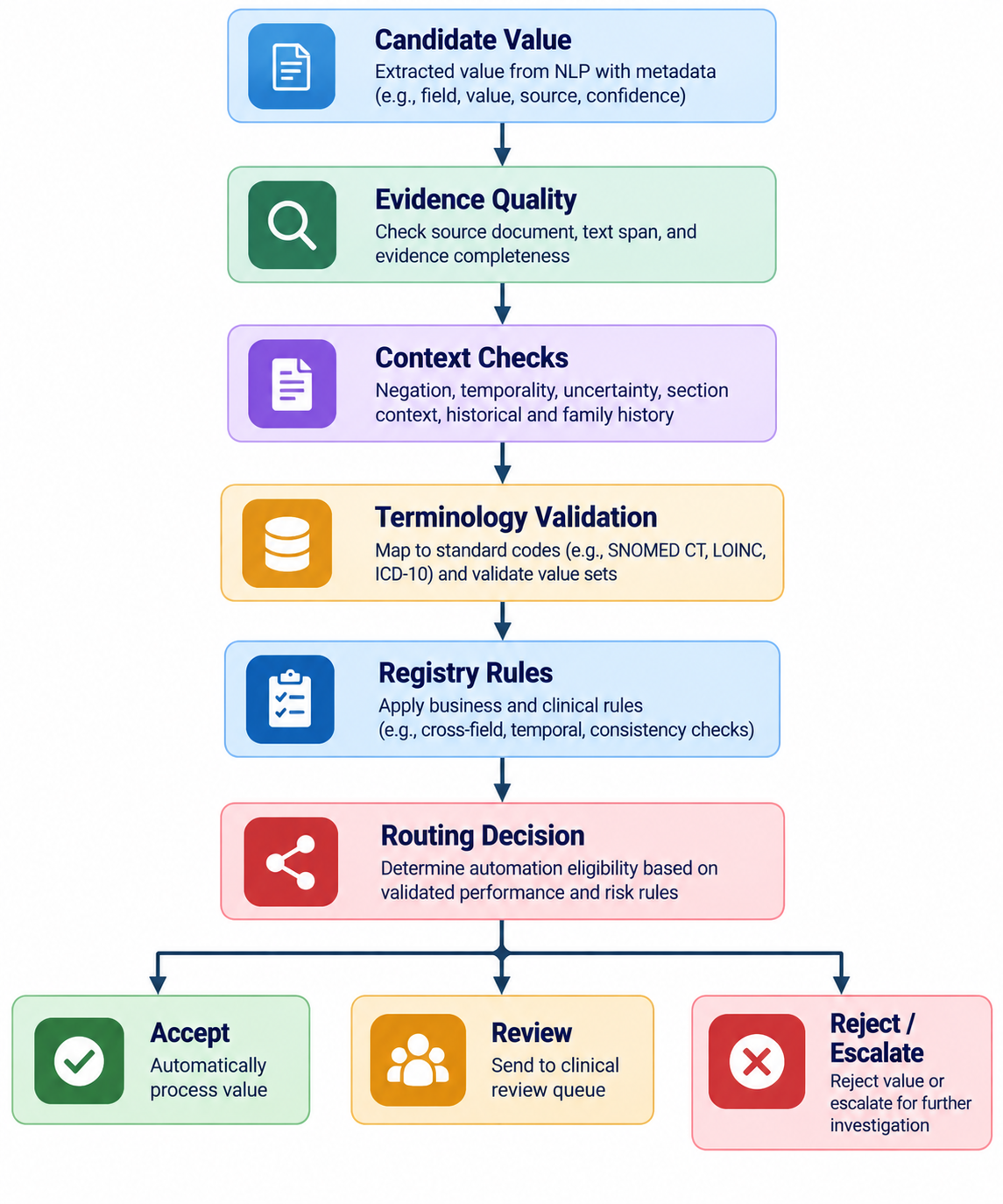
The automation threshold should therefore be based on validated system performance and registry-specific risk, not a raw model score alone.
Step 10: Preserve Clinical Adjudication
The clinical reviewer should be able to:
- See the candidate value.
- Open the supporting source.
- See the evidence span.
- Accept the value.
- Correct the value.
- Reject the value.
- Record an adjudication reason.
- Escalate unresolved cases.
A useful status model is:
CANDIDATE
|
+–> AUTO-PROCESS
|
+–> CLINICAL REVIEW
|
+–> DATA CONFLICT
|
+–> INSUFFICIENT EVIDENCE
|
+–> REJECTED
The exact routing rules should be determined by the registry, clinical domain, validated system performance, and organizational policy.
The CDC’s current eMaRC Plus implementation is a useful real-world example because its automated decisions can be overridden by users.
This is the difference between automation that assists abstraction and automation that silently determines the registry record.
Step 11: Validate the End-to-End Registry Pipeline
NLP testing is only one part of production validation. HL7 CREDS includes a test plan covering:
- unit testing
- integration testing
- logical-model creation
- mapping validation
- data retrieval
- submission Bundle creation
- submission testing.
A complete implementation should therefore test:
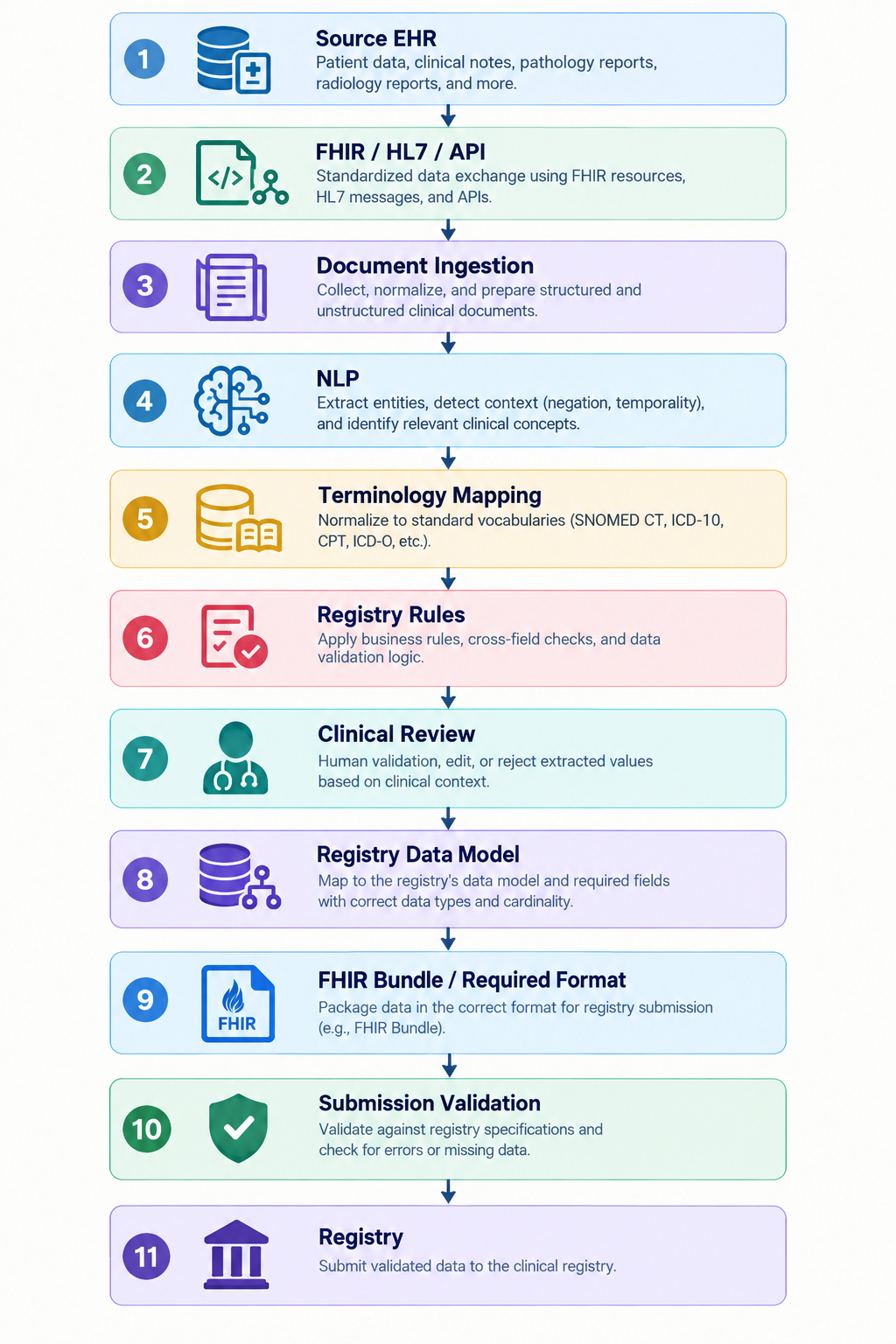
Testing only the NLP model leaves integration and transformation errors undetected.
Step 12: Monitor the System After Go-Live
Validation does not end when the model reaches production. Monitor:
- extraction performance
- review rates
- correction rates
- false-positive patterns
- false-negative patterns
- terminology changes
- document-template changes
- source-system changes
- registry-definition changes
- model versions
- rule versions
A production lifecycle can look like:
Production Data
|
Performance Monitoring
|
Error Analysis
|
Drift / Change Detection
|
Rule or Model Update
|
Regression Testing
|
Revalidation
|
Controlled Deployment
NIST’s AI Risk Management Framework organizes AI risk management around Govern, Map, Measure, and Manage and describes the framework as voluntary guidance for incorporating trustworthiness considerations across the AI lifecycle.
For registry NLP, that framework can be translated into ownership, intended-use definition, risk identification, performance measurement, controlled changes, and ongoing monitoring.
Conclusion
NLP can reduce the manual effort required to abstract clinical registry data, but the safest and most technically defensible architecture does not treat automated extraction as final clinical truth.
The stronger model is: Define → Extract → Map → Validate → Review → Submit → Monitor.
AHRQ establishes the importance of standardized registry definitions, training, reliability assessment, and re-abstraction. CDC demonstrates real-world NLP use in cancer-registry workflows, including automated extraction and user overrides.
HL7 CREDS provides a standards-based framework for defining registry information, retrieving data from multiple sources, transforming it into submissions, and validating those submissions. DeepPhe-CR demonstrates how NLP can be integrated into computer-assisted cancer-registry abstraction workflows. NIST provides a voluntary AI risk-management structure covering Govern, Map, Measure, and Manage.
The result is not an autonomous registry.
It is a traceable, validated, human-supervised abstraction pipeline that uses NLP to reduce repetitive work while preserving clinical review where it matters.
Build a Production-Ready Clinical Data and Registry Automation Pipeline
Moving from an NLP proof of concept to production requires more than extracting clinical terms. CapMinds can help healthcare organizations connect EHR and clinical data sources, implement HL7/FHIR interoperability, design data-mapping and validation workflows, and build production-grade healthcare data pipelines with the integration and governance considerations required for real-world deployment.