Payer-Provider Integration Services
Reduce Claim Denials & Speed Up Reimbursements With Payer-Provider Integration
Connect payers, providers, EHRs, and billing systems through FHIR APIs and X12 transactions to reduce manual follow-ups, improve transaction visibility, and support more timely reimbursement.






















Our Payer-Provider Integration Services
Connect the Information Behind Coverage, Care, and Payment
Advanced Capabilities
Engineer Payer Connections for Complex Operational Workflows
Cross-System Identity Alignment
Associate patients, members, subscribers, providers, and encounters using defined identifiers, with review paths for conflicting or incomplete records.
Payer-Specific Rule Configuration
Structure payer platform integration around shared logic and partner-specific codes, routing, companion guides, and documentation rules to simplify ongoing maintenance.
Authorization Workflow Orchestration
Coordinate requirements discovery, documentation tasks, submission, and responses while keeping human review and unresolved cases visible to the responsible team.
FHIR and EDI Coexistence
Connect API-based workflows with established X12 transactions where appropriate, preserving each exchange’s meaning, requirements, and operating responsibilities.
Transaction Lifecycle Tracking
Distinguish receipt, validation, acceptance, pending review, adjudication, and payment states so a successful transfer is not mistaken for a completed process.
Duplicate and Retry Controls
Use transaction identifiers, reconciliation checks, and controlled retry policies to avoid duplicate submissions while recovering from failed or delayed exchanges.
Provider Attribution and Access
Implement applicable treatment-relationship checks, provider attribution, patient choices, and access restrictions before exposing payer-held information through connected applications.
EFT and ERA Reconciliation
Associate payment and remittance information through available trace details, with investigation queues for unmatched deposits, adjustments, and posting discrepancies.
Operational Metrics and Audit Trails
Track transaction age, processing failures, unresolved exceptions, and support actions to help teams prioritize work and investigate recurring delays.
Endpoint and Transaction Readiness Testing
Test data contracts, security controls, realistic responses, and failure scenarios with each partner before introducing the connection into live operations.
Business Outcomes
Reduce the Work Between a Payer Response and the Next Action
Case Studies
We’ve successfully implemented a range of solutions. See how healthcare organizations
like yours achieved measurable results with CapMinds.

End-to-End RCM Automation for UiPath Using a Custom EMR
- 100% automation of standard RCM processes
- 50% faster claim turnaround
- Zero errors in claim formatting and submission

Westside Behavioral Care with a Custom EMR Platform
- Centralized EMR with consolidated patient data.
- 100% paperless onboarding process
- 90% automation in scheduling and documentation

UDS Reporting for Ventura County Health Care Agency (VCHCA)
- Automated processing of 100,000+ records
- FHIR validation and HRSA mock submission in 10 weeks
- 100% HRSA compliance
Still Chasing Payer Updates Across Portals and Spreadsheets?
Tell us where coverage checks, authorization requests, claim status, or remittance posting slows your team down. We’ll help identify the integration work needed to close those gaps.
Who Do We Serve?

Health plans and payer organizations

Medicare Advantage and Medicaid managed care organizations

Hospitals and health systems

Medical groups and multi-site provider networks

Specialty practices and ambulatory care organizations

FQHCs and community health centers

EHR and practice management vendors

Healthcare clearinghouses and transaction platforms

Revenue cycle and billing service organizations

Digital health and care coordination companies
Why Choose CapMinds as a Payer-Provider Integration Partner?
18+ Years in Healthcare Technology
Apply long-standing healthcare experience to workflow decisions, interoperability challenges, operational risks, and modernization planning.

Clinical and Financial Integration Expertise
Connect EHR data, coverage responses, authorizations, claims, and remittance workflows, understanding how each affects the next operational step.
API and EDI Engineering Together
Address FHIR APIs and X12 transactions within one technical scope, choosing the exchange method that fits the partner and workflow.
End-to-End Core Workflows Testing
Test eligibility, authorization, claims, provider data, and remittance flows to confirm each exchange supports the intended operational task.
100% In-Scope Interface Documentation
Receive mappings, connection specifications, and support runbooks for every agreed interface, helping internal teams maintain integrations with less vendor dependence.
24/7 Monitoring Options
Track agreed payer transactions continuously, with configured alerts and escalation paths that help teams identify failures before unresolved work accumulates.

What Our Clients Say
Hear from healthcare leaders who’ve transformed their operations with our services & solution.
What Makes CapMinds a Trusted Payer-Provider Integration Partner?
The same patient’s information may be correct in the EHR, incomplete in an authorization request, and mismatched on a claim. Fixing one interface alone may leave the surrounding process unchanged. Our healthcare payer integration consulting identifies those gaps before development. CapMinds then connects the surrounding workflows through application engineering and transaction mapping, with explicit data requirements, acceptance checks, and support responsibilities.

HIPAA
COMPLIANCE

ISO 9001:2015
CERTIFIED

GDPR
COMPLIANT
SOC 2 TYPE 2
CERTIFIED

HL7 FHIR
STANDARDS

SNOMED CT
COMPATIBLE

HITRUST
ALIGNED
Technology & Integration Experience
The APIs and Transactions Behind Connected Payer Operations
FHIR and Healthcare APIs

Prior Authorization Workflows

Eligibility and Claim Transactions

Remittance and Payment Data

Provider and Member Information

EHR and Revenue Cycle Systems

Connectivity and Integration Infrastructure

Make Payer Connectivity Part of Your Daily Workflow
Start with the transaction that creates the most repeated work. Our payer integration consulting defines data requirements, partner dependencies, and acceptance checks, then scopes delivery around a practical operational improvement.
- Connect payer APIs with EHR and billing workflows
- Automate supported eligibility and status exchanges
- Integrate authorization requests and responses
- Link claims with acknowledgments and follow-up tasks
- Bring remittance details into posting and reconciliation
Frequently Asked Questions
What are payer-provider integration services?
Payer-provider integration services connect clinical, administrative, and financial information between health plans, provider organizations, and their applications. Scope can include APIs, EHR connectivity, eligibility verification, prior authorization, claims, provider data, remittance, testing, and ongoing technical support.
Can eligibility verification run during scheduling or registration?
Yes, eligibility verification can run during scheduling or registration where the connected systems and payer service support that workflow. We can trigger eligibility requests and present available responses for staff review. An eligibility response does not guarantee payment; final reimbursement depends on the service, documentation, contract, and claim adjudication.
What is the difference between claim submission and payer data access?
Claim submission sends a request for adjudication, commonly through an X12 837 transaction. A payer data-access API exposes permitted existing information, such as claims and encounters, for an authorized use. Retrieving claim data through FHIR is not the same as submitting a claim for payment.
Will integration automatically approve authorization requests?
No. Integration can improve information exchange and workflow visibility, but the payer makes the determination. Some requests still require clinical review or additional documentation. We capture supported decision and status information so staff know whether approval, correction, or follow-up is needed.
Does the Provider Access API include remittance information?
Under CMS-0057-F, the Provider Access API shares specified claims, encounter, clinical, and prior authorization information with eligible providers. Provider remittances and enrollee cost-sharing information are excluded from its required claims/encounter dataset. Remittance integration is handled through the appropriate separate workflow.
Does provider data integration include credentialing?
Provider data integration exchanges and reconciles identifiers, locations, affiliations, and other agreed records. It can support a credentialing application’s data needs, but it does not itself complete primary-source verification, payer enrollment, or credentialing decisions. Those responsibilities must be scoped separately.
How long does payer-provider integration take?
A focused, single-payer connection, such as eligibility (270/271) or claim status, typically takes about 4 to 10 weeks. A mid-complexity project with multiple transactions, EHR workflow integration, or prior authorization takes roughly 3 to 6 months, while a multi-payer FHIR API program can take 6 to 12 months or more.
These are rough estimates, and the actual schedule depends on partner access, mapping complexity, test environments, and acceptance requirements. We define the first deliverable and dependencies before confirming milestones.
Can you provide ongoing integration support?
Yes. CapMinds can provide ongoing integration support. Support can include traffic monitoring, failed transaction investigation, mapping maintenance, credential updates, partner escalation, and release testing. Coverage hours, response expectations, and responsibilities across systems and vendors are defined in the support agreement.
Can you integrate with our existing EHR or billing system?
Yes, CapMinsd can integrate with the existing EHR or Billing system where the installed system exposes suitable interfaces or supports the required transactions. We assess the workflow, data access, payer connectivity, and receiving-system capabilities first. Some integrations also require clearinghouse participation, vendor coordination, or additional interface permissions.
Do FHIR APIs replace X12 claims and remittance transactions?
No. FHIR APIs and X12 transactions serve different purposes and often coexist. X12 remains the adopted standard for transactions such as eligibility, claims, and electronic remittance. FHIR can support relevant data-access and prior authorization use cases under applicable requirements.
Can you implement electronic prior authorization within our EHR?
We can integrate supported coverage requirements, documentation collection, submission, and response workflows. The approach depends on EHR functionality, payer endpoints, and applicable FHIR or X12 requirements. We also plan for unresolved cases and manual fallback paths where electronic processing cannot complete the workflow.
Can you support CMS-0057-F implementation work?
Yes. We can scope technical work against the requirements applicable to an impacted payer and its partners. CMS-0057-F includes provisions effective in 2026 and API requirements with compliance dates primarily in 2027. We verify the payer category, relevant dates, and current guidance during discovery.
Can you match electronic payments with remittance advice?
Yes, we can match electronic payments with remittance advice where the payment and ERA feeds provide suitable trace and claim information. We associate available EFT details with X12 835 remittance and support the billing system’s posting capabilities. Missing or conflicting references are routed for reconciliation rather than silently assigned.
Can you improve an existing payer connection?
Yes. We review mappings, request/response behavior, acknowledgments, access settings, companion-guide requirements, and unresolved exceptions. The engagement can target a specific failure or workflow bottleneck rather than replacing all current interfaces.
How much do payer-provider integration services cost?
An entry-level, single-payer integration typically costs roughly $20,000 to $50,000, a mid-complexity integration with several transactions and EHR workflow changes about $50,000 to $150,000, and a multi-payer FHIR and EDI program $150,000 to $400,000 or more. Ongoing support is commonly 15 to 20 percent of the build cost per year.
EHR vendor, clearinghouse, payer connectivity, infrastructure, and third-party fees may be separate, and a requirements review establishes the scope and relevant cost components. These are rough estimates. Costs depend on the connected systems, payer count, transactions, APIs, mapping, testing, and support scope.
How do we begin a payer-provider integration project?
Share the payer and provider systems, target workflow, transaction types, current bottlenecks, and any available interface documentation. De-identified samples and error reports help clarify scope. We then identify access requirements, delivery dependencies, and the next implementation steps.
Resources
Insights for Healthcare Technology Teams.
How to Build a Disconnected Environment System Using OpenEMR
For the past decade, enterprise healthcare IT operated on a single, unquestioned assumption: the cloud is always reachable. Multi-campus hospital networks, Management Services Organizations, and specialty medical […]
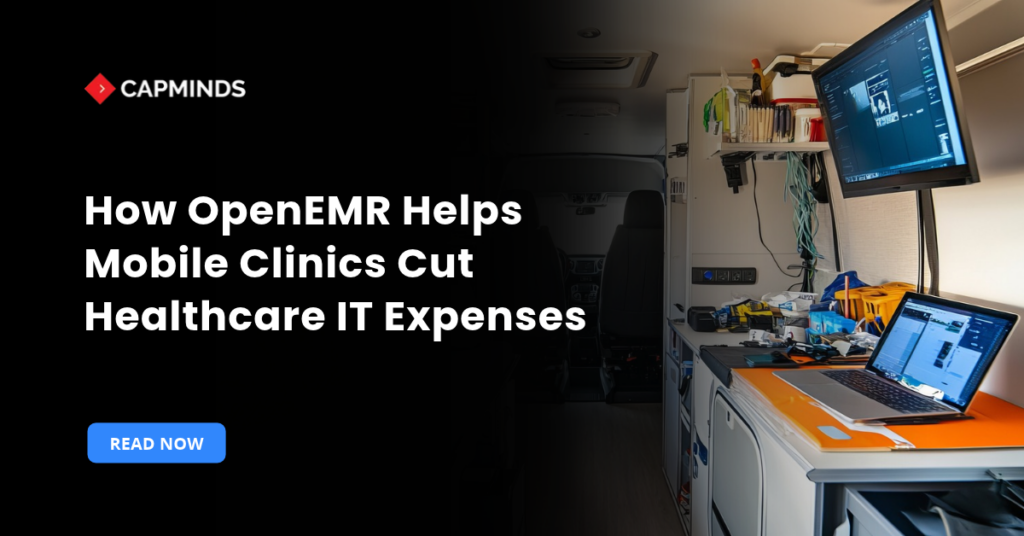
How OpenEMR Helps Mobile Clinics Cut Healthcare IT Expenses
More than 3,600 mobile clinics function in the United States and provide approximately 10 million health care visits annually. As they grow, they face healthcare IT costs, […]
OpenEMR Architecture Roadmap for Mid-Sized Healthcare Organizations
OpenEMR is an open-source EHR/PM system that is ONC-certified and widely used. It offers a web/mobile interface and provides core activities such as patient records, scheduling, prescriptions, […]