Healthcare AI Product Engineering Service
Turn Healthcare AI Prototypes into Production-Ready Products with Scalable Engineering
Advance your healthcare AI prototype with model engineering, EHR integration, and production monitoring to reduce launch rework, support growing demand, and deliver usable product features.



















Our Healthcare AI Product Engineering Services
Healthcare AI Engineering Services That Turn Product
Ideas Into Working Solutions
Advanced Capabilities
Make AI Behavior Inspectable, Testable, and Controllable
Traceable Inputs and Outputs
Associate model responses with available source references, prompt versions, and processing records while controlling sensitive information captured in operational logs.
Evidence-Aware Retrieval
Check whether cited passages support individual statements; a source link alone does not establish factual support or resolve conflicting information.
Structured Output Contracts
Validate schemas and required fields separately from factual accuracy, routing malformed responses and unsupported content through appropriate exception or review paths.
Bounded Tool Execution
Restrict agents to authorized tools and actions, with approval checks for consequential changes and records of attempted and completed operations.
Human Review by Workflow
Route drafts, exceptions, and consequential decisions to appropriate reviewers, preserving corrections and final ownership within the product experience.
Subgroup and Site Testing
Assess performance across relevant populations, input types, and deployment sites, accounting for data leakage and differences from the development environment.
Adversarial and Access Testing
Evaluate prompt injection, sensitive-data exposure, unauthorized retrieval, and tool misuse alongside conventional application security and tenant isolation controls.
Cost and Response Controls
Measure inference latency and cost per completed task, using appropriate routing, quotas, batching, and caching within the feature’s access boundaries.
Business Outcomes
Turn Model Performance Into Product and Operational Value
Case Studies
We’ve successfully implemented a range of solutions. See how healthcare organizations
like yours achieved measurable results with CapMinds.

End-to-End RCM Automation for UiPath Using a Custom EMR
- 100% automation of standard RCM processes
- 50% faster claim turnaround
- Zero errors in claim formatting and submission

Westside Behavioral Care with a Custom EMR Platform
- Centralized EMR with consolidated patient data.
- 100% paperless onboarding process
- 90% automation in scheduling and documentation

UDS Reporting for Ventura County Health Care Agency (VCHCA)
- Automated processing of 100,000+ records
- FHIR validation and HRSA mock submission in 10 weeks
- 100% HRSA compliance
What Is Holding Your Healthcare AI Project Back?
Share your product goal and current blocker. We’ll help identify the data, integration, and evaluation questions to address first.
Who Do We Serve?

Healthcare Software Vendors

Digital Health Startups

Hospitals and Health Systems

Physician Groups and Clinics

Health Plans and Payers

Telehealth and RPM Providers

Medical Device Manufacturers

Healthcare Analytics Companies

Life Sciences Organizations

Revenue Cycle Management Companies
Why Choose CapMinds as a Healthcare AI Product Development Company?
18+ Years in Healthcare Technology
Bring proven healthcare technology experience to complex decisions, workflows, risks, and long-term transformation goals confidently.

24/7 AI Service Monitoring
Monitor inference failures, response times, usage, and spending continuously, with configured alerts and escalation paths to help teams identify production issues sooner.
Defined Engineering Deliverables
Specify architecture, evaluation reports, API contracts, deployment configuration, and operational runbooks as engagement deliverables, with ownership and access terms established upfront.
Named Review Responsibilities
Identify which clinical, product, and regulatory reviewers participate, who supplies them, and who approves decisions that require expertise beyond technical testing.
Operations Planned With the Build
Establish monitoring, model-provider dependencies, incident ownership, update testing, and recovery procedures before the feature enters ongoing production use.
30-Day Post-Launch Optimization
Analyze production samples, reviewer corrections, and cost per accepted task during the first month, then prioritize fixes before expanding customer access.

What Our Clients Say
Hear from healthcare leaders who’ve transformed their operations with our services & solution.
What Makes CapMinds a Practical Healthcare AI Platform Development Partner?
CapMinds approaches healthcare AI as a product engineering engagement: a user task, working software, connected data, and a maintainable deployment. We bring model behavior together with application integration and operational requirements. Our AI-Powered Healthcare Product Development process uses demonstrations, test evidence, and agreed deliverables to review progress, with clinical and regulatory responsibilities identified for the proposed use.

HIPAA
COMPLIANCE

ISO 9001:2015
CERTIFIED

GDPR
COMPLIANT
SOC 2 TYPE 2
CERTIFIED

HL7 FHIR
STANDARDS

SNOMED CT
COMPATIBLE

HITRUST
ALIGNED
Technology & Integration Experience
Choose the AI Stack Around the Product Requirement
Model Development and Inference

Language, Retrieval, and Documents

Healthcare Data and Integration
Data Preparation and Storage

Application and Agent Engineering

Deployment and Operations

Security and Governance

Put a Practical Engineering Plan Behind Your Healthcare AI Product
Bring a product requirement, prototype, or production issue. We’ll help define a first deliverable, establish data and integration dependencies, and identify how to assess its performance. Start with the work needed to make the next development decision.
- Define the user action and intended output
- Assess data, model, and integration requirements
- Establish review points and failure behavior
- Agree on evaluation and release criteria
- Plan technical handover and production support
Frequently Asked Questions
What Types of Healthcare AI Projects Can CapMinds Help Us Build?
CapMinds can build a new healthcare AI product or platform, advance an existing prototype, integrate AI into your healthcare application, or improve a system already in production. Depending on your needs, the engagement can cover data pipelines, models, AI agents, application development, testing, deployment, and ongoing support. Your proposal defines the scope, deliverables, and responsibilities before development begins.
Should We Use a Commercial Model, Private Deployment, or Custom ML?
We compare feasible options against the task, available data, hosting constraints, model-provider terms, cost, and performance requirements. A conventional model or rules may be sufficient. Private deployment and fine-tuning are considered where justified; neither automatically improves accuracy, security, or economics.
Can the AI Capability Work Inside an EHR?
That depends on the EHR’s APIs, extension points, permissions, licensing, and vendor approval. We assess available read and write operations and the intended review experience. Patient association and destination behavior are tested before results or actions reach a live record.
How Do You Handle Uncertain Answers and Agent Actions?
We define when the product should ask for clarification, decline to answer, route work for review, or stop an action. Source support, tool permissions, and output checks are tested. Model confidence is not treated as proof of correctness, and consequential actions receive the controls required by the use case.
How Long Will the First Deliverable Take?
Timing depends on data access, labeling, model work, application dependencies, and evidence requirements. Discovery defines a first deliverable with acceptance criteria and external dependencies before milestones are confirmed. Prototype development, product integration, and any required clinical study or regulatory work are estimated separately.
Who Owns the Code, Data, and Model Artifacts?
Ownership, access, and usage rights are established in the engagement terms. Custom code, datasets, prompts, configurations, and model artifacts can have different conditions. Third-party models, open-weight licenses, and provider restrictions are identified so the handover does not imply rights the project cannot transfer.
What Does Healthcare AI Architecture Design Include?
Healthcare AI Architecture Design considers how models, data pipelines, application services, APIs, security controls, evaluation, deployment, and monitoring work together. The architecture is shaped by the product’s intended use, existing technology, data access, scale, and operating requirements rather than by model selection alone.
Can You Work With Our Existing Product and Engineering Team?
Yes. We assess the application architecture, development practices, APIs, deployment environment, and current backlog. Responsibilities can be divided between your team and CapMinds, with named owners for dependencies, code review, acceptance, and production changes. Existing components are retained where they fit the requirements.
Do We Need Patient Data Before Development Can Begin?
Discovery and some prototypes can use synthetic, de-identified, or non-patient reference data. Representative authorized data may be necessary for meaningful performance evaluation. Data rights, agreements, re-identification risks, retention, and model-provider usage terms are assessed before patient information enters training or inference pipelines.
How Will You Measure Accuracy and Business Value?
We establish reference standards and a baseline before testing. Measures depend on the task and can include critical errors, omissions, accepted outputs, complete handling time, subgroup performance, and total operating cost. Operational monitoring is supplemented with sampled expert review or later reference outcomes where available.
Who Provides Clinical Review, and Could FDA Requirements Apply?
The scope identifies whether clinical reviewers come from your organization, CapMinds, or an agreed specialist partner. Required expertise and decision ownership are established upfront. Intended use and software function inform regulatory assessment; technical acceptance and human review do not by themselves establish clinical validation or determine device status.
What Determines Development and Operating Cost?
Build effort depends on feature complexity, data preparation, integrations, testing, and deployment needs. Operating estimates include model usage, infrastructure, retrieval services, monitoring, human review, and maintenance. We assess cost per completed or accepted task, including failed attempts and exceptions, rather than token prices alone.
What Support Is Available After Launch?
Support can include pipeline failures, inference services, knowledge indexes, evaluation regressions, cost or latency changes, and controlled updates. Coverage hours, response expectations, provider dependencies, and rollback responsibilities are defined in the agreement. Performance assessments account for where reliable reference outcomes are available and where additional review is needed.
Resources
Insights for Healthcare Technology Teams.
How to Build a Disconnected Environment System Using OpenEMR
For the past decade, enterprise healthcare IT operated on a single, unquestioned assumption: the cloud is always reachable. Multi-campus hospital networks, Management Services Organizations, and specialty medical […]
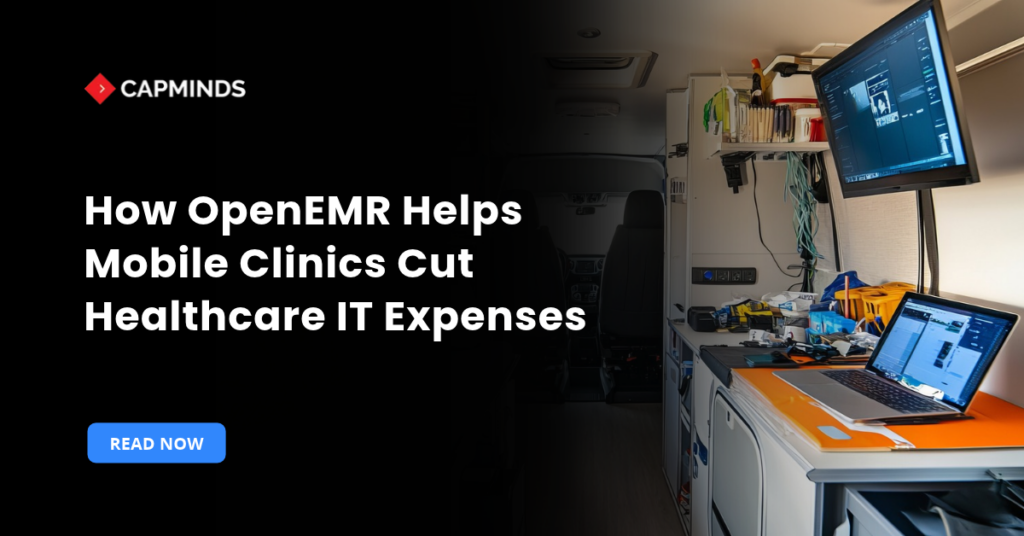
How OpenEMR Helps Mobile Clinics Cut Healthcare IT Expenses
More than 3,600 mobile clinics function in the United States and provide approximately 10 million health care visits annually. As they grow, they face healthcare IT costs, […]
OpenEMR Architecture Roadmap for Mid-Sized Healthcare Organizations
OpenEMR is an open-source EHR/PM system that is ONC-certified and widely used. It offers a web/mobile interface and provides core activities such as patient records, scheduling, prescriptions, […]