How To Build a Custom EHR Using Claude, Gemini, n8n & Whisper
If your healthcare company has an annual revenue of $10 million to $30 million, it is almost guaranteed that your present Electronic Health Record system is one of your top three operational costs, as well as your most problematic vendor relationship. You are paying for features you do not use. You are locked into upgrade cycles you did not choose. Your healthcare team loses 30-40 minutes every patient session due to documentation. And if your company expands, adds a new service line, a new location, or a new payer, your EHR vendor sends you a new invoice.
- $2M+ Average 5-year EHR licensing cost for a mid-market healthcare org
- 34% of physician time is spent on EHR documentation vs. patient care
- 62% of clinicians report EHR as a major contributor to burnout
- $400K Average annual per-physician EHR productivity loss
The main issue is that Epic, Cerner, athenahealth, and eClinicalWorks were designed for the ordinary healthcare organization, therefore, they don’t fit everyone completely. You’ve been bending your clinical procedures to fit your software, but the software should be adapting to fit you.
The good news? In 2025, for the first time in healthcare IT history, building a custom EHR is no longer a $10M–$20M multi-year enterprise software project.
With Claude, Gemini, n8n, and Whisper, a healthcare organization with the right implementation partner can have a fully functional, HIPAA-compliant, FHIR-ready custom EHR in production for a fraction of that cost and own it forever.
Why Now? The AI Inflection Point in Healthcare
Healthcare AI is not a future trend. It is the current operating reality for organizations that want to win. The convergence of four forces has made 2025 the ideal window to build your custom EHR:
- Large Language Models are clinically capable. Claude 3.5 and Gemini 1.5 Pro can create clinical documentation, extract ICD-10 codes, summarize patient histories, and write discharge instructions with near-clinician quality. Before 2024, this capability did not exist at scale.
- No-code automation has matured.n8n now connects to over 400 healthcare-related systems, labs, pharmacies, insurers, patient portals, and billing platforms without requiring special integration code for each one.
- Voice-to-clinical-text is ready for use in production. Whisper (OpenAI) achieves more than 95% accuracy in clinical dictation, including specialty terminology, accented speech, and ambient conversation recording.
- FHIR R4 is now the federal standard. The 21st Century Cures Act requires every major health institution, payer, and lab to disclose FHIR APIs, making custom EHR integration far easier than it was five years ago.
- Cloud-native infrastructure is both inexpensive and compliant.AWS HealthLake, Google Cloud Healthcare API, and Azure Health Data Services offer HIPAA BAA-compliant, HL7-native infrastructure at prices that make a custom build economically feasible.
Meet Your Build Team: Claude, Gemini, n8n & Whisper
Each of the four AI tools in this stack serves a unique and essential purpose in your personalized EHR. Understanding what each accomplishes and why it was picked over alternatives is critical before you begin.
Claude (Anthropic)
Claude serves as the primary clinical AI brain of your EHR. It drafts SOAP notes from voice transcripts, generates prior authorization letters, summarizes patient charts for handoffs, writes care plans, extracts structured data from unstructured clinical text, and powers the AI assistant that your clinicians interact with daily. Claude’s constitutional AI design makes it uniquely well-suited to healthcare, it is trained to be honest, refuse fabrications, and cite uncertainty.
Gemini (Google)
Gemini’s 1M-token context window and multimodal capacity make it ideal for evaluating extensive patient records, digesting medical imaging reports, reading lab PDFs, and enabling the EHR’s intelligent search.
When a doctor requests “show me all diabetic patients over 60 with an A1C above 8 who haven’t had a foot exam this year,” Gemini converts the natural language into structured searches across your database.
n8n
n8n is the nervous system connecting every component of your EHR to the external world. Lab results are flowing in from Quest and LabCorp. Insurance eligibility checks are firing automatically at check-in. Appointment reminders triggering via SMS. Prescription refill requests routing to pharmacy.
Claims submitted to payers. CCD documents exchanging with referral networks. n8n handles all of this without brittle point-to-point integrations.
Whisper (OpenAI)
Whisper transforms your EHR from a documentation burden into an invisible system. Clinicians speak naturally during the patient encounter. Whisper transcribes in real time, capturing medical language, medicine names, and procedure codes with 95%+ accuracy.
Claude then converts the transcript into a comprehensive SOAP note that is pre-filled into the EHR and ready for the physician to examine and sign. The average documentation time is reduced from 15 minutes to around 3 minutes per interaction.
What a Mandate-Grade EHR Must Include
Before you write any code, you must first determine what is non-negotiable.
A custom EHR that cannot acquire meaningful use certification, pass a HIPAA audit, or interchange data with the rest of the healthcare ecosystem is not a true EHR; rather, it is a costly problem. Here’s the entire necessary feature set:
Clinical Core (Must-Have)
- Patient demographics and registration include the Master Patient Index, insurance coverage, emergency contact information, and consent management.
- Clinical documentation includes SOAP notes, history and physical, progress notes, procedure notes, discharge summaries, and care plans.
- Problem List and Diagnosis Management: ICD-10-CM coded diagnoses, chronic condition monitoring, and differential diagnosis assistance.
- Medication Management: NCPDP SCRIPT e-prescription, medication interaction check, formulary verification, and DEA-compliant controlled substance prescribing
- Order management includes lab, radiology, referral, and procedure orders, all with clinical decision support.
- Results Management includes lab results ingestion (HL7 2.x), aberrant flagging, provider alerting procedures, and result acknowledgment tracking.
- Vital Signs and Flowsheets: Time-series vitals, growth charts, and personalized flowsheets for specialty care.
- Immunization Registry: VXu HL7 messaging, IIS integration, and CDC immunization schedule compliance.
- Allergy and Adverse Reaction Tracking includes allergen coding (SNOMED/NDF-RT), severity classification, and clinical decision support alerts.
- Preventive care and population health include identifying care gaps, tracking quality measures (HEDIS, UDS), and managing registries.
Administrative & Operational
- Scheduling includes multi-provider, multi-location appointments, waitlist management, and online patient self-scheduling.
- Revenue Cycle Management (RCM) includes insurance eligibility verification, charge capture, CPT/ICD-10 coding help, claim submission (837P/837I), ERA/EOB processing (835), and denial management.
- Patient Portal includes secure communications, visit summaries, lab results, medicine refill requests, appointment requests, and health questionnaires.
- Referral Management: tracking outbound referrals, exchanging C-CDA documents, communicating with specialists, and closing the loop.
- Reporting and analytics include UDS reports (for FQHCs), MIPS/MACRA quality reporting, customized operational dashboards, and payer-specific reporting.
Compliance & Interoperability (Federal Mandates)
- FHIR R4 API is 21st Century Cures Act compliant, uses SMART FHIR permission, and has patient data access endpoints.
- HL7 Messaging v2.x supports ADT, ORM, ORU, MDM, and SIU messages for legacy system integration.
- C-CDA Document Generation: Continuing Care Documents for care transitions, referrals, and patient requests.
- HIPAA technical safeguards include AES-256 encryption at rest and in transit, audit logging, access controls, session management, and multi-factor authentication.
- ONC Health IT Certification (optional): 2015 Edition. Cure updates certification for Meaningful Use attestation.
- Information Blocking Compliance: ONC Information Blocking Rules, patient access rights, and verified API access.
Phase 1 — Ideation: From Pain to Product Vision
The most costly mistake in bespoke EHR development is to construct the wrong item too quickly. Before your team produces a single line of code, you need a 30-day ideation process that turns clinical pain into product specifications.
The Five Ideation Questions Every Healthcare Executive Must Answer
- What does your current EHR do that no one uses? Survey your clinical staff. In our experience, 40–60% of EHR features are never touched. Building a custom system means you build what matters, nothing else.
- Where does your workflow break down most frequently? Map the patient journey from scheduling to discharge to billing. Every friction point is a development requirement. Every workaround your staff has created is a design clue.
- What data does your organization need that you currently cannot access? Most mid-market health systems sit on gold mines of clinical data they cannot query. Your custom EHR should be designed for insight from day one.
- Which integrations are necessary and which are optional? List all of the external systems to which your EHR must link. Rank them by clinical and operational impact. The top 10 are your MVP integration scope.
What does “done” look like after 90 days, 6 months, and 2 years?
A custom EHR is not a time-limited endeavor. It’s an evolving platform. Define success milestones before you start, so that every sprint has a distinct north star.
The Idea Output: A 20-30-page Product Requirement: A document containing workflow maps, data model sketches, integration needs, compliance requirements, and a prioritized product backlog. This document serves as the foundation for the rest of your project. Do not ignore it. Do not rush anything.
How Claude Accelerates Ideation
This is where Claude pays for itself before the first line of code is written. Upload your current EHR vendor contract, your clinical workflow documentation, and your staff survey results. Ask Claude to identify the gaps, generate user stories, draft your PRD structure, and create a prioritized feature matrix. What would take a business analyst 6–8 weeks takes 3–5 days with Claude as a collaborative thinking partner.
Phase 2 — Roadmap: The 12-Week Blueprint
Here is the exact week-by-week roadmap we use to take a healthcare organization from zero to a go-live-ready custom EHR in 12–16 weeks. This is based on real delivery timelines, not theoretical estimates.
Weeks 1–2 Discovery & PRD Finalization
Clinical workflow mapping sessions with department leads. Current EHR audit. Integration inventory. HIPAA gap analysis. User persona definition. PRD drafting with Claude. Technical architecture decisions.2
Weeks 3–4 UX Design & Clinical Validation
Wireframing of all core screens. High-fidelity mockups for patient chart, scheduling, and documentation. Clinical staff usability testing. Design system creation. Gemini-powered search UX design. Whisper ambient documentation flow design.3
Weeks 5–7 Core Build — Clinical Foundation
Database schema build (FHIR-aligned data model). Patient demographics module. Scheduling engine. Encounter documentation with Whisper + Claude integration. Problem list, medication list, allergy list. Vital signs and flowsheets. Role-based access control.
Weeks 8–10 Integrations & Administrative Build
n8n integration layer deployment. Lab interfaces (HL7 v2 → FHIR). eRx integration (Surescripts or DrFirst). Insurance eligibility (Availity or Change Healthcare). Claims submission (837P). Patient portal build. FHIR R4 API surface. Immunization registry connection.
Weeks 11–12 QA, Security Audit & Go-Live Prep
HIPAA technical safeguard audit. Penetration testing. Performance load testing. Clinical validation with physician champions. Staff training program execution. Data migration from legacy EHR. Go-live cutover plan. Hypercare support protocol.
Which integrations are necessary and which are optional? List all of the external systems to which your EHR must link. FQHCs with UDS reporting requirements typically require 2–3 additional weeks for reporting module validation.
Phase 3 — Design: UX That Clinicians Actually Use
The single most common reason custom EHR projects fail is not technical; it is clinical adoption. A system that clinicians refuse to use because it slows them down is worse than no system at all. EHR design must be driven by clinician behavior, not software conventions.
The 7 Principles of Clinical UX That Actually Work
| Principle | What It Means in Practice | How AI Enables It |
| Clicks matter enormously | Every additional click in a clinical workflow costs 3–5 seconds. Across 20 patients a day, that is 3–5 hours of lost clinical time per physician per week. | Claude pre-fills documentation based on prior encounters and voice transcript |
| Context switching kills efficiency | Clinicians should never leave the patient chart to complete a task. Ordering, prescribing, messaging, and documenting happen in one view. | Gemini surfaces relevant information in context without requiring a separate search |
| The chart is the product | Every clinician interaction should contribute to a richer patient chart. Design for completeness as a byproduct of normal workflow. | Whisper captures ambient conversation, and Claude structures it into the chart automatically |
| Alert fatigue kills safety | Clinicians override 90%+ of drug interaction alerts because there are too many. Alert design must be ruthlessly prioritized to critical-only. | Claude’s clinical reasoning can stratify alert severity more accurately than rule-based systems |
| Mobile is not optional | Physicians round with iPads. NPs take mobile notes. The EHR must work on every screen size without sacrificing functionality. | Responsive design with voice input makes mobile documentation as powerful as desktop |
| Specialty matters | A pediatric encounter looks nothing like an OB visit or a behavioral health session. Specialty-specific templates and workflows are not optional for a clinical tool. | Claude generates specialty-specific documentation templates on demand |
| Patients are users too | The patient portal is part of your EHR product. Patient engagement directly impacts quality scores, HEDIS metrics, and revenue. | Gemini powers natural language patient queries; Claude drafts patient-friendly summaries |
Phase 4 — Technical Architecture & HIPAA Compliance
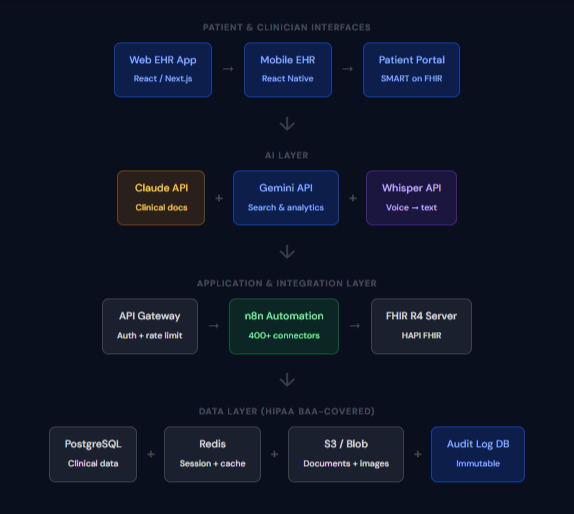
The technical architecture of a custom EHR is where most healthcare IT teams get lost. Here is the complete, production-tested architecture we use for every custom EHR build.
The Reference Architecture

HIPAA Technical Safeguard Checklist
- All PHI saved in databases, file storage, and backups is encrypted at rest using AES-256.
- All API requests and web traffic must be encrypted in transit with TLS 1.3 or higher. There is no HTTP authorization.
- Access controls: RBAC based on the principle of least privilege. Definitions of the roles of physician, nurse practitioner, medical assistant, front desk, billing, and administration.
- Multi-factor authentication: TOTP or hardware key MFA required for all clinical user accounts
- Audit logging: Immutable, tamper-evident logs of every PHI access, modification, and export event
- Automatic logoff: Session timeout after configurable inactivity period (typically 15 minutes in clinical settings)
- Emergency access procedure: Break-glass mechanism for emergency care with full audit trail
- Backup and disaster recovery: Daily encrypted backups, 15-minute RPO, 4-hour RTO, tested quarterly
- BAA coverage for all AI APIs: Anthropic, Google, and OpenAI all offer HIPAA Business Associate Agreements. These must be executed before any PHI is processed.
- Penetration testing: Annual third-party pen test minimum; quarterly automated vulnerability scanning
FHIR R4 Data Model Strategy
Your custom EHR database should be built on a FHIR-aligned data model from day one, not retrofitted. The core FHIR resources you will implement include: Patient, Practitioner, Organization, Encounter, Condition, MedicationRequest, Observation, DiagnosticReport, Immunization, AllergyIntolerance, DocumentReference, CarePlan, Appointment, Schedule, and Claim. Using HAPI FHIR Server as your open-source FHIR foundation reduces implementation time by 4–6 weeks compared to building FHIR compliance from scratch.
Phase 5 — The Build: How Each AI Tool Powers the System
Claude: The Clinical Documentation Engine
The most transformative capability Claude brings to your EHR is ambient clinical documentation. Here is exactly how it works in production:
Ambient Documentation: From Conversation to Signed Note
- Clinician taps “Start Encounter” in the EHR. Whisper begins ambient audio capture (with patient consent).
- Whisper transcribes the 10–15 minute clinical conversation in real time, achieving 95%+ accuracy on medical terminology.
- The transcript is pseudonymized (patient identifiers replaced with tokens) before being sent to the Claude API via a HIPAA-compliant proxy.
- Claude analyzes the transcript and generates a structured SOAP note — Subjective, Objective, Assessment, Plan: pre-filled with coded diagnoses (ICD-10), medication changes, and follow-up orders.
- The structured note appears in the EHR, ready for clinician review. The clinician reviews, edits if needed, and signs. Total time: under 3 minutes.
- n8n automatically routes any new orders (labs, referrals, prescriptions) to the appropriate downstream systems.
In our FQHC client deployment, ambient documentation with Whisper + Claude reduced per-encounter documentation time from an average of 14.2 minutes to 2.8 minutes, a reduction of 80%. Across 150 daily encounters, that is 27 hours of physician and NP time recovered every single day.
Gemini: Clinical Intelligence & Population Health
Gemini’s role in your custom EHR goes far beyond search. Its 1-million-token context window enables capabilities that simply do not exist in any commercial EHR today:
- Full chart summarization: “Summarize Mrs. Johnson’s last 3 years of care in 5 bullet points before I enter the room.” Gemini reads the entire chart history and produces a clinically accurate brief.
- Natural language population queries: “Show me all patients over 65 with CHF who have not had a BNP in 6 months.” Gemini translates this into a structured database query and returns results in seconds.
- Lab trend analysis: Gemini analyzes years of lab results to surface trends, a rising creatinine that has not yet crossed the abnormal threshold, and a pattern of intermittent hyperglycemia that precedes formal diabetes diagnosis.
- Imaging report extraction: Gemini reads radiology reports and extracts structured findings, critical findings are flagged for immediate provider notification.
n8n: The Integration Brain
n8n is the operational backbone that makes your EHR function as a connected system rather than a clinical island. Here are the 12 most critical n8n workflows in every custom EHR we build:
| Workflow | Trigger | Connected Systems | Business Impact |
| Insurance Eligibility Check | Appointment booked | Availity, Change Healthcare | Eliminates day-of eligibility surprises |
| Lab Result Ingestion | HL7 ORU message received | Quest, LabCorp, in-house lab | Instant provider notification; auto-charts result |
| Appointment Reminders | 24h + 2h before appointment | Twilio (SMS), SendGrid (email) | Reduces no-show rate by 25–35% |
| Prior Authorization | Medication or procedure ordered | Payer portals, Claude (letter draft) | Reduces PA denial rate; saves 45 min per PA |
| Claims Submission | Encounter signed | Clearing house (Availity/Change) | Same-day claims submission; faster cash flow |
| Referral Tracking | Referral order created | Specialist EHR, fax, Direct messaging | Closes referral loop; quality measure compliance |
| Patient Portal Sync | Any chart update | Patient portal app | Real-time patient access; information blocking compliance |
| Immunization Registry Report | Immunization administered | State IIS (SOAP/HL7) | Automatic VXu submission; no manual reporting |
| Care Gap Alerts | Nightly population scan | Internal analytics, EHR | Proactive outreach; HEDIS gap closure |
| Prescription Monitoring Check | Controlled substance prescribed | State PDMP | PDMP compliance automation; prescriber safety |
| Critical Lab Alert | Abnormal result flagged | Provider mobile, EHR inbox | Patient safety; liability reduction |
| UDS Report Generation | Monthly/quarterly trigger | HRSA, internal database | FQHC compliance automation eliminates manual reporting |
Phase 6 — Go-Live: Training, Migration & Cutover
The go-live phase is where the most well-built EHR projects fail. Not because the software does not work, but because the human and operational elements were not prepared. Here is how to get it right.
Data Migration Strategy
Migrating from a legacy EHR to a custom system requires a disciplined data migration strategy. The approach we use follows three tracks:
Active Patient Records — Full Migration
All patients seen within the last 36 months are fully migrated, with demographics, problem lists, medication lists, allergy lists, immunization records, and the last 12 months of encounters. This data is transformed to your FHIR R4 data model and validated against source records by a clinical team before go-live.
Historical Records — Archive Access
Records older than 36 months are archived in a read-only legacy viewer accessible from within the new EHR. Clinicians can pull historical records on demand without the operational cost of migrating data that is rarely accessed.
New Patients & Encounters — Native
All new patients and all encounters after the go-live date are natively created in the custom EHR. The legacy system runs in read-only mode for 90 days post-go-live before decommissioning.
Training Protocol
Staff training is not a one-time event, it is a 90-day program with three phases. Role-based training (physicians vs. MAs vs. front desk), a 2-week parallel run where staff use both old and new systems, and a 30-day hypercare period with on-site support available.
The Whisper ambient documentation feature requires a 2-hour dedicated training session with each clinical user, but once mastered, it is the feature that most powerfully drives adoption.
Real Case Study: Our FQHC Client
Client Profile: Federally Qualified Health Center (FQHC) · 4 locations · 18,000 active patients · $14M annual revenue · Previously on a legacy EHR (name withheld per NDA) · Paying $380,000/year in EHR licensing
The Problem
Our FQHC client was trapped in a three-year contract renewal cycle with their legacy EHR vendor. The system had not received meaningful UDS reporting updates in two years. Their clinical staff spent an average of 2.3 additional hours per day on documentation tasks beyond what was clinically necessary. Their patient portal had less than 8% active enrollment. They were unable to export their own clinical data in FHIR format, an information blocking concern that created federal compliance risk.
“We were paying $380,000 a year for software our physicians described as ‘the enemy.’ Three physicians had cited the EHR as a factor in their resignation. We knew something had to change, we just did not think building our own was an option until we saw what AI could do.”
Chief Medical Officer, FQHC Client (name withheld per NDA)
The Build
We completed the full custom EHR build in 16 weeks, including all UDS reporting requirements specific to FQHC operations. The system was built on a FHIR R4 data model, integrated with Quest and LabCorp via HL7 v2.x, connected to Surescripts for eRx, and deployed on AWS with a fully executed HIPAA BAA.
The Results (12-Month Post Go-Live)
- $1.9M 5-year EHR cost savings vs. legacy contract renewal
- 80% Reduction in per-encounter documentation time (14 min → 2.8 min)
- 38% Increase in patient portal enrollment (8% → 46%)
- 0 Physician resignations citing EHR as a factor in 12 months post-launch
By recovering 27 physician-hours per day previously lost to documentation, the FQHC increased daily patient capacity by 22 encounters, adding an estimated $680,000 in annual revenue at its average reimbursement rate without hiring a single additional clinician.
Internal ROI analysis, 12-month post-implementation review
ROI Calculator & Cost Comparison
Let’s run the math for a representative mid-market healthcare organization: $15M revenue, 12 physicians/NPs, 3 locations, 25,000 active patients.
| Cost Category | Legacy EHR (5 years) | Custom EHR (5 years) | Difference |
| Base licensing / build cost | $1,800,000 | $580,000 | -$1,220,000 |
| Implementation & training | $240,000 | $0 (included) | -$240,000 |
| Annual support & maintenance | $180,000/yr → $900,000 | $60,000/yr → $300,000 | -$600,000 |
| Customization & add-on modules | $350,000 | $0 (built to spec) | -$350,000 |
| Documentation time cost (12 physicians @ $150/hr) | $2,340,000 | $468,000 | -$1,872,000 |
| Revenue from recovered capacity | $0 | +$1,200,000 | +$1,200,000 |
| 5-Year Total | $5,630,000 | $1,148,000 | Save $4.48M |
Estimates based on aggregate client data. Actual results vary by organization size, specialty mix, and current EHR contract terms. Documentation time savings calculated at 80% reduction per encounter x 20 encounters/day/physician x 250 clinical days/year. Revenue recovery assumes a 15% capacity increase at an average reimbursement of $200 per visit.
Ready to Build Your Custom EHR? CapMinds’ Digital Health Tech Services Are Here to Help
At CapMinds, we deliver end-to-end digital health technology services designed to transform how your organization operates, documents, and grows.
From custom EHR development to full-stack healthcare integrations, our expert team brings the clinical intelligence, compliance know-how, and technical depth your organization needs.
- Custom EHR development & implementation
- AI-powered clinical documentation (Claude + Whisper)
- FHIR R4 API & HL7 v2.x integration services
- Healthcare workflow automation with n8n
- HIPAA compliance & security audit services
- Revenue cycle management (RCM) solutions
- Patient portal development & engagement tools
- Population health & analytics services
- Telehealth & remote patient monitoring
- And more tailored digital health solutions
Stop bending your clinical workflows to fit off-the-shelf software.
Partner with CapMinds to build a fully compliant, AI-powered EHR that fits your organization and own it forever. Contact us today to schedule a free discovery consultation and see how much your organization could save.
Frequently Asked Questions
Is a custom EHR HIPAA compliant by default?
No, HIPAA compliance is not a property of software. It is a continuous practice. A custom EHR achieves HIPAA compliance through technical safeguards (encryption, access controls, audit logging), administrative safeguards (policies, training, risk analysis), and physical safeguards (data center security, device management). All three must be implemented and maintained. HIPAA Business Associate Agreements must also be executed with every third-party vendor that processes PHI, including AI API providers.
Can we achieve ONC Health IT Certification with a custom EHR?
Yes, but it is an optional and significant additional investment. ONC 2015 Edition Cures Update certification requires testing by an ONC-Authorized Testing Laboratory (ATL) and is required for Medicare/Medicaid Promoting Interoperability incentive payments. For organizations that need certification, we recommend building to the certification criteria from the start rather than retrofitting.
How does data migration work from Epic / athenahealth / eClinicalWorks?
All major EHR vendors are required by the 21st Century Cures Act to provide patient data access via FHIR R4 APIs. This means bulk data export in FHIR format is legally mandated, vendors cannot block it. We use this API for structured data migration (demographics, problem lists, medications, allergies, immunizations, lab results). Unstructured data (clinical notes) requires additional processing, which Claude handles with high accuracy.
What happens if Claude / Gemini / Whisper has an outage?
AI features are additive, never blocking. The EHR core (scheduling, documentation, prescribing, billing) functions fully without AI. When AI APIs are unavailable, clinicians revert to manual documentation workflows. Graceful degradation is a design requirement, not an afterthought.
How do you handle AI errors in clinical documentation?
Every AI-generated clinical document requires clinician review and signature before it becomes a finalized medical record. The AI generates a draft; the clinician owns the final. This workflow mirrors how voice-to-text systems have worked in radiology dictation for 20+ years. The legal and clinical responsibility remains with the licensed provider, AI accelerates, it does not replace clinical judgment.
What is the minimum organization size that makes a custom EHR economically viable?
Based on our client data, the economics favor a custom build for organizations with 5+ full-time clinical providers, $5M+ in annual revenue, and a minimum 3-year planning horizon. Below that threshold, a customized version of a mid-market EHR (DrChrono, Kareo, Jane App) with AI augmentation is often the better choice. Above $5M in revenue and 10+ providers, the ROI of a custom build becomes compelling within 18–24 months.
How do you keep the EHR current with regulatory changes?
Custom EHR maintenance includes a regulatory monitoring service that tracks CMS, ONC, DEA, and NCPDP rule changes that affect EHR requirements. Our standard support agreement includes regulatory updates as part of the annual maintenance fee, so your EHR stays compliant without requiring you to monitor the Federal Register.
Can the custom EHR connect to hospital EHRs for transitions of care?
Yes. C-CDA document exchange via Direct messaging (DirectTrust) and FHIR R4 APIs enables bidirectional clinical data exchange with hospital EHRs, specialist EMRs, and care coordination platforms. We have implemented connections to Epic, Cerner, and Meditech installations for transitions of care, referral management, and ADT notification workflows.