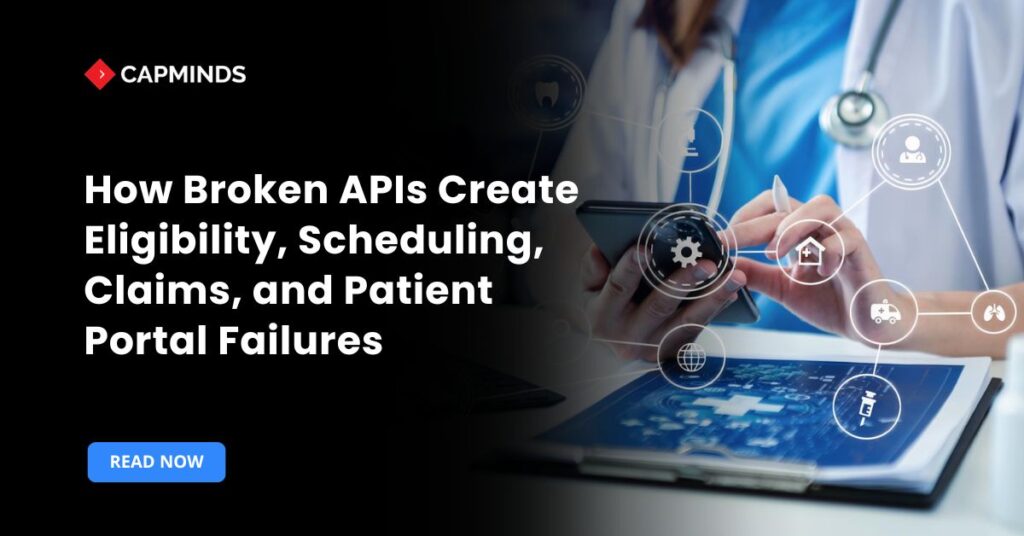
How Broken APIs Create Eligibility, Scheduling, Claims, and Patient Portal Failures
Your eligibility API returned a successful response. The appointment appeared in the scheduling application. A claim file was left in the billing system. The patient logged into the portal. So everything worked. Right? Not necessarily. A healthcare API can return an HTTP 200 response while sending an outdated insurance plan, exposing an unavailable appointment, dropping a claim acknowledgment, or showing incomplete patient information.
That is what makes healthcare API integration failures difficult to detect. The connection may be technically available while the business workflow behind it is already failing.
And the consequences rarely stay inside the integration engine. They surface as eligibility errors, scheduling conflicts, claim rejections, portal complaints, manual work queues, delayed reimbursement, and frustrated patients.
This guide explains how broken healthcare APIs create those failures, how to identify the root cause, and how mid-sized and large healthcare organizations can build a more reliable integration operating model.
Key Takeaways
- A successful API response does not prove that the underlying healthcare workflow was completed.
- Eligibility, scheduling, claims, and portal failures often originate from the same identity, mapping, synchronization, or monitoring defects.
- FHIR improves data standardization, but it does not eliminate local workflow rules, vendor-specific behavior, or legacy EDI dependencies.
- Endpoint uptime alone cannot reveal silent data loss or incorrect business outcomes.
- Healthcare API monitoring should measure completed workflows, reconciliation rates, data freshness, and downstream acceptance.
- Reliable integration requires technical controls, operational ownership, and business-level observability.
What Are Healthcare API Integration Failures?
Healthcare API integration failures occur when an API cannot reliably exchange, interpret, synchronize, or apply healthcare data across connected systems.
Some failures are obvious:
- The endpoint is unavailable.
- Authentication fails.
- A request times out.
- The server returns an error.
Others are silent:
- The response contains incomplete benefit information.
- A provider appears available when the slot is no longer bookable.
- The receiving system accepts a FHIR resource but cannot use it correctly.
- A claim is transmitted but never reaches payer adjudication.
- A portal displays an old medication, balance, or test result.
In other words, API availability is not the same as workflow reliability.
A reliable healthcare API integration must move the correct information, for the correct patient, at the correct time, into the correct downstream workflow.
Why API Reliability Matters More in 2026
Healthcare organizations are connecting more external applications, payer services, digital access tools, analytics platforms, AI systems, and patient engagement products to their core EHR environments.
Federal interoperability requirements are also expanding.
CMS requires affected payers to support additional Patient Access, Provider Access, Payer-to-Payer, and Prior Authorization API capabilities, with most API requirements under CMS-0057-F taking effect on January 1, 2027.
At the same time, API adoption does not automatically create end-to-end interoperability.
A February 2026 ASTP/ONC data brief found that approximately nine in ten US hospitals enabled patient access through an API in 2024. Seven in ten hospitals reported using standards-based APIs for that access.
However, ASTP/ONC also found that hospitals still relied heavily on non-standard methods when exchanging information with third-party technologies for clinical and administrative use cases.
The result? Healthcare organizations may have more APIs than ever, but they also have more dependencies to test, monitor, secure, and maintain.
How One Broken API Creates Multiple Operational Failures
Healthcare workflows are rarely powered by one API call. Consider a simplified patient access and revenue-cycle workflow:
Patient registration → insurance verification → appointment scheduling → clinical encounter → charge capture → claim submission → claim status → patient balance → portal update
Each step depends on data created or confirmed earlier. A patient identity mismatch during registration can cause the wrong coverage record to be queried.
An incomplete eligibility response can allow an appointment to proceed without recognizing that the service requires authorization.
An appointment interface can assign the wrong department or provider identifier. That error can then affect charge routing, claim creation, and portal display. The visible problem may appear in claims.
But the original defect may have occurred several systems earlier.
This is why integration teams should investigate healthcare system integration issues as connected workflow failures, not isolated interface tickets.
1. Broken APIs Create Eligibility Verification Failures
Eligibility verification normally begins with patient, subscriber, payer, plan, provider, and service-date information.
In traditional EDI workflows, providers submit an X12 270 eligibility inquiry and receive a 271 response.
FHIR-based workflows may use Coverage, CoverageEligibilityRequest, and CoverageEligibilityResponse resources, depending on the payer and implementation.
The workflow looks straightforward.
But eligibility data must pass through several layers:
Registration system → EHR or practice management system → integration layer → clearinghouse or payer → response mapping → staff workflow
A defect at any layer can produce a misleading result.
Common eligibility API failure patterns
Patient and subscriber mismatches
An API request may use the patient’s internal medical record number when the payer expects a subscriber identifier. Other requests fail because of differences in:
- Name formatting
- Date of birth
- Member ID
- Group number
- Dependent relationship
- Payer routing identifier
- Coverage effective date
The API may return “member not found,” even though coverage is active.
Incomplete benefit interpretation
An eligibility response may confirm active coverage without clearly communicating:
- Copayment
- Coinsurance
- Deductible status
- Service-specific benefits
- Network limitations
- Remaining visit limits
- Authorization requirements
Staff members then see “active” and assume the service is covered.
That assumption can produce patient estimate errors, authorization failures, and downstream denials.
Stale eligibility data
A cached response may be reused after coverage has changed.
This often happens when organizations do not define how long eligibility responses remain valid or when reverification should occur.
A check performed during appointment creation may no longer be reliable on the date of service.
Payer-specific response differences
Two payers may use the same standard but populate benefits, messages, and error codes differently.
Without payer-specific normalization, the receiving system may interpret semantically different responses as equivalent.
The operational impact
Broken eligibility integrations can create:
- Incorrect patient responsibility estimates
- Missed prior authorization requirements
- Increased front-desk verification work
- Delayed check-in
- Patient dissatisfaction
- Medical necessity or coverage denials
- Rework for revenue-cycle teams
Eligibility should therefore be monitored as a business outcome, not only as a successful 270/271 or FHIR transaction.
2. Broken APIs Create Scheduling Failures
Scheduling is not simply a list of open times. A bookable appointment may depend on:
- Provider availability
- Location
- Department
- Appointment type
- Visit duration
- Patient age
- Referral status
- Insurance participation
- Resource availability
- Clinical prerequisites
- Scheduling templates
- Hold and release rules
FHIR provides resources such as Schedule, Slot, and Appointment to represent parts of this workflow.
But the standard does not automatically capture every operational rule configured inside an EHR or departmental scheduling system.
Common scheduling API failure patterns
Stale slot availability
A patient-facing application retrieves an available slot, but another system books it before the patient completes the transaction.
Without a temporary hold, final availability check, or transactional booking process, two users may attempt to reserve the same appointment.
Incomplete appointment-type mapping
An external application may request a generic “new patient” appointment while the EHR requires a specialty-specific visit type.
The appointment may be:
- Rejected
- Routed to the wrong queue
- Assigned the wrong duration
- Booked with an unsuitable provider
- Created without required preparation instructions
Provider and location mismatches
One system may identify a physician by NPI, another by an internal provider ID, and another through a PractitionerRole or departmental identifier.
An incorrect crosswalk can show the wrong clinician, facility, or scheduling pool.
One-way synchronization
The patient application creates the appointment, but cancellations and reschedules performed in the EHR do not flow back.
The portal continues to display the old appointment.
Reminder systems may also send notifications for a visit that no longer exists.
Why scheduling integrations are difficult
An HL7 case study involving Cleveland Clinic and Oscar Health showed that FHIR could support scheduling queries and patient self-scheduling, but the implementation still faced technical, operational, and provider workflow challenges.
The lesson is important:
A standards-compliant scheduling API can exchange appointment data without fully representing how an organization controls access to appointments.
3. Broken APIs Create Claims and Revenue-Cycle Failures
Claims workflows combine EHR data, charge capture, coding, payer rules, clearinghouse responses, claim status messages, and remittance information.
The X12 transaction chain may include:
- 837 claim submission
- 999 implementation acknowledgment
- 277CA claim acknowledgment
- 276/277 claim-status exchange
- 835 electronic remittance advice
FHIR implementations may also use Claim, ClaimResponse, Coverage, and ExplanationOfBenefit resources. The danger is assuming that “sent” means “accepted.”
Common claims integration failure patterns
Charges never reach the billing system
An encounter is completed in the EHR, but the interface fails to transfer one or more charges.
Possible causes include:
- Missing department mappings
- Unsupported modifiers
- Invalid provider identifiers
- Queue failures
- Interface timeouts
- Unhandled message formats
- Status-dependent routing errors
Unless encounters are reconciled against generated claims, the organization may not know that billable activity disappeared.
Acknowledgments are not processed
A clearinghouse may reject a claim before it reaches the payer.
If the integration does not ingest or correctly interpret the 999 or 277CA response, the billing system may continue to show the claim as submitted.
Staff members discover the rejection only after the expected payment fails to arrive.
Duplicate claim submission
A timeout may occur after the receiver accepts the claim but before the sender receives confirmation.
If the integration automatically retries without an idempotency control, the same claim may be submitted again.
Mapping changes break downstream transactions
An EHR, clearinghouse, payer, or middleware upgrade can change:
- Required fields
- Code sets
- Validation rules
- Endpoint behavior
- File structures
- Response formats
The API can remain available while acceptance rates decline.
Claim status is disconnected from work queues
A 277 response may identify a rejected, pending, or additional-information status.
But if the status is not mapped to a usable billing queue, staff members still need to search payer portals manually.
The financial impact
The 2025 CAQH Index reported that electronic transactions and improved data exchange helped US healthcare avoid an estimated $258 billion in administrative costs during 2024.
It also identified a remaining $21 billion savings opportunity through additional automation.
That opportunity will not be realized by adding APIs alone. It requires reliable transactions that reduce, rather than relocate, manual work.
Are API Failures Disrupting Critical Healthcare Workflows?
CapMinds identifies and resolves API failures disrupting eligibility, scheduling, claims, patient portals, and connected healthcare workflows.
4. Broken APIs Create Patient Portal Failures
A patient portal is often treated as one application. Operationally, it is a presentation layer over multiple systems.
A portal may depend on APIs connected to:
- EHR clinical records
- Scheduling
- Registration
- Identity management
- Laboratory systems
- Imaging systems
- Billing
- Payments
- Secure messaging
- Prescription services
- Consent management
A failure in any of these integrations becomes a patient-facing problem.
Common patient portal integration problems
Missing or delayed results
The laboratory result exists in the source system but has not reached the EHR, has not been released, or is not included in the portal API response.
The patient sees an incomplete record and contacts the care team.
Incorrect balances
The portal retrieves a balance before insurance adjudication, after a payment that has not been posted, or from the wrong billing account.
Patients may receive conflicting amounts through the portal, statement, and call center.
Duplicate or fragmented records
Weak patient matching can create multiple portal identities or connect an account to an incomplete patient record. This may prevent patients from viewing appointments, results, or messages associated with another record.
Authentication and authorization failures
Expired tokens, incorrect scopes, identity-provider outages, and misconfigured consent rules can block legitimate access.
Conversely, overly broad scopes may expose more information than the application needs.
Partial data responses
The API may successfully return demographics and medications while omitting documents, encounter notes, or newer result types.
The portal appears operational even though the patient record is incomplete.
Why portal failures matter
A broken internal interface creates a support ticket.
A broken portal API creates a patient experience failure. It can increase call volume, reduce trust in digital access, delay patient action, and create information-access concerns.
8 Root Causes Behind Most Healthcare API Failures
Most healthcare API integration failures can be traced to eight categories.
| Root cause | What goes wrong | Typical result |
| Identity mismatch | Patient, provider, payer, or location identifiers do not align | Incorrect or missing records |
| Semantic mismatch | Systems interpret the same field differently | Wrong benefit, status, or workflow |
| Timing failure | Data arrives late, out of sequence, or not at all | Stale portal and scheduling information |
| Version drift | One system changes its API or implementation guide | Validation and mapping failures |
| Authentication failure | Tokens, certificates, scopes, or secrets fail | Access interruption |
| Workflow mismatch | The API does not represent local operational rules | Technically valid but unusable transactions |
| Retry failure | Requests are lost, duplicated, or processed twice | Missing or duplicate records |
| Observability gap | Teams monitor endpoints but not business outcomes | Silent failures remain undetected |
FHIR can reduce structural variation, but it does not remove these risks.
The HL7 FHIR specification defines common resources and RESTful interactions.
However, servers can support different resources, operations, search parameters, versioning behavior, and implementation profiles.
The core FHIR REST specification also does not itself provide the complete authentication, authorization, and audit model. Implementations normally rely on additional frameworks such as SMART App Launch, OAuth 2.0, OpenID Connect, and organization-specific security controls.
How to Detect Silent API Failures
Traditional infrastructure monitoring asks:
- Is the server available?
- Did the request receive a response?
- How long did it take?
- What was the HTTP status?
Healthcare API monitoring must go further. It should ask:
- Did the eligibility response include usable benefit information?
- Did the booked appointment appear in the source EHR?
- Did every completed encounter create an expected charge?
- Was the transaction completed within the required operational window?
- Did the payer or clearinghouse accept the claim?
- Did the portal display the most recently released result?
- Did the response belong to the correct patient?
Monitor four levels
1. Transport monitoring
Track availability, latency, timeouts, certificate failures, authentication errors, and HTTP status codes.
2. Payload monitoring
Validate required fields, profiles, identifiers, terminology, cardinality, formats, and code sets.
3. Workflow monitoring
Confirm that the receiving system completed the intended action. For example, do not stop at “appointment request accepted.” Confirm that the appointment was created with the correct patient, provider, location, visit type, and status.
4. Business-outcome monitoring
Measure whether the workflow achieved its operational purpose. Examples include:
- Eligibility verification completion rate
- Book-to-EHR reconciliation rate
- Encounter-to-claim conversion rate
- Claim acknowledgment rate
- Portal data-freshness compliance
- Manual work generated per 1,000 transactions
Proven Framework for Reliable Healthcare API Integration
Reliable API integration requires more than fixing individual errors. It requires an integration reliability program.
Step 1: Map the complete workflow
Document every system, API, message, queue, transformation, identifier, and human handoff.
Start with the business event and trace it to the outcome.
For claims, that means tracing the workflow from encounter completion through charge capture, claim generation, clearinghouse acceptance, payer status, remittance, and patient balance.
Step 2: Define the source of truth
Specify which system owns:
- Patient identity
- Coverage
- Provider data
- Appointment status
- Charges
- Claim status
- Patient balance
- Result-release status
Without ownership rules, systems can overwrite newer data with older information.
Step 3: Establish interface contracts
Document more than the endpoint. Define:
- Supported FHIR profiles or EDI versions
- Required and optional fields
- Identifier systems
- Code sets
- Error behavior
- Timeouts
- Retry rules
- Idempotency requirements
- Data-freshness expectations
- Security scopes
- Version-change procedures
Step 4: Normalize data in the integration layer
Use healthcare middleware integration to translate vendor-specific formats into governed canonical models.
Normalization should cover identity, terminology, status values, dates, payer identifiers, provider identifiers, departments, locations, and appointment types.
Avoid placing every vendor-specific rule inside downstream applications.
Step 5: Design for failure
Assume that endpoints will time out, tokens will expire, messages will arrive twice, and downstream systems will become unavailable. Use:
- Controlled retries
- Exponential backoff
- Idempotency keys
- Dead-letter queues
- Replay capability
- Correlation identifiers
- Transaction history
- Version-aware updates
Retries should never create duplicate appointments, claims, or patient records.
Step 6: Reconcile systems of record
Compare what should have happened with what actually happened. Examples:
- Scheduled appointments versus appointments created in the EHR
- Completed encounters versus charges generated
- Claims sent versus claims acknowledged
- Payments received versus balances updated
- Released results versus results displayed in the portal
Reconciliation detects silent data loss that endpoint monitoring misses.
Step 7: Run synthetic workflow tests
Execute controlled test transactions on a scheduled basis.
A strong synthetic test can:
- Create or identify a test patient.
- Verify coverage.
- Retrieve an appointment slot.
- Book and cancel an appointment.
- Confirm the change in the EHR.
- Validate the portal display.
- Confirm logs and audit events.
These tests reveal failures before patients or billing teams report them.
Step 8: Assign operational ownership
Every critical integration should have:
- A business owner
- An application owner
- A service-level objective
- An incident path
- A vendor escalation path
- An integration owner
- A recovery procedure
“Integration team” is not a sufficient ownership model when one failure affects registration, scheduling, RCM, and patient support.
Healthcare API Reliability Metrics to Track
Mid-sized and large healthcare organizations should track metrics that connect technical performance to operational impact.
| Workflow | Reliability metrics |
| Eligibility | Success rate, usable response rate, response time, and manual fallback rate |
| Scheduling | Slot accuracy, booking completion, duplicate booking rate, synchronization lag |
| Claims | Encounter-to-claim rate, acknowledgment rate, rejection rate, unprocessed response count |
| Portal | Data freshness, login success, missing-data rate, portal-related call volume |
| Integration platform | Queue depth, replay volume, mapping errors, failed retries, version drift |
| Operations | Mean time to detect, mean time to recover, transactions requiring manual intervention |
The goal is not simply 99.9% API uptime. The goal is a reliable business workflow.
When Should You Modernize the Integration Architecture?
Healthcare organizations should consider a broader integration modernization effort when:
- Interface failures are discovered by users rather than through monitoring.
- The same data is mapped separately in multiple point-to-point connections.
- Teams cannot trace a transaction across systems.
- Claims are sent without acknowledgment or reconciliation.
- Portal data frequently differs from the EHR.
- Scheduling rules are duplicated outside the source system.
- Upgrades repeatedly break downstream applications.
- Integration support depends on one employee or vendor.
- Manual work continues to increase despite new automation.
In these environments, fixing one endpoint at a time usually treats symptoms rather than the operating model.
End-to-End Healthcare API Integration Services From CapMinds
Broken healthcare APIs should not be repaired one endpoint at a time.
CapMinds provides end-to-end Healthcare API Integration Services that identify the underlying workflow, data, middleware, and monitoring issues behind eligibility errors, scheduling failures, claim delays, and unreliable patient portal experiences.
Our healthcare interoperability specialists assess your EHR, practice management, clearinghouse, payer, portal, and third-party application environment, then design scalable integrations around measurable operational outcomes.
Our associated services include:
- Healthcare API development and integration
- HL7 and FHIR interoperability services
- EHR and EMR integration
- Eligibility and payer connectivity
- Scheduling and practice management integration
- Claims, clearinghouse, and RCM integration
- Patient portal integration and modernization
- Mirth Connect and custom middleware development
- API testing, monitoring, reconciliation, and support
- Identity, terminology, and data-mapping remediation
- Healthcare cloud, security, compliance, and more
CapMinds helps healthcare organizations replace fragile point-to-point connections with governed integration architecture, bidirectional data exchange, automated exception handling, transaction traceability, and business-level monitoring.
We can also modernize legacy interfaces, resolve production incidents, support platform upgrades, and manage integrations after deployment.
Whether you need to repair one critical workflow or modernize an enterprise integration ecosystem, CapMinds delivers the engineering, healthcare domain expertise, and operational support required to keep patient access, revenue-cycle, and digital health systems connected.
Schedule a Healthcare Integration Strategy Call
Frequently Asked Questions
What is the most common cause of healthcare API integration failures?
Identity and data-mapping inconsistencies are among the most common causes. Patient IDs, member numbers, provider identifiers, appointment types, locations, payer codes, and status values often differ across systems. The connection may remain available while the receiving application links the data incorrectly or cannot apply it to the intended workflow.
Can a FHIR API still fail even when it is standards-compliant?
Yes. FHIR defines resource structures and API interactions, but organizations may support different profiles, fields, search parameters, extensions, terminology, write operations, and workflow rules. A valid FHIR resource may still be incomplete for a local use case or interpreted differently by the receiving system.
How do API failures cause claim denials?
API defects can transmit inaccurate coverage, provider, authorization, diagnosis, procedure, modifier, or demographic information into the claim workflow. Other failures prevent charges or claim acknowledgments from reaching the medical billing system. These problems can cause front-end rejections, payer denials, duplicate submissions, delayed corrections, and missed filing deadlines.
What should healthcare API monitoring include?
Healthcare API monitoring should include availability, latency, authentication, payload validation, queue status, mapping errors, data freshness, downstream acceptance, reconciliation, and business outcomes. Organizations should confirm that each transaction completed the expected action, not merely that the endpoint returned a successful response.
How can healthcare organizations prevent duplicate API transactions?
Use unique business identifiers, idempotency controls, version checks, correlation IDs, and retry rules that distinguish an unprocessed request from a lost response. The receiving system should recognize repeated submissions and return the previous result or reject the duplicate without creating a second appointment, claim, or record.
When should an organization use healthcare middleware integration?
Middleware is useful when an organization connects multiple EHRs, payers, clearinghouses, portals, digital health applications, and legacy systems. It centralizes transformation, routing, validation, monitoring, security, retries, and reconciliation so that vendor-specific rules do not need to be recreated independently inside every application.