Epic AI Agents Every Health System Should Consider
Epic’s AI strategy is moving deeper into the workflows where clinicians document care, patients use MyChart, revenue-cycle teams manage authorizations and denials, and health systems coordinate operational work.
At HIMSS 2026, Epic reported that more than 85% of its customers were using Epic AI capabilities. The company is also expanding from AI that summarizes, drafts, and recommends toward agents that can perform multi-step work inside defined workflows.
That does not mean every health system should activate every available AI capability.
The more useful question for a CIO, CMIO, Chief AI Officer, or Epic application leader is:
Which Epic AI workflows solve a meaningful operational problem, can be validated locally, and have sufficiently clear human-review, access, monitoring, and escalation controls to move into production?
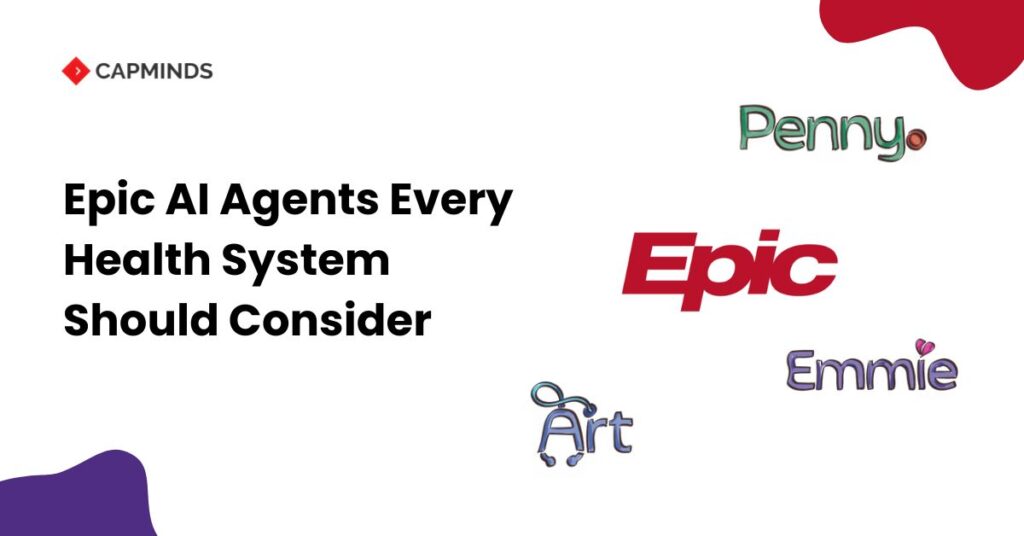
There is also an important terminology distinction. Art, Emmie, and Penny are broad Epic AI capability families for clinicians, patients, and revenue-cycle or operational teams. AI Charting is an Art capability. Agent Factory is Epic’s platform for creating and monitoring customizable AI agents. They should not all be treated as equally autonomous “agents.”
This guide examines the Epic AI areas health systems should evaluate, where they fit operationally, what can go wrong, and what needs to be in place before scaling them.
What Are Epic AI Agents?
Epic organizes much of its AI portfolio around three personas: Art for clinicians, Emmie for patients, and Penny for revenue cycle and operations. Alongside those products, AI Charting brings ambient documentation into Art, while Agent Factory extends Epic toward customizable agents capable of working across multi-step workflows.
That creates a spectrum of automation.
Some capabilities summarize information. Others generate drafts for a person to review. Some prepare work for downstream action. Agent Factory is designed for workflows in which agents can reason, decide, and act within configured boundaries.
Health systems therefore should evaluate what the AI is permitted to do, not merely whether a feature carries an “AI” label.
| Epic AI area | Primary user | Typical role in the workflow | Main implementation concern |
| Art | Clinicians | Summarization, drafting, clinical workflow assistance | Accuracy, omissions, clinician review, workflow fit |
| Emmie | Patients | MyChart questions, navigation, scheduling, explanations | Patient safety, escalation, grounding, privacy |
| Penny | Revenue cycle and operations | Authorization, coding, denials, utilization and administrative support | Policy accuracy, auditability, payer context |
| AI Charting | Clinicians | Ambient capture, draft note creation, order queueing | Consent, documentation quality, order accuracy, review |
| Agent Factory | Health-system teams | Custom multi-step agents operating across workflows | Permissions, action boundaries, monitoring, rollback |
The implementation question is consequently not “Do we have Epic AI?”
It is: What workflow are we delegating, what data does the AI receive, what output or action can it produce, who remains accountable, and how do we detect when it gets something wrong?
1. Art: AI Support Inside Clinician Workflows
Art is Epic’s clinician-focused AI layer.
Current Epic documentation describes Art capabilities that can summarize patient information, draft responses to patient messages, create draft outpatient and inpatient documentation, surface patient-history insights, draft care-plan content, and support other documentation-oriented workflows.
The value for a health system is not simply “faster documentation.”
A stronger use case is reducing the amount of cognitive and clerical work required to reconstruct a patient’s story across notes, results, messages, and other chart information.
Consider an inpatient clinician preparing for rounds. The challenge is often not a lack of information. It is the opposite: the relevant facts are distributed across a large clinical record. A well-designed summarization workflow can shorten the path from chart review to a usable clinical picture.
The same principle applies to message drafting. AI can prepare a response, but the health system still needs rules determining which messages are appropriate for drafting, what chart context can be used, when a message should be escalated, and whether certain categories require direct clinician handling.
What should be validated before expanding Art?
Do not measure Art only through utilization.
Health systems should evaluate:
- factual accuracy;
- clinically material omissions;
- edit rates;
- clinician acceptance;
- time saved;
- inappropriate recommendations or conclusions;
- differences by specialty or workflow;
- effects on documentation quality;
- escalation behavior when information is ambiguous.
Epic has published organization-specific results showing reductions in documentation time for some Art workflows. These examples can support a business case, but they should not be converted into guaranteed performance assumptions for another health system. Local workflows, templates, patient mix, staffing, and implementation design can materially change results.
The safest operational model is therefore:
Art produces assistance → clinician evaluates it → clinician remains responsible for the final clinical documentation or decision.
2. Emmie: Patient-Facing AI Inside MyChart Workflows
Emmie brings a different risk profile because the person interacting with the AI may be the patient rather than a trained employee.
Epic describes Emmie as a MyChart-based AI assistant that can help patients find information, answer questions using information available through their chart, support scheduling and rescheduling, provide reminders, explain certain results or instructions in more accessible language, and help with billing-related questions and workflows.
That can reduce friction in several high-volume workflows.
A patient may not need to call the access center to move an appointment. Another may need help understanding where to find information in MyChart. Someone reviewing a result may benefit from plain-language context before deciding whether they need additional help.
Epic has reported examples including appointment rescheduling activity at Ochsner and reductions in billing-related customer-service messages at Rush. Those results demonstrate potential, but they remain organization-specific outcomes rather than universal expectations.
Where patient-facing AI becomes harder
The risk increases when a question moves from navigation into clinical interpretation.
A health system needs explicit boundaries for questions involving:
- worsening symptoms;
- urgent or emergent concerns;
- medication changes;
- unclear results;
- behavioral-health crises;
- conflicting information;
- sensitive diagnoses;
- questions requiring clinical judgment.
A safe workflow needs more than an accurate language model.
It needs an escalation architecture.
For example:
Patient question → intent classification → approved information retrieval → response generation → safety check → patient response or staff escalation
The health system should also validate whether answers remain grounded in appropriate chart information, whether uncertainty is communicated correctly, whether escalation happens reliably, and whether language or accessibility differences alter performance.
Patient-facing AI should therefore be evaluated as part of the patient-access and clinical communication workflow, not as a standalone chatbot project.
Planning an Epic AI Pilot?
CapMinds helps you validate Epic AI workflows, secure PHI, establish oversight, and scale safely into production.
Talk to a Healthcare AI Integration Expert
3. Penny: Revenue-Cycle and Operational AI
Revenue cycle may offer some of the clearest near-term opportunities for AI because many workflows contain repetitive information gathering, documentation review, policy comparison, drafting, and administrative decision support.
Epic’s Penny capabilities include support for prior authorization, utilization review, coding, denials, appeal-letter drafting, assessment of medical-necessity information, and other operational workflows.
Consider prior authorization.
Staff may need to find the relevant diagnosis, treatment history, previous therapy, procedure information, and other clinical evidence before responding to payer questions.
AI can potentially reduce the manual search and drafting burden.
But there is an important distinction between:
finding and drafting evidence And making an unsupervised determination that the evidence satisfies the payer requirement.
Payer policies change. Requirements differ across plans and services. Clinical documentation may contain conflicting or incomplete information. Health systems therefore need to know which policy version was applied, what evidence supported the response, what information was generated by AI, and who reviewed the final submission when review is required.
The same applies to denial appeals.
An AI-generated appeal can be useful when it assembles existing facts into a structured draft. It becomes risky when unsupported arguments, incorrect payer rules, or clinical statements are introduced.
Epic reported in early 2026 that organizations actively using Penny in professional billing had seen coding-related denial reductions exceeding 20% in some cases, and that denial appeal workflows had reduced appeal-letter preparation time.
These are Epic-reported customer observations, not guaranteed outcomes.
What should revenue-cycle leaders measure?
A pilot should establish baseline and post-implementation measures such as:
- authorization turnaround time;
- staff handling time;
- percentage of drafts accepted without changes;
- material corrections;
- denial reason distribution;
- appeal preparation time;
- payer-specific failure patterns;
- policy-reference errors;
- downstream rework.
AI should remove unnecessary administrative effort without obscuring why a submission, coding suggestion, or appeal was produced.
4. Epic AI Charting: Ambient Documentation With Clinical Workflow Consequences
Epic released AI Charting in February 2026 as part of Art.
According to Epic, the capability can listen during a patient encounter, generate a draft clinical note, and queue orders based on the conversation for clinician review. Epic also described personalization features that allow clinicians to adjust how their notes are structured.
This is more consequential than adding a transcription tool.
Ambient documentation sits directly between:
patient-clinician conversation → captured audio/context → generated documentation → orders → signed medical record
That creates several implementation questions.
Documentation fidelity
Does the generated note preserve the clinically important meaning of the encounter?
The evaluation should test incorrect additions, omissions, temporal errors, negation, laterality, medication details, diagnoses, and specialty-specific terminology, not simply grammar quality.
Order queueing
A queued order is not the same as an executed order.
Health systems should maintain clear review and approval points before clinically consequential orders move forward. Testing should deliberately include conversations containing ambiguity, hypothetical statements, discontinued plans, patient refusals, and changes made late in an encounter.
Patient privacy and consent
Ambient workflows can involve audio capture and additional data processing.
Organizations need to determine applicable federal and state privacy requirements, organizational policy, notice or consent expectations, retention practices, third-party data handling, and whether captured information is used for model development.
CHAI’s 2026 guidance for ambient AI specifically recommends evaluating clinical performance, safety, fairness, privacy, operational impact, patient experience, clinician experience, and ongoing model changes across the lifecycle rather than treating predeployment testing as sufficient.
The clinician signature cannot become a ceremonial control.
If clinicians begin approving AI-generated notes without meaningful review, the organization may create automation bias rather than eliminate documentation risk.
5. Agent Factory: Where Epic AI Becomes More Agentic
Agent Factory deserves separate treatment because it shifts the architecture from primarily assistive generative AI toward multi-step agents.
Epic describes Agent Factory as a platform for creating and monitoring AI agents that can reason, decide, and act across workflows. Epic has said organizations will be able to customize agents, provide organization-specific policies or knowledge, and deploy them according to local timelines.
Epic also emphasizes traceability of agent activity.
This is where governance must become more granular.
A summarization tool can produce a bad summary. An agent with access to tools can potentially produce a bad summary and then use it to perform the next workflow step.
Health systems should therefore model Agent Factory deployments around four separate concepts:
Reasoning boundary → data boundary → permission boundary → action boundary
Suppose an agent prepares an infusion chart.
It may need to retrieve labs, medication information, prerequisites, and other chart elements.
But should it only identify missing information? Can it modify a work queue? Can it send a message? Can it initiate another workflow?
Each additional permission expands the consequence of an error.
This is already moving beyond concept-stage experimentation.
Healthcare IT News reported in July 2026 that Advocate Health had Agent Factory workflows in production for inpatient pharmacy and infusion chart preparation, while ECU Health was using Epic-built prototypes for patient-transfer and discharge-related workflows.
Availability, maturity, and use cases can still vary by Epic customer and implementation, so health systems should confirm current product availability directly with Epic before planning around a specific feature.
Start with bounded autonomy
The most appropriate first agent is rarely the one with the most power.
Good early candidates tend to have four properties:
- the task is repetitive;
- required inputs can be clearly defined;
- outputs or actions are observable;
- errors can be intercepted or reversed.
An agent gathering information for chart preparation is therefore a fundamentally different risk proposition from an agent independently changing a medication plan.
Agent Factory should be treated as an enterprise automation platform with clinical-grade governance requirements, not merely another generative-AI feature.
Build Epic AI Around the Workflow, Not the Demo
CapMinds provides Healthcare AI Integration and EHR Workflow Engineering Services for organizations evaluating AI within Epic-centered environments.
Our work can support:
- Epic AI readiness assessment;
- AI pilot and workflow selection;
- Epic workflow and dependency mapping;
- human-review and escalation architecture;
- clinical AI output validation;
- role-based access and PHI controls;
- audit logging and AI governance;
- revenue-cycle automation readiness;
- patient-facing AI safety review;
- clinical documentation workflow testing;
- change management and adoption.
The objective is not to automate every workflow.
It is to identify where AI can create measurable value while preserving the controls, accountability, and clinical judgment an enterprise health system requires.