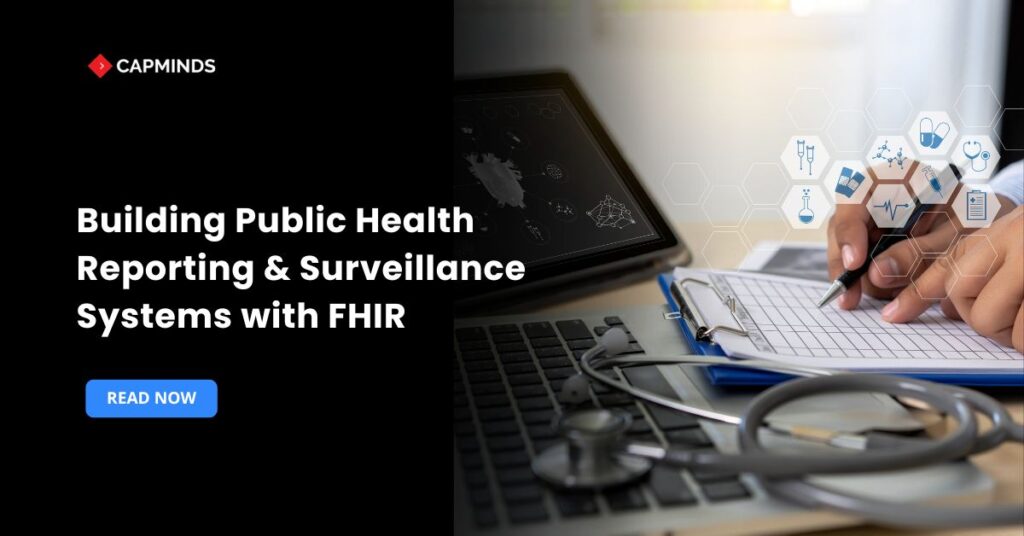
Building Public Health Reporting & Surveillance Systems with FHIR
Reporting and surveillance systems in the field of public health are important pillars that aid in monitoring, controlling, and preventing outbreaks of infectious diseases, and the population health management in general.
Poor interoperability, lack of timely reporting, and data fragmentation have continued to be major challenges to many public health agencies because of different legacy systems and formats.
FHIR is a new solution to these problems that can be used to achieve real-time, standardized, and safe exchange of health data by facilitating the use of standardized EHR.
Moving Towards FHIR Public Health: Pain Points And Opportunity
Conventional public health reporting systems are usually based on manual procedures or outdated communication standards, which cause delays in the submission of data, irregular data submission, or incomplete data submission.
The early and proper reporting is crucial in the detection of outbreaks, the management of cases, and the allocation of resources, but the different standards of the data, their tedious integration, and a low level of automation are the problems of public health organizations.
The implementation of FHIR public health reporting is an opportunity to optimize the working processes, enhance the data quality, and surveillance abilities.
Public health interoperability FHIR helps agencies at local, state, and federal levels to obtain more unified, actionable data in a faster and more comprehensive manner through the use of modern APIs and standardized data models.
Why FHIR Is Essential for Public Health Agencies
FHIR assists the public health agencies by making it easier to share the data between healthcare providers, laboratories, and the public health departments.
The fact that it is built around RESTful APIs and resource modules makes it easy to integrate into existing systems, as well as future-proof the architecture.
The characteristics of extensibility and uniform resource designs contribute to the alignment with the changing needs of public health and the requirements and standards, including TEFCA and USCDI.
The FHIR-based public health architecture can facilitate automated disease reporting with FHIR and, in turn, minimize manual work and errors. FHIR reporting workflows are real-time, which implies that health events can be identified as they happen and reported without incident to enable faster public health response.
Key FHIR Resources Used in Reporting
The public health reporting and surveillance systems are based on a small number of FHIR resources that ensure a uniform and unified framework for capturing clinical and administrative data:
Observation: Records the vital signs, lab reports, diagnostic tests, and other measurements that are necessary in disease surveillance.
Condition: Document patient diagnosis, e.g., infectious disease diagnosis, and pertinent clinical history.
Encounter: Provided the information about patient visits and care episodes that are important to understand the context and timelines of the case.
Practitioner: This is data regarding medical practitioners engaged in working with patients and reporting.
Bundle: Transacts a group of FHIR resources together so that they are submitted and processed as a unit, which applies to automated reporting pipelines.
Related: The Complete Guide to FHIR in Healthcare: Architecture, Use Cases, and Implementation
High-Level FHIR Architecture for Public Health Reporting Architecture
The common FHIR-based public health reporting system would consist of several parts that have to cooperate:
Data Ingest – Gathers clinical and laboratory information straightaway out of electronic health records (EHRs), labs, among others, through FHIR APIs.
Validation – Assures the incoming data is compliant with the mandatory FHIR profiles, USCDI standards, and other public health-specific extensions to preserve quality and consistency.
Mapping – Transforms clinical data into reportable formats and is compliant with case reporting mapping standards and individual public health processes, such as Electronic Laboratory Reporting (ELR).
Transmission – Forwards formatted reports to the appropriate public health-related endpoints, including CDC systems or state health information exchanges.
API Endpoints: It is a standardized interface that helps in querying, updating, and retrieving public health-related data to facilitate communication in both directions.
How FHIR Improves Surveillance
FHIR surveillance systems were useful in monitoring and controlling such diseases as tuberculosis (TB), COVID-19, and respiratory syncytial virus (RSV).
For TB reporting, FHIR allows the safe and structured transmission of diagnostic confirmations of the disease and treatment progress, which is useful in contact tracing and case management.
FHIR-based reporting has been used to hasten the real-time exchange of data among laboratories and governments on situations and mobilization resources during the COVID-19 pandemic.
FHIR can be used in RSV and STI surveillance to provide automated notifications and aggregate data reporting to speed up interventions and epidemiological analysis by the public health.
Step-by-Step: Building a FHIR-Based Reporting System
- Determine reporting workflow, data elements, and reporting destination requirements.
- Develop the FHIR resources required, especially Observation, Condition, Encounter, Practitioner, and Bundle structure.
- Build and implement API endpoints to meet CDC interoperability requirements and state requirements on public health.
- Adopt data validation layers to be compliant with USCDI and TEFCA.
- Establish automatic mappings of clinical data and public health case reporting formats, including ELR integration.
- End-to-end provider, lab, and public health authority test workflows.
- Welcome stakeholder training and create constant control to ensure the quality of data and system effectiveness.
CapMinds Public Health Interoperability Services
Delivering strong public health reporting isn’t just about adopting FHIR; it’s about integrating the right systems, ensuring seamless workflows, and guaranteeing that every data exchange meets national interoperability standards.
CapMinds helps public health agencies and healthcare organizations modernize their reporting and surveillance systems with secure, scalable, and fully FHIR-aligned digital health solutions.
At CapMinds, we deliver end-to-end services designed to streamline your public health data exchange, improve reporting accuracy, and accelerate real-time surveillance.
Our Public Health & FHIR Integration Services include:
- FHIR-based public health reporting system development
- HL7, CDA, and FHIR interoperability services
- Automated ELR & case reporting integration
- TEFCA-ready data exchange and compliance
- EHR integration and workflow optimization
- Cloud deployment, modernization & API engineering
- Data mapping, validation & quality assurance
- Ongoing maintenance, monitoring & support
With CapMinds, you gain a trusted partner who ensures your agency or organization moves from fragmented legacy systems to a unified, scalable public health ecosystem.
Ready to modernize your public health reporting?
CapMinds is here to help you build a future-proof, fully interoperable FHIR-enabled infrastructure.