NextGen EHR/EMR Support
NextGen EHR Consulting Services That Increases Revenue & Reduces Operational Gaps
From implementation and workflow optimization to revenue cycle improvement and seamless integrations, our NextGen EHR consulting services help healthcare organizations increase efficiency, stay compliant, and drive measurable financial growth.




Why Healthcare Organizations Struggle with NextGen & How to Fix It
Common gaps organizations face in NextGen
How CapMinds helps improve NextGen performance
We align NextGen around clinical, operational, and specialty-specific workflows.
We strengthen billing, claims, and payment workflows to reduce reimbursement friction.
We help optimize scheduling, intake, and patient experience workflows.
We improve analytics and reporting visibility for stronger operational insight.
Where NextGen Integrations Become a Bottleneck
NextGen supports flexible care delivery, but integrations and data initiatives often depend on limited internal bandwidth. CapMinds works alongside teams to deliver secure integrations, interoperability, and reporting support without slowing day-to-day operations.
NextGen Solutions We Offer
NextGen Implementation Services
As a trusted NextGen implementation partner, we manage structured system deployment aligned with specialty-specific workflows. Implementation planning includes module configuration, billing alignment, and reporting setup before activation. We coordinate provider onboarding and operational readiness across locations. Go-live oversight reduces early-stage claim disruption. Post-launch validation confirms workflow stability and revenue performance.
Sub-services include:
- Specialty-based system configuration
- Multi-location rollout planning
- Payer rule and billing setup
- Reporting configuration alignment
- Interface configuration support
- Go-live performance validation
NextGen RCM services
Revenue performance in NextGen environments depends on accurate configuration and disciplined workflow control. Our NextGen billing services focus on improving collections, reducing AR aging, and strengthening charge capture accuracy. We analyze billing breakdowns and recurring payer friction. For organizations seeking external support, we help with outsourcing NextGen revenue cycle management through structured oversight and performance transparency.
Sub-services include:
- Charge capture validation
- NextGen denial management analysis
- Claims workflow refinement
- AR performance monitoring
- Coding accuracy review
- Revenue reporting reconciliation
NextGen workflow optimization
NextGen’s strength lies in specialty customization, but poorly structured templates can slow providers and affect documentation quality. Our NextGen EHR optimization services focus on improving specialty template performance and reducing documentation friction. We evaluate real-world usage patterns and refine the configuration accordingly. Optimization improves both provider efficiency and reimbursement accuracy.
Sub-services include:
- Specialty template refinement
- Clinical workflow restructuring
- Documentation standardization
- Scheduling optimization review
- User adoption assessment
- Performance improvement planning
NextGen Integration Services
Multi-site practices often require connectivity with labs, imaging centers, clearinghouses, and third-party platforms. Our NextGen API integration services ensure secure and reliable connectivity across systems. We provide NextGen EHR integration services aligned with enterprise data exchange standards. Structured NextGen interoperability services maintain stable information flow and reporting accuracy.
Sub-services include:
- NextGen API integration architecture
- Third-party system connectivity setup
- Lab and imaging interface configuration
- Clearinghouse integration planning
- Data exchange validation
- Interoperability performance monitoring
NextGen Migration Services
Practice acquisitions, platform upgrades, or system transitions require structured migration oversight. Our NextGen migration services focus on protecting clinical, demographic, and financial records during transition. We provide NextGen data migration support with reconciliation checkpoints and controlled validation. Cutover planning minimizes scheduling and billing disruption. Post-migration audits confirm data integrity.
Sub-services include:
- Legacy system data assessment
- Structured data mapping strategy
- Secure extraction planning
- Migration validation framework
- Cutover coordination support
- Post-migration reconciliation
NextGen Denial Management Optimization
NextGen environments often generate high denial volumes when payer configuration is misaligned. Our NextGen denial management services analyze denial trends, payer rule breakdowns, and coding inconsistencies. We correct configuration gaps and strengthen billing workflows. Denial remediation reduces recurring revenue leakage and stabilizes collections.
Sub-services include:
- Denial trend analysis
- Payer rule alignment review
- Coding workflow correction
- Appeals process refinement
- Revenue leakage analysis
- Clean claim rate optimization
NextGen Performance Stabilization
System upgrades, customization drift, or billing inefficiencies can disrupt multi-provider environments. Our stabilization services identify technical and operational root causes affecting performance. We correct configuration inconsistencies and restore reporting accuracy. Performance recovery focuses on predictable revenue flow and operational reliability.
Sub-services include:
- Performance issues assessment
- Workflow correction
- Upgrade impact review
- Reporting discrepancy resolution
- Backlog prioritization
- Stabilization roadmap development
NextGen Managed Services
Growing ambulatory groups require structured oversight to maintain billing and documentation accuracy. Our NextGen managed services provide ongoing monitoring aligned with revenue operations and reporting needs. We coordinate updates, enhancements, and issue resolution proactively. Continuous oversight reduces risk during growth or acquisition phases.
Sub-services include:
- Application monitoring
- Enhancement request management
- Upgrade coordination
- Revenue performance monitoring
- Operational reporting support
- Ongoing support services
NextGen Consulting Services
For expanding specialty groups and enterprise ambulatory networks, our NextGen consulting services provide a structured evaluation of workflow efficiency, billing alignment, and scalability readiness. Advisory engagements focus on measurable operational improvement and system governance maturity. Strategic oversight supports long-term revenue and compliance stability.
Sub-services include:
- Practice performance assessment
- Revenue configuration review
- Scalability evaluation
- Operational governance alignment
- Workflow advisory planning
- Efficiency benchmarking
NextGen Integrated Services We Support
Telehealth & Virtual Care Platforms
Patient Engagement & Scheduling Tools
CRM & Care Coordination Systems
Billing, RCM & Clearinghouse Platforms
Laboratory & Imaging Systems
Population Health & Analytics Platforms
Health Information Exchanges (HIEs)
Struggling to Connect Systems Around NextGen?
Get a free technical assessment to review interoperability, data workflows, and integration paths.
Why Choose CapMinds for NextGen
What Makes Us A Trusted Partner for
NextGen Environments
CapMinds partners with healthcare organizations to support NextGen through secure integration, interoperability, and data services. We deliver governed execution that maintains system performance, compliance, and operational continuity.



What Our Clients Say
Hear from healthcare leaders who’ve transformed their operations with our services & solution.
Looking to Get More Out of Your NextGen Setup?
From integrations to data workflows and optimization, we’ll help you extend NextGen in a way that fits your operations.
Request a Technical Consultation Today:
- NextGen integration & interface assessment
- HL7 / FHIR interoperability planning
- Data migration & reporting support
- Go-live stabilization & optimization
FAQs
What does a NextGen EHR implementation consultant do?
A NextGen EHR implementation consultant helps healthcare organizations configure the system, map workflows, migrate data, train users, test billing processes, and prepare teams for go-live.
Their role is to make sure NextGen supports clinical, administrative, financial, and reporting workflows from day one.
Consultants also help reduce setup mistakes that can affect scheduling, documentation, charge capture, claims, patient communication, and interoperability after launch.
How do NextGen consultants support post-launch stabilization?
NextGen consultants support post-launch stabilization by resolving user issues, fixing configuration gaps, validating billing workflows, monitoring task queues, and helping staff adjust to the new system. This support is especially important during the first few weeks after go-live.
Stabilization often focuses on provider documentation, scheduling flow, charge capture, claim submission, reporting accuracy, patient portal use, and interface performance.
What causes workflow inefficiencies in NextGen?
Workflow inefficiencies in NextGen often come from poor template design, unclear task ownership, duplicate documentation, incomplete training, misconfigured user roles, and disconnected clinical or billing workflows. Over time, these issues create staff workarounds and slower patient throughput.
Common signs include delayed chart completion, front desk bottlenecks, claim holds, referral gaps, and inconsistent reporting.
How do you stabilize an underperforming NextGen environment?
An underperforming NextGen environment is stabilized by identifying the workflows causing the most operational pressure first. These may include slow documentation, billing delays, reporting issues, task backlogs, interface errors, or poor user adoption.
A stabilization plan usually includes workflow audits, configuration cleanup, user retraining, template refinement, reporting validation, and stronger ownership for recurring system issues.
How do you improve system speed and reliability in NextGen?
System speed and reliability in NextGen improve through a combination of technical review and workflow cleanup. Slow performance may come from network issues, workstation problems, overloaded reports, inefficient templates, integration delays, or poorly structured daily processes.
A proper review should check user complaints, device performance, reporting load, interface queues, task volume, and department-specific bottlenecks before recommending fixes.
How do specialty clinics optimize workflows in NextGen?
Specialty clinics optimize workflows in NextGen by tailoring templates, visit types, order sets, documentation flows, coding support, referral processes, and reporting around specialty-specific needs. A cardiology clinic, behavioral health practice, orthopedic group, and dermatology clinic will not use the system the same way.
Specialty-focused optimization improves documentation speed, care coordination, billing accuracy, patient throughput, and provider adoption.
How do NextGen optimization services improve provider productivity?
NextGen optimization services improve provider productivity by simplifying documentation, refining templates, improving order workflows, reducing duplicate data entry, and aligning the system with specialty-specific care patterns. Providers spend less time fighting the system and more time completing accurate clinical work.
Optimization can also reduce after-hours charting, improve visit closure rates, and support cleaner coding and billing documentation.
How long does the NextGen implementation take?
NextGen implementation typically takes 8 to 16 weeks for small and mid-sized practices. Larger groups, specialty clinics, multi-location organizations, or projects involving complex billing, data migration, and integrations may take 4 to 9 months.
The timeline depends on provider count, specialty requirements, legacy system readiness, interface needs, reporting setup, payer configuration, training availability, and workflow redesign scope.
How do healthcare organizations optimize workflows in NextGen?
Healthcare organizations optimize workflows in NextGen by reviewing scheduling, intake, clinical documentation, orders, referrals, billing, reporting, and patient communication from end to end. The goal is to remove duplicate steps, unnecessary clicks, and unclear handoffs.
A strong optimization project improves patient flow, provider productivity, staff coordination, billing accuracy, and visibility across daily practice operations.
How can clinics reduce operational gaps in NextGen?
Clinics can reduce operational gaps in NextGen by mapping how work moves across the full patient visit cycle. This includes appointment scheduling, eligibility checks, intake, documentation, orders, billing, follow-up, and reporting.
Once gaps are identified, consultants can adjust templates, routing rules, task queues, billing workflows, user permissions, and training so teams work from one consistent process.
What is NextGen go-live support?
NextGen go-live support is hands-on assistance during the transition from implementation to daily use. It helps providers, front desk staff, billers, administrators, and managers resolve issues quickly while the practice begins working in the new system.
Support usually includes workflow troubleshooting, user guidance, billing validation, issue escalation, configuration fixes, and monitoring of critical clinical and revenue cycle processes.
What are signs that NextGen needs optimization?
NextGen needs optimization when providers spend too much time documenting, claims are delayed, staff rely on manual workarounds, reports are inconsistent, or patient communication feels disconnected. Rising denials, incomplete charts, task backlogs, and slow front desk workflows are also warning signs.
Optimization is especially valuable after growth, specialty expansion, staff turnover, payer changes, new integrations, or a rushed implementation.
How do consultants recover failed NextGen implementations?
Consultants recover failed NextGen implementations by first identifying what went wrong across workflows, configuration, training, data migration, billing, reporting, and integrations. Recovery should focus on the highest-risk areas affecting care delivery and revenue.
Typical recovery work includes stabilizing daily operations, correcting build issues, retraining users, validating migrated data, fixing claims workflows, and rebuilding trust with clinical and administrative teams.
How to choose the right NextGen EHR consulting partner?
Choose a NextGen EHR consulting partner with proven experience in implementation, optimization, billing workflows, specialty configuration, interoperability, reporting, and post-go-live support. The right partner should understand both system configuration and real healthcare operations.
Ask about similar practice experience, provider count, specialty workflows, payer mix, data migration, integrations, revenue cycle improvement, training approach, and long-term support availability.
CapMinds Resources
Take a look at our latest blogs.
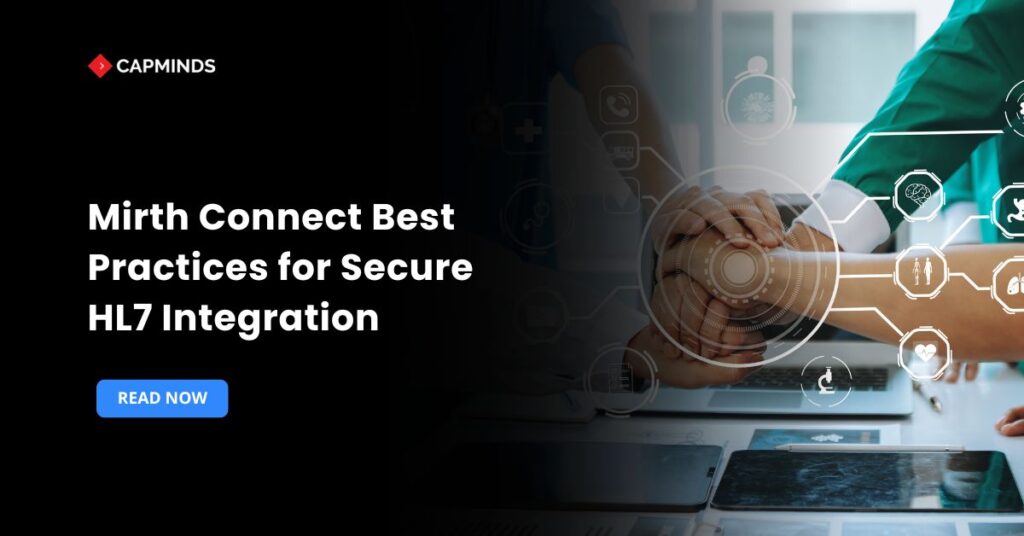
Mirth Connect Best Practices for Secure HL7 Integration
The smooth and safe transfer of data in a complicated structure of healthcare is not a benefit, but a requirement. The core of this interchange is commonly […]
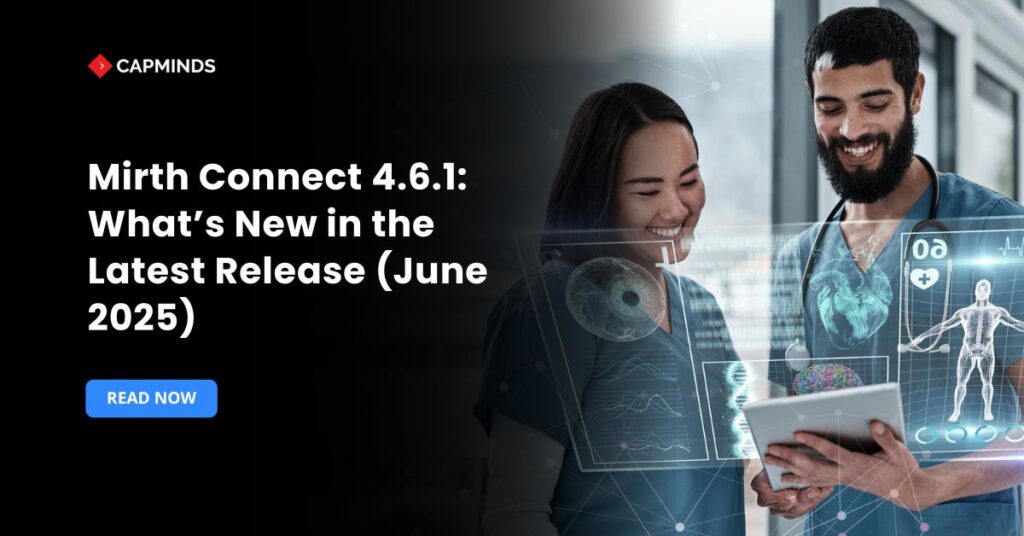
Mirth Connect 4.6.1: Features, Security Updates & Release Notes
Mirth Connect integration tools make healthcare data exchange easier, supporting all major messaging standards like HL7 v2, FHIR, X12 EDI, and more. This interface engine helps route, […]
Audit Logging in Mirth Connect: Ensuring Transparency and Compliance
Data transparency and compliance are essential in today’s healthcare IT environment. Every clinical information exchange needs to be monitored, verified, and kept in a manner compliant with […]