Healthcare Integration Services
Healthcare Interoperability Solutions That Connect EHRs, Labs & Apps - Fast and Secure
Eliminate data silos and unify fragmented systems with HIPAA-compliant HL7 & FHIR integrations. Automate data flow, reduce manual work, and achieve better outcomes across your healthcare network.





















No more regulatory roadblocks! CapMinds ensures your data
exchange is secure, seamless, and fully compliant.
Healthcare providers face constant challenges in meeting interoperability mandates, such as HIPAA, FHIR, and HL7, while managing fragmented platforms and legacy systems.
At CapMinds, our standards-based interoperability solutions are built with compliance at the core. We integrate EHRs, labs, imaging systems, and APIs securely — giving providers a unified patient record that meets today’s evolving regulations. With us, you reduce compliance risks while improving care coordination.
How CapMinds Can help?
We deliver end-to-end medical billing audit services that result in reduced claim denials, faster
reimbursement, improved compliance scores, and a boost in your practice revenue.
0 %
0 %
0 %
0 $
CapMinds Healthcare Interoperability Solutions for Seamless Data Exchange
HL7 & FHIR Integration Services
- At CapMinds, we offer the best healthcare software integration by implementing HL7 v2, HL7 v3, and FHIR standards.
- Our interoperability experts analyse, build, and implement secure interfaces that connect disparate EHRs, labs, pharmacies, and other health systems.
- With our real-time integration services, healthcare providers can get access to complete patient health records and deliver coordinated care.
- Integrating FHIR API with Existing Systems
- Building a Native FHIR System from Scratch
We offer FHIR integration models for healthcare systems, including:
EHR & EMR Connectivity
- At CapMinds, we ensure stronger connectivity between leading EHR platforms like Epic, Cerner, Allscripts, NextGen, and OpenEMR by offering the best EHR integration solution.
- Here, every healthcare provider involved in patient care gets access to updated and complete patients’ medical histories.
- By connecting and ensuring EHR interoperability across different healthcare applications, we help organisations to improve clinical workflow and support better decision-making.
- Multi-EHR Integration
- Cross-Platform Data Sharing
- Custom API & HL7/FHIR Connectivity
- Legacy System Integration
Our EHR interoperability solutions include:
Imaging & DICOM Interoperability
- CapMinds supports secure image exchange through successful DICOM integration, enabling radiology images and reports to flow seamlessly across providers without any intervention.
- Our experts validate DRGs, POA indicators, and physician documentation practices to ensure coding accuracy from the start.
- We ensure that medical imaging data is interoperable with EHRs and PACS systems, reducing delays in diagnostics and improving collaborative care.
- Seamless PACS & EHR Integration
- Standards-Based DICOM Exchange
- Multi-Format Image Support
- Cloud-Enabled Image Storage & Access
Our healthcare interoperability workflow solutions also include:
API-Driven Interoperability Solutions
- Using modern RESTful APIs and FHIR-based frameworks, we deliver fast, scalable data interoperability solutions for healthcare practices.
- APIs simplify the entire integration process with reliable mobile health apps, remote patient monitoring tools, and other third-party platforms.
- We help healthcare organisations drive digital healthcare innovation, reduce expenses, and provide quality healthcare to patients.
Custom Interface & Channel Development
- CapMinds specializes in building custom interfaces and channels that seamlessly connect diverse healthcare systems like small clinics, specialty centers.
- Labs and pharmacies.
- Using Mirth Connect and advanced middleware, we design scalable data flows to support the unique clinical and operational needs of healthcare practices, and also make sure our customization services minimize manual data entry and improve operational efficiency.
- HL7, FHIR & DICOM Channel Creation
- EHR & Third-Party Application Connectivity
- Workflow-Specific Customization
- Scalable Middleware Development
Our key healthcare interoperability solutions include:
Clinical & financial Integration
- Make your clinic integrate & connect easily with different systems to make care delivery smoother.
- At CapMinds, we empower your practice with EHR-integrated lab, imaging, e-prescribing, EPCS, and pharmacy without disruptions.
- Financial integration is vital for healthcare organizations, and we make those complications easier for you.
- We effectively handle detailed claims & financial transactions, clearinghouses, patient payment collections, and payment processing on time, and help to improve patient satisfaction.
Healthcare Interoperability Consulting Solutions
- CapMinds offers expert consulting solutions to help healthcare organizations overcome the complexities of interoperability.
- We research, analyse your existing systems, identify gaps, and redesign strategies for powerful data exchange across EHRs and third-party applications.
- Our healthcare integration experts specialize in data standards to ensure secure, standards-compliant integration.
- From planning to execution, we make sure your interoperability roadmap delivers compliant solutions with measurable outcomes.
- Interoperability Readiness Assessment
- Custom Interface & API Development
- Compliance & Security Advisory
- Optimization & Change Management
Our key consulting solutions include:
Who Do We Serve?
Powerful Healthcare Interoperability Features
Drag-and-Drop Interface Builder
We provide a visual builder that lets you design HL7, FHIR, and X12 channels with zero coding. Our built-in templates cut onboarding time by up to 40%.
AI-Driven Mapping & Validation
Our system auto-suggests mappings, flags anomalies, and learns with each transaction – ensuring higher data accuracy and faster go-live for interoperability projects.
Real-Time Monitoring Dashboard
We help our clients to achieve 2× faster data exchange and real-time SLA compliance tracking, helping operations teams act before issues impact care.
Smart Error Resolution Engine
We provide self-healing routines that automatically resolve 90% of common data format errors. We ensure every action is logged for root-cause analysis and regulatory reporting.
Secure Cloud & On-Prem Deployments
We offer fully managed, ISO-27001/SOC 2 certified cloud or on-prem options. Our secure end-to-end encryption option helps you achieve seamless interoperability.
API & Middleware Development
We help you build custom APIs to meet your needs and middleware to integrate non-standard systems and devices in a short period with ease.
Optimize Healthcare Data Flow
Get a free interoperability workflow audit — identify bottlenecks, save time, and prevent costly compliance gaps.
What Makes Us a leading healthcare interoperability platform?
Case Study
Title – Integrating HL7, FHIR, & API Capabilities with CapMinds
Challenge – Achieve seamless interoperability across multiple healthcare systems.
Solution – Deployed a scalable HL7, FHIR, and API integration framework with rapid interface development.
Results – Successfully delivered a cost-efficient, high-speed interoperability framework.
What makes us a trusted healthcare interoperability company
CapMinds is globally recognized for excellence in Healthcare IT security, regulatory compliance, responsive support, and service quality. Trusted by leading healthcare organizations, we uphold the highest standards to safeguard patient data, ensure uninterrupted operations & deliver solutions you can rely on.






What Our Clients Say
Hear from healthcare leaders who’ve transformed their operations with our service & solution.
Let’s Simplify Healthcare Interoperability with CapMinds
Consult with our experts and claim your complimentary interoperability assessment now.
- Accelerated HL7 & FHIR Integrations
- Scalable Multi-EHR Connectivity
- 24/7 Expert Technical Support
- 100% HIPAA & ONC-Compliant Solutions
FAQ
What are healthcare interoperability solutions?
Healthcare interoperability solutions are systems and services that enable clinical and administrative data to move securely between different healthcare platforms. They connect electronic health records, laboratory systems, pharmacy networks, billing systems, analytics platforms, and patient applications so information flows in a structured and usable format. These solutions typically include integration engines, API layers, data normalization processes, terminology mapping, identity matching, and monitoring tools that ensure reliability and compliance.
How can healthcare organizations improve interoperability?
Organizations should begin with a structured interoperability roadmap tied to operational goals. Standardizing exchange methods across systems is critical. Many organizations continue using HL7 version two for core feeds while adopting FHIR APIs for modern applications and patient access workflows. Establishing governance around data mapping, version control, and change management prevents interface sprawl and long term instability.
What is the difference between HL7 and FHIR?
HL7 version two is a message based standard commonly used for admission discharge transfer events, laboratory results, and scheduling updates. FHIR is a modern standard built around structured resources that are accessible through web based APIs. HL7 version two remains widely used in hospital environments, while FHIR supports modern application access, patient portals, and third party integrations.
What is SMART on FHIR and how is it used?
SMART on FHIR is a framework that allows external applications to launch securely within an electronic health record environment while accessing data through standardized FHIR APIs. It enables clinical tools, care management apps, and decision support solutions to function inside existing workflows without custom one off integrations.
How do TEFCA guidelines impact interoperability?
TEFCA establishes a national framework for trusted data exchange across networks. It sets expectations around security, governance, and standardized communication. Organizations must ensure their integration strategies align with national exchange requirements and evolving participation rules. This influences vendor selection, data sharing policies, and long term architecture planning.
How does interoperability work between labs, pharmacies, and hospitals?
Hospitals send orders to labs and receive structured results back into the electronic record. Pharmacy workflows involve medication data exchange and electronic prescribing networks. Interoperability ensures that admissions, laboratory updates, medication changes, and discharge events flow accurately between all participating systems so care teams remain informed.
How do you test interoperability before going live?
Testing includes technical validation, data mapping verification, and workflow simulation. Technical validation confirms message structure and authentication. Mapping verification ensures data fields translate correctly across systems. Workflow simulation confirms that real world scenarios function as expected. Staging environments are essential before production deployment.
What are the benefits of cloud based healthcare interoperability solutions?
Cloud deployments offer scalability, simplified disaster recovery, and centralized monitoring. They allow organizations to expand integration capacity without purchasing additional physical infrastructure. Cloud environments also support rapid onboarding of new partners and applications.
What are the costs of cloud versus on premise interoperability solutions?
On premise deployments require hardware investment, ongoing maintenance, and internal infrastructure management. Cloud deployments operate on subscription or usage models and may reduce internal operational overhead. Total cost comparison should include staffing, uptime reliability, scalability needs, and long term maintenance.
How is patient consent managed in data exchange?
Consent management involves capturing patient authorization in a structured format and enforcing that authorization during data access. Systems must record disclosure activity and apply access controls based on purpose of use and recipient. Clear governance prevents both unauthorized disclosure and unnecessary data restriction.
How do interoperability solutions reduce data silos?
By enabling structured data exchange, interoperability allows information to move between departments and partner systems without manual duplication. Shared access layers ensure that providers, care coordinators, and administrators view consistent information rather than isolated system records.
How does interoperability support population health management?
Population health programs require consolidated data across encounters, services, and locations. Interoperability enables aggregation of clinical, financial, and utilization data into a unified dataset. This supports risk stratification, care gap identification, quality reporting, and targeted outreach programs.
Why is interoperability important for value based care?
Value based care depends on measurable outcomes, coordinated treatment, and cost control. Without data exchange between systems, care teams operate with incomplete information. Interoperability allows providers to track patient journeys across settings, identify care gaps, reduce duplicate testing, and report quality measures accurately. It directly supports reimbursement models that reward performance and population outcomes.
What are common challenges in achieving interoperability?
The biggest challenge is not technical connection but data meaning. Systems may use different coding structures, field definitions, and workflow triggers even when they follow the same standard. Patient matching inconsistencies, vendor limitations, security reviews, and testing cycles often delay projects. Long term success requires ownership, documentation, and continuous monitoring.
What role do FHIR servers play in healthcare interoperability?
A FHIR server acts as a structured data layer that exposes healthcare information through standardized resources such as Patient, Observation, and Encounter. It enables secure application access, centralized data exchange, and consistent API management. In many organizations, a FHIR server aggregates information from multiple systems and presents it in a unified format for downstream use.
How do APIs enable healthcare interoperability?
APIs provide controlled, authenticated access to specific data elements when needed. Instead of sending large data feeds, APIs allow systems to request relevant information on demand. This model improves flexibility, security oversight, and scalability. It is particularly useful for patient access, mobile applications, and cross organization data exchange.
How do you integrate legacy healthcare systems with modern platforms?
Legacy systems often rely on older messaging standards or file exports. Integration typically involves routing structured feeds into an integration layer, validating and transforming the data, and exposing it in modern formats such as FHIR resources. Proper monitoring and mapping documentation ensure legacy feeds remain stable and usable over time.
Do you provide support for both real time and batch data integration?
Yes. Real time integration supports immediate workflows such as admission notifications and laboratory result delivery. Batch integration supports large data transfers, reporting extracts, and historical uploads. A mature interoperability framework supports both without compromising performance or governance.
How long does it take to implement healthcare interoperability software?
A single interface can sometimes be implemented within a few weeks if access and requirements are clear. Enterprise level interoperability involving multiple systems, governance controls, and production monitoring may take several months. Most delays occur during testing and coordination rather than initial configuration.
Is cloud based interoperability secure for patient data?
Cloud deployments can meet strict security requirements when configured correctly. Encryption, access control, network isolation, monitoring, and audit logging must be engineered carefully. Security depends on architecture and governance rather than hosting location alone.
How do you ensure data security and compliance during integration?
Security is addressed through encrypted data transmission, restricted system access, credential management, audit logging, and structured change control. Governance procedures such as access reviews and incident response planning support regulatory compliance. Security is treated as an ongoing operational responsibility.
How do interoperability platforms handle data governance?
Interoperability platforms maintain controlled mappings, version management, terminology standardization, and structured monitoring. Governance ensures consistent data definitions, quality validation, and accountability for each interface. Without governance, integrations become unstable and difficult to maintain.
How does interoperability reduce operational costs?
Reliable data exchange reduces manual reconciliation, duplicate testing, and billing errors. Staff spend less time searching for information or re entering data across platforms. Over time, this efficiency translates into measurable administrative cost savings.
What should organizations look for in a healthcare interoperability company?
Organizations should evaluate domain expertise, familiarity with major electronic health record vendors, experience with HL7 and FHIR standards, security practices, testing discipline, and long term support capability. A strong interoperability partner understands both technical architecture and clinical operations, ensuring integrations remain stable beyond initial deployment.
CapMinds Resources
Take a look at our latest blogs.
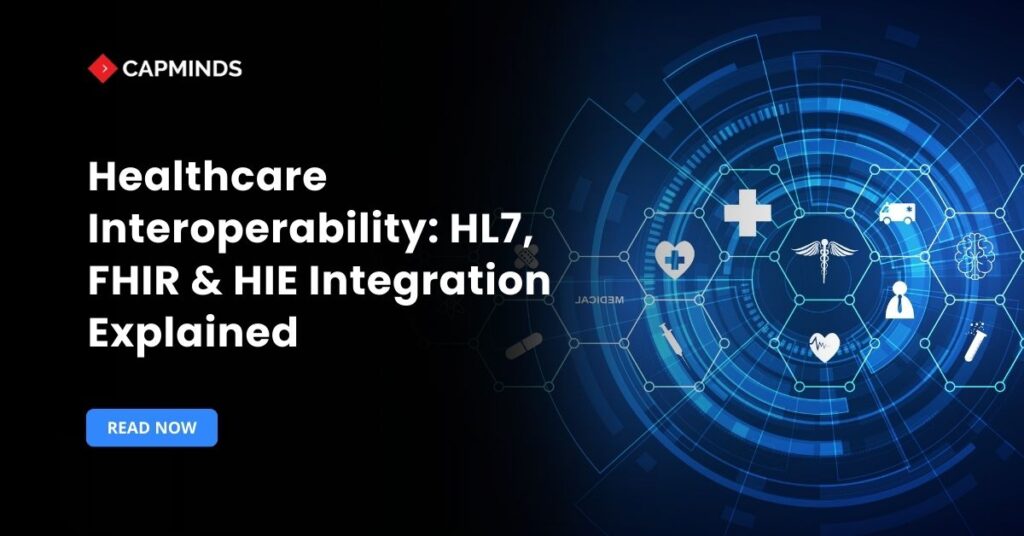
Healthcare Interoperability: HL7, FHIR & HIE Integration Explained
Healthcare delivery depends on information moving across a dense, heterogeneous mesh of systems: EHR/EMR platforms, laboratory information systems, radiology information systems, PACS archives, pharmacy and medication management, […]
Custom vs. Off-the-Shelf Interfacing Solutions: A CTO’s Guide to Integration Decisions
Health-system CTOs must balance connecting several clinical, revenue-cycle, and auxiliary applications while maintaining budgets and innovation. There are two main approaches: one is creating a custom interface […]
Building Interoperability Layers That Support Clinical Decision-Making at the Point of Care
A medication allergy alert or a sepsis risk score reaching the doctor before an order is issued might be the difference in data-rich hospitals. Many organizations still […]