Designing a 24/7 Healthcare NOC and SOC Operating Model Across Hospitals, Clinics, and Cloud Workloads
A hospital EHR becomes unavailable at 2:00 AM.
Clinicians may see only one symptom: the system is down. For the IT team, however, the failure could originate anywhere across a chain of applications, infrastructure, networks, security controls, cloud services, integrations, and external dependencies.
Common Reasons for Healthcare IT Outages and Downtime
An EHR or other critical clinical service can become unavailable because of:
- Database saturation or performance degradation
- Compute, memory, or storage failures
- Network, WAN, DNS, or connectivity failures
- Identity or authentication service outages
- Application or interface-engine failures
- Failed software, configuration, or infrastructure changes
- Cloud or SaaS service disruptions
- Third-party vendor or integration failures
- Power, facility, or hardware failures
- Ransomware, malware, or other cyber incidents
- Backup or recovery-system failures during restoration
HHS ASPR TRACIE recognizes that both malicious incidents and non-malicious hardware or software failures can disrupt healthcare IT systems, including EHRs. It also warns that third-party incidents can create cascading effects across hospitals and other healthcare facilities.
The challenge is that the first alert rarely tells the operations team which of these conditions is actually occurring. An EHR slowdown may initially look like an infrastructure problem while suspicious authentication activity or widespread encryption indicates a security incident. Conversely, an apparent security event may ultimately originate from an application, network, or cloud-service failure.
That is why healthcare organizations should not design the Network Operations Center (NOC) and Security Operations Center as isolated monitoring functions.
A mature 24/7 healthcare operating model connects clinical service availability, infrastructure observability, cybersecurity detection, cloud telemetry, medical-device dependencies, incident management, downtime procedures, and recovery validation.
The objective is not simply to generate more alerts. It is to determine which clinical service is affected, which dependencies are involved, whether the event is operational or potentially malicious, who owns the next action, and how the clinical workflow can be restored safely.
This matters because healthcare IT failures can directly affect operational continuity and patient care. HHS has documented that cyber incidents can create prolonged downtime, patient diversion, cancelled services, and delayed procedures, while EHR disruptions from technical failures and other events reinforce the need for contingency planning and recovery readiness.
The rest of this guide explains how to design a 24/7 healthcare NOC and SOC operating model across hospitals, clinics, and cloud workloads so operational failures and security incidents can be detected, correlated, escalated, and recovered with clinical impact at the center of the response.
What Is a Healthcare NOC and SOC Operating Model?
A NOC focuses primarily on service availability and performance across infrastructure, networks, applications, interfaces, storage, databases, endpoints, and cloud workloads.
A SOC focuses primarily on detecting, investigating, containing, and coordinating responses to cybersecurity threats.
They should not be treated as identical functions.
Instead, healthcare organizations need a shared operating layer that connects:
- asset and service inventories;
- telemetry and observability;
- security events;
- clinical criticality;
- incident severity;
- escalation procedures;
- change and problem management;
- downtime operations;
- recovery validation.
NIST Cybersecurity Framework 2.0 reinforces this broader model. Its Govern, Identify, Protect, Detect, Respond, and Recover functions are intended to operate as interconnected cybersecurity outcomes across IT, IoT, OT, cloud, mobile, and other technology environments.
Importantly, operating a 24/7 SOC is not itself a blanket HIPAA Security Rule requirement. Whether continuous NOC/SOC coverage is appropriate should be determined from organizational risk, clinical operating hours, system criticality, threat exposure, contractual commitments, and service availability requirements.
How to Design a 24/7 Healthcare NOC and SOC Operating Model
1. Start With Clinical Services, Not Monitoring Tools
Before deciding what dashboards the NOC should display or what data the SIEM should ingest, build a clinical service dependency model.
For each critical service, map:
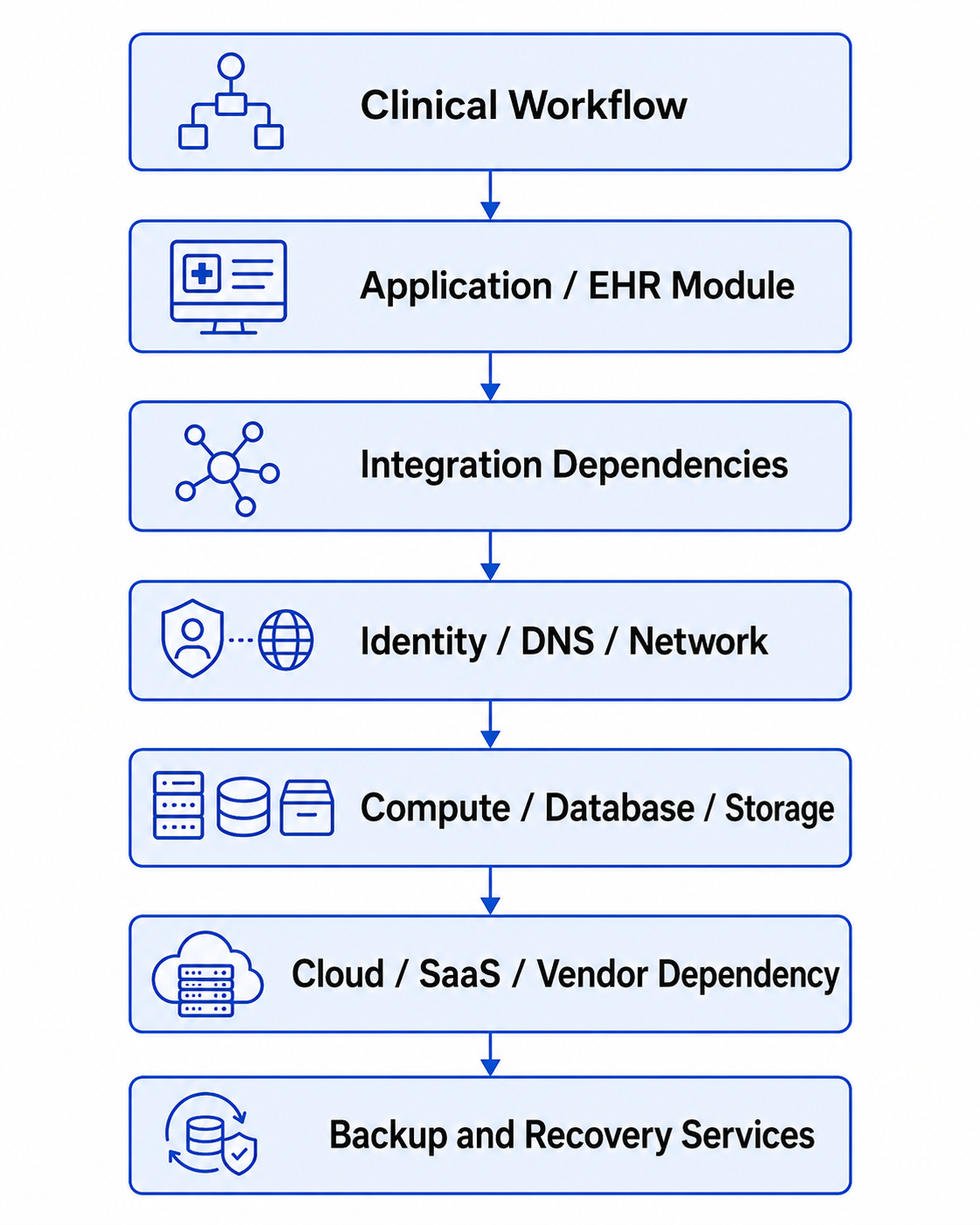
For example, laboratory ordering may depend on the EHR, interface engine, HL7 feeds, identity services, network paths, LIS connectivity, databases, and third-party components.
Each critical service record should identify:
- clinical and technical owner;
- locations served;
- upstream and downstream dependencies;
- clinical criticality;
- approved downtime procedure;
- recovery priority;
- escalation contacts;
- Recovery Time Objective (RTO);
- Recovery Point Objective (RPO), where applicable.
HIPAA contingency-planning requirements include application and data criticality analysis as an addressable implementation specification. HHS guidance also emphasizes identifying critical applications and data so recovery and contingency activities can be prioritized appropriately.
This changes what an alert means.
A CPU threshold on an interface server is no longer simply an infrastructure alert if it is also delaying ADT, orders, results, or other clinical message traffic.
2. Build One Operations Fabric Without Collapsing NOC and SOC Responsibilities
A practical architecture looks like this:
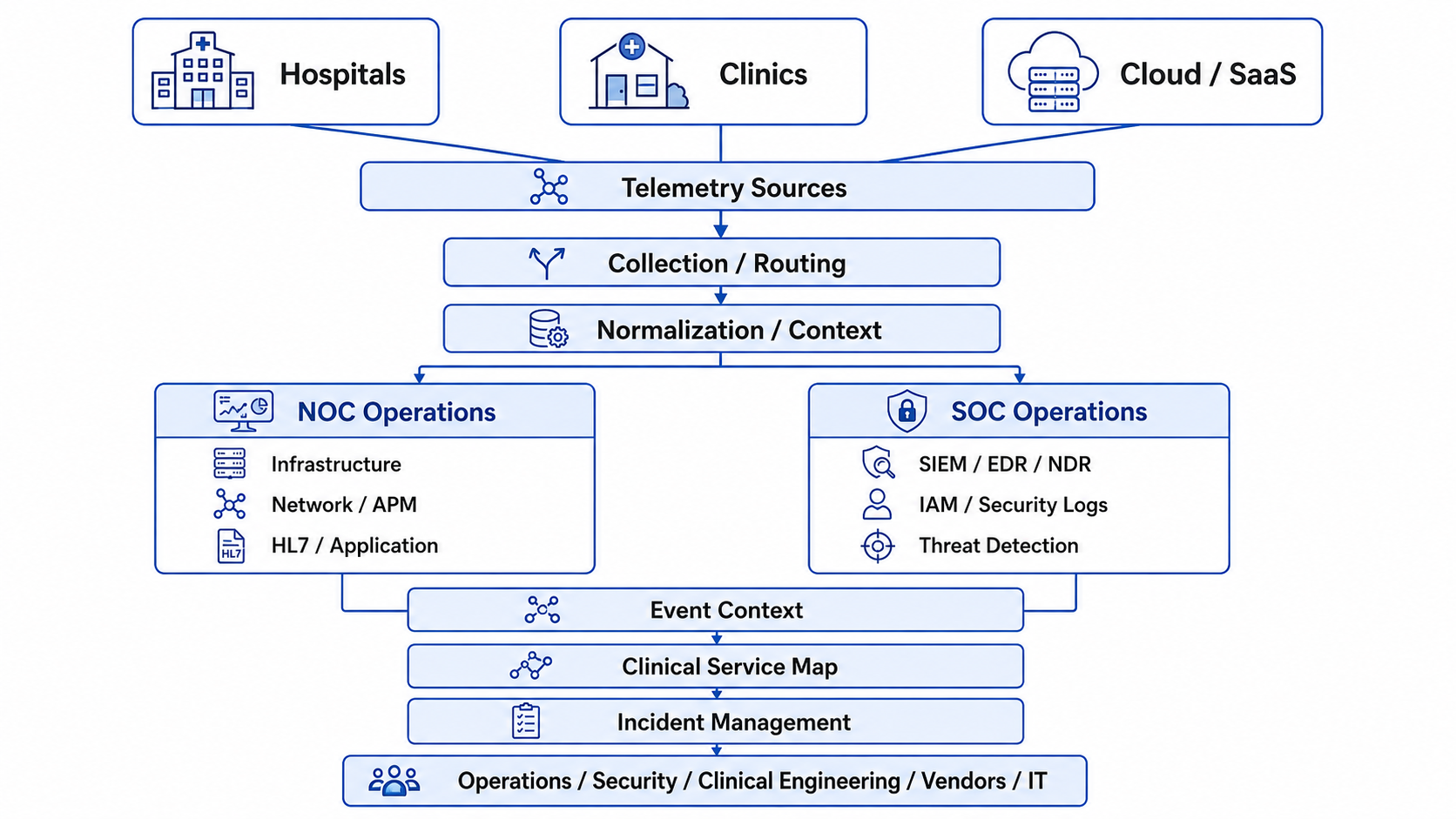
The NOC remains accountable for operational health.
The SOC remains accountable for cyber investigation and response. Events involving both domains should trigger a coordinated incident rather than two disconnected tickets.
3. Design Telemetry for Hospitals, Clinics, and Cloud Workloads
NOC telemetry
Depending on architecture, useful operational signals can include:
- WAN and SD-WAN state;
- packet loss and latency;
- firewall and VPN availability;
- DNS and DHCP health;
- VM and host utilization;
- database availability and latency;
- storage capacity and latency;
- backup failures;
- synthetic application transactions;
- APM signals;
- HL7 interface errors and queue depth;
- API and FHIR endpoint availability;
- certificate expiration;
- cloud resource health.
SOC telemetry
Security visibility can include:
- EDR and endpoint events;
- network security telemetry;
- IAM and privileged-access activity;
- VPN and firewall events;
- vulnerability findings;
- application audit records;
- email-security events;
- cloud control-plane activity;
- WAF events;
- authentication anomalies.
HHS’s Healthcare and Public Health Cybersecurity Performance Goals explicitly identify centralized log collection as an enhanced goal intended to improve visibility and incident response.
Cloud telemetry requires deliberate configuration
Cloud visibility should not be assumed simply because workloads run in a hyperscaler.
For AWS organizations, CloudTrail organization trails can log events across the management account and member accounts.
In Azure, Activity Log entries and platform metrics are collected automatically, but resource logs are not collected by default. Resource logs generally require diagnostic settings to route them to destinations such as Log Analytics, Event Hubs, or storage.
Google Cloud Admin Activity audit logs are enabled by default. However, Data Access audit logs are disabled by default for most services and must be explicitly enabled where needed; BigQuery is an exception.
The NOC/SOC telemetry strategy therefore needs to define what must be collected, from where, for what operational or investigative purpose, and for how long.
4. Monitor the Monitoring Plane
One frequently overlooked failure mode is the monitoring system itself. A healthy dashboard does not prove that telemetry is healthy.
The operating model should detect:
- stopped log collectors;
- missing agents;
- SIEM ingestion delays;
- failed synthetic checks;
- monitoring API failures;
- expired collector certificates;
- broken notification channels;
- disconnected sites;
- abnormal drops in expected event volume.
Telemetry-source health should therefore be monitored separately from the underlying workload. Otherwise, a failed collector can look exactly like a quiet environment.
[/vc_column_text][/vc_column][/vc_row]See Where Your NOC/SOC Model Has Gaps
Identify gaps across monitoring, escalation, cloud visibility, and clinical recovery before they become costly operational incidents.
5. Prioritize Incidents by Clinical Impact and Security Risk
Healthcare severity should not be determined by server count alone. A localized problem can be severe if it stops a time-sensitive clinical workflow. An illustrative severity model could be:
| Level | Example Definition |
| SEV-1 | Critical clinical service disruption, enterprise-wide outage, or credible destructive cyber incident |
| SEV-2 | Major degradation or confirmed security event with contained operational impact |
| SEV-3 | Localized issue with an available workaround and limited immediate clinical impact |
| SEV-4 | Low-risk event, warning, maintenance issue, or informational condition |
This is an example operating model—not an HHS or NIST-mandated severity classification.
Severity should consider:
clinical impact + affected sites + blast radius + security confidence + workaround availability + expected duration + recovery complexity.
HHS’s HIPAA Audit Protocol specifically discusses defining security incidents according to criticality levels and establishing appropriate roles, reporting, and response procedures.
6. Establish a 24/7 Escalation Model
An organization may use an escalation structure such as:
Tier 0 — Approved automation and enrichment
Event correlation, deduplication, ticket enrichment, health checks, and low-risk automated actions.
Tier 1 — Initial triage
Confirm the event, identify the affected service, establish impact, gather telemetry, and begin the appropriate escalation process.
Tier 2 — Domain specialists
Network, infrastructure, application, cloud, database, interoperability, or cybersecurity specialists.
Tier 3 — Advanced escalation
Senior engineering, application owners, security leadership, clinical engineering/HTM, vendors, or architecture specialists.
This tier model is an architectural choice, not a regulatory requirement.
For major incidents, a designated incident commander should coordinate technical workstreams, communication, clinical escalation, vendor involvement, and recovery decisions.
Shift handoffs should explicitly transfer unresolved incidents, degraded services, temporary controls, vendor cases, containment actions, planned changes, and the next recovery milestone.
7. Define NOC-to-SOC Crossover Conditions
The operating model needs explicit rules for when an infrastructure event becomes a cybersecurity investigation. Examples include:
- widespread file encryption;
- simultaneous unexplained endpoint failures;
- unusual authentication activity during an outage;
- abnormal administrative actions before service degradation;
- suspicious DNS behavior combined with endpoint detections;
- unexpected configuration changes;
- unexplained privileged-account activity;
- security telemetry coinciding with infrastructure failures.
The reverse is also important. SOC containment actions may create infrastructure or clinical impact and therefore require NOC coordination.
A shared incident record prevents each team from investigating only its half of the problem.
8. Use Clinical-Safe Containment for Medical Devices
A standard enterprise workstation and a network-connected medical device should not automatically receive identical response actions.
FDA guidance recognizes that cybersecurity incidents affecting medical devices can affect device function and potentially create patient-safety concerns. FDA-supported preparedness guidance recommends multidisciplinary participation involving clinicians, Health Care Technology Management professionals, IT, emergency response, risk management, and facilities teams.
Therefore, containment involving network-connected medical devices should be risk-based and coordinated with cybersecurity, clinical engineering/HTM, clinical operations, and appropriate device vendors when isolation could affect device functionality or patient care.
Network segmentation can provide an additional containment boundary. HHS specifically recommends separating mission-critical assets into discrete network segments to reduce opportunities for lateral movement following compromise.
9. Design for Downtime and Recovery, Not Only Detection
Restoring a server does not necessarily restore the clinical workflow.
Recovery may require validation of:
- identity and authentication;
- databases and storage;
- application functionality;
- interface engines;
- queued HL7 traffic;
- FHIR/API connectivity;
- downstream systems;
- clinical data integrity;
- medical-device connectivity;
- user workflow.
NIST SP 800-61 Rev. 3 recommends prioritizing recovery actions, checking restoration assets for integrity issues, restoring essential services in the appropriate order, confirming restoration with system owners, and monitoring restored systems before recovery is considered complete.
Healthcare organizations should also prepare out-of-band operational procedures for situations where normal identity, email, collaboration, ticketing, or communication platforms are unavailable.
That can include controlled emergency-access procedures, alternative communication methods, offline contact information, and accessible downtime documentation.
HIPAA technical safeguards specifically require an emergency access procedure for obtaining necessary ePHI during an emergency.
10. Align the Operating Model With HIPAA Without Overstating HIPAA
The current HIPAA Security Rule requires regulated entities to implement security-incident procedures, regularly review information-system activity, maintain contingency planning, and implement audit controls for systems containing or using ePHI.
As of August 2026, HHS confirms that the current Security Rule remains in effect while proposed cybersecurity modifications continue through rulemaking.
One important retention distinction must also be maintained.
HIPAA requires specified Security Rule documentation to be retained for six years after the later of its creation date or the date when it was last in effect. This requirement should not be generalized into a claim that every NOC, firewall, SIEM, cloud, or application log must be retained for six years.
Log retention should instead be established according to applicable regulatory requirements, risk, investigation requirements, contractual obligations, organizational policies, and operational needs.
11. Measure Clinical Resilience, Not Ticket Volume
MTTA and MTTR are useful, but they do not tell the entire story.
A healthcare NOC/SOC should consider metrics such as:
- critical-service availability;
- time to restore clinical workflow;
- repeat incident rate;
- telemetry-source coverage;
- monitoring-source health;
- false-positive rate;
- restoration-test success;
- percentage of critical services with mapped dependencies;
- percentage of assets with identified owners;
- incident recurrence;
- corrective actions completed after major incidents.
The final measure of success is not simply whether an alert was closed.
It is whether the organization could detect the event, understand its clinical impact, coordinate the correct teams, maintain safe operations, restore the required service, validate recovery, and reduce the likelihood of recurrence.
Build a Healthcare Operations Model Around Clinical Continuity
A 24/7 healthcare NOC/SOC is not simply a room full of dashboards.
It is an operating model connecting people, clinical services, infrastructure, cybersecurity, cloud workloads, medical devices, vendors, escalation procedures, downtime operations, and recovery processes.
CapMinds helps healthcare organizations design and manage IT operations across hospitals, ambulatory environments, EHR platforms, interoperability infrastructure, networks, cloud workloads, cybersecurity controls, backup and disaster recovery, and 24/7 support operations.
Need to identify gaps in your current NOC/SOC coverage before the next outage or security incident exposes them?
Talk to CapMinds about building a healthcare IT operating model designed around availability, security, and clinical continuity.