How to Build FHIR-Native Healthcare Apps Without Starting From Scratch
Building a FHIR-native healthcare application does not require your engineering team to recreate every healthcare interoperability capability from the ground up.
FHIR servers, implementation-guide packages, SMART authorization patterns, terminology services, validation frameworks, software development kits, and EHR sandboxes can provide much of the foundation. Your team can then focus its custom engineering effort on the clinical workflow, product experience, decision logic, and operational capabilities that differentiate the application.
The challenge is knowing what to reuse and what still requires deliberate product engineering.
A FHIR API may make a Patient or Observation resource accessible, but it does not automatically solve:
- Patient identity across organizations
- Local-to-standard terminology mapping
- Different EHR search capabilities
- Clinical workflow ownership
- Write-back restrictions
- Consent and authorization policies
- Conflicting updates
- Incomplete or inconsistent source data
- Production monitoring and recovery
- Performance for analytical workloads
A strong FHIR-native healthcare app development strategy therefore uses FHIR as a reusable interoperability foundation, not as a promise that every healthcare system will behave identically.
This guide explains how digital health companies, healthcare SaaS vendors, and enterprise innovation teams can build FHIR-native applications faster without creating a fragile integration architecture.
What Is a FHIR-Native Healthcare Application?
“FHIR-native” is an industry architecture term, not a formal HL7 conformance category.
In this guide, a FHIR-native application uses versioned FHIR resources, profiles, implementation guides, terminology bindings, and API interactions as primary clinical contracts across its core services or integration boundaries.
A conventional healthcare application may use a proprietary internal clinical model and add FHIR only at the external integration layer. Every incoming FHIR resource must then be translated into an internal object, and every outbound transaction must be translated back.
A FHIR-native architecture keeps more of the product aligned with FHIR concepts such as:
- FHIR R4Resources
- Profiles
- Extensions
- Canonical URLs
- References
- ValueSets
- CodeSystems
- ConceptMaps
- Search parameters
- CapabilityStatements
- OperationOutcomes
- Provenance
That does not mean every database table must store raw FHIR JSON.
A team may still use relational tables, document stores, search indexes, caches, and analytical projections where they improve performance or simplify product logic.
The important distinction is that the clinical contract remains traceable to declared FHIR artifacts instead of becoming an undocumented proprietary model.
A study of real-world FHIR applications found substantial variation in their clinical functions, technical characteristics, launch approaches, and implementations. This reinforces an important point: FHIR provides a common foundation, but it does not prescribe one universal application architecture.
FHIR-Native Does Not Mean Automatically Interoperable
Two products can both support FHIR R4 and still fail to exchange usable information. They may differ in:
- Supported resources
- Required profiles
- Must support interpretations
- Search parameters
- Terminology versions
- Extensions
- Authorization scopes
- Read and write permissions
- Error behavior
- Data completeness
- Workflow assumptions
FHIR conformance therefore does not guarantee end-to-end interoperability. Successful interoperability requires agreement across multiple layers:
| Interoperability layer | Required agreement |
| Transport | How systems connect securely |
| API | Supported interactions, operations, and searches |
| Structure | Resources, elements, cardinalities, and data types |
| Profiles | Use-case-specific constraints |
| Terminology | Code systems, ValueSets, mappings, and versions |
| Identity | How patients, practitioners, and organizations are matched |
| Authorization | Who can access which information |
| Workflow | What happens before and after the exchange |
| Governance | Ownership, consent, retention, and audit requirements |
FHIR reduces the need to invent these contracts. It does not eliminate the need to define, test, and govern them.
Understand the 2026 U.S. FHIR Baseline
FHIR Release 5, version 5.0.0, remains the current published core FHIR version.
However, much of the U.S. certification and production environment continues to use FHIR R4.
The current published US Core Implementation Guide is version 9.0.0. It was published in June 2026, remains based on FHIR R4, and aligns with USCDI v6. The regulatory baseline for the ONC Certification Program’s standardized API criterion currently references:
- FHIR Release 4.0.1
- USCDI v3
- US Core 6.1.0
- SMART App Launch 2.0.0
- Bulk Data Access 1.0.0 for applicable population services
ASTP/ONC approved US Core 9.0.0 and USCDI v6 through the 2026 Standards Version Advancement Process in June 2026. Certified health IT developers may begin voluntarily using those 2026 SVAP-approved versions on August 29, 2026, subject to applicable SVAP requirements.
This creates four different meanings of “current”:
- The latest published HL7 version
- The version adopted in federal certification regulations
- A newer SVAP-approved version
- The version actually enabled by a customer’s EHR
A healthcare SaaS product should therefore maintain a standards-version matrix instead of hard-coding one universal FHIR configuration.
| Contract area | Version details to record |
| Base FHIR | R4, R4B, or R5 |
| U.S. core profile | US Core 6.1, 7, 8, or 9 |
| U.S. data baseline | Applicable USCDI version |
| Authorization | SMART App Launch version |
| Workflow IGs | Da Vinci, CARIN, Gravity, mCODE, or others |
| Terminology | Code-system and ValueSet versions |
| Customer capability | Resources and operations actually enabled |
Version governance prevents one customer upgrade from unexpectedly breaking other deployments.
A Practical FHIR-Native App Architecture
A reusable FHIR platform for healthcare apps should separate external interoperability differences from product-specific logic.
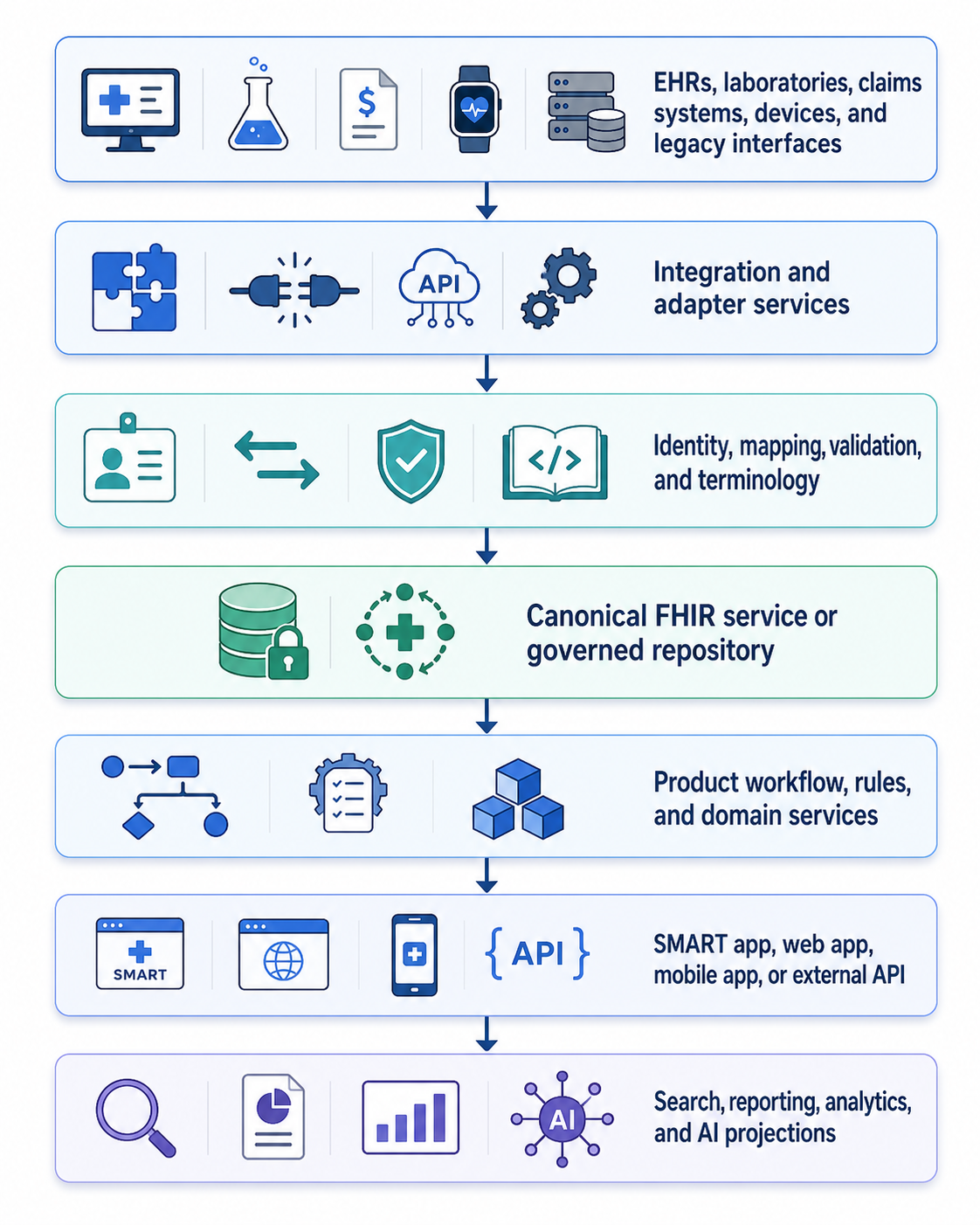
Security, consent, auditing, observability, and tenant isolation apply across every layer.
Integration and adapter layer
This layer connects to external systems through:
- FHIR REST APIs
- SMART on FHIR
- HL7 v2
- C-CDA
- X12
- Vendor APIs
- Secure file exchange
- Event or message feeds
It should absorb source-specific differences so that the product layer does not become filled with conditional logic for individual EHRs.
Semantic services
This layer handles:
- Patient and organization identity
- Source-to-FHIR transformation
- Terminology validation
- Local-code mapping
- Profile validation
- Unit normalization
- Provenance
- Exception handling
Databricks and Health Samurai describe a FHIR-native health data architecture that converts HL7 v2, C-CDA, X12, and other source data into FHIR while applying terminology normalization, patient deduplication, and implementation-guide validation.
These capabilities illustrate why source normalization remains necessary even when the target application is FHIR-native.
Canonical FHIR service
The canonical service provides a predictable internal clinical contract. It may be implemented through:
- An open-source FHIR server
- A commercial healthcare developer platform
- A managed cloud FHIR service
- A custom service using established FHIR libraries
- A governed data platform exposing FHIR APIs
Product services
Product services should contain the capabilities that differentiate the application:
- Care management workflows
- Clinical decision support
- Remote monitoring
- Prior authorization
- Patient engagement
- Specialty documentation
- Referral management
- Quality improvement
- Population health workflows
The product should call a stable internal contract rather than embedding every EHR’s behavior directly into business logic.
Decide Which System Owns the Data
Before choosing a FHIR server or healthcare interoperability platform, define the source of truth for each workflow. Three common patterns are available.
1. Connected SMART application
The EHR remains the clinical source of truth. The application retrieves data during an EHR or standalone SMART interaction and stores limited clinical information. This model can fit:
- Clinical calculators
- Decision-support applications
- Patient summaries
- Focused workflow extensions
- Provider-facing embedded applications
It minimizes data duplication but makes application availability and performance more dependent on the connected EHR.
2. Operational FHIR repository
The application maintains its own longitudinal FHIR repository and becomes the system of record or system of engagement for a defined workflow.
This model may fit:
- Care management platforms
- Remote patient monitoring
- Specialty healthcare SaaS
- Multi-organization networks
- Longitudinal patient applications
It requires stronger synchronization, identity resolution, provenance, conflict management, retention, backup, and recovery controls.
3. Hybrid synchronized model
The application stores resources required for its workflow while retrieving other information from the EHR when needed. This is often practical, but ownership must be explicit.
For every resource or field, define:
- Which system creates it
- Which system may modify it
- Whether updates flow in one or both directions
- How conflicting updates are resolved
- How deleted or entered-in-error records are handled
- How source provenance is retained
- What happens when synchronization fails
Do not select a platform until these ownership rules are documented.
What You Can Reuse Instead of Building
The goal is to avoid rebuilding commodity FHIR infrastructure while retaining control over the product’s differentiated workflow.
FHIR servers and persistence
An open-source implementation such as HAPI FHIR can provide FHIR parsing, REST server capabilities, search, persistence, terminology features, and extensibility.
Its JPA server can provide a database-backed FHIR REST implementation, but the application team remains responsible for deployment, configuration, scaling, security, upgrades, and operations.
A managed service may reduce infrastructure work. AWS HealthLake, for example, provides a managed FHIR R4 data store and is identified by AWS as HIPAA eligible. HIPAA eligibility does not make an application automatically compliant; the customer remains responsible for appropriate configuration, access control, agreements, monitoring, and use.
Mobile development libraries
Google’s Android FHIR SDK provides Kotlin libraries for offline FHIR storage, synchronization, Questionnaire-based forms, workflow logic, FHIRPath, and CQL-based processing.
It can accelerate mobile-first healthcare applications, but it does not replace a complete SaaS backend, authorization service, or enterprise integration architecture.
Implementation-guide packages
FHIR implementation guides can provide reusable:
- StructureDefinitions
- Extensions
- ValueSets
- CodeSystems
- Search requirements
- CapabilityStatements
- Operations
- Examples
- Conformance rules
Use an established implementation guide when it fits the use case.
Create custom profiles or extensions only when the business requirement is not represented adequately by the base standard or a recognized guide.
Conformance testing
Inferno provides open-source FHIR conformance test kits targeting certification criteria and implementation guides. Public Inferno services must not be used with PHI or other sensitive information. Teams should also verify the availability of individual hosted services because the public Inferno Resource Validator is planned for discontinuation as early as August 2026.
Reusable components shorten development, but they do not remove the need for architecture, clinical validation, security engineering, or production testing.
Build Your FHIR-Native App Without Rebuilding the Stack
Accelerate your healthcare app launch with reusable FHIR architecture, secure integrations, and production-ready engineering support.
How to Build a FHIR-Native Healthcare App
1. Begin With the Clinical Workflow
Do not begin with a list of FHIR resources. Begin with the operation the user needs to complete. For example:
- A care manager opens a patient from the EHR.
- The application receives patient and encounter context.
- It retrieves conditions, medications, laboratory results, and care plans.
- The care manager completes an assessment.
- The application generates follow-up tasks.
- Approved information is written back.
- Every access and change is audited.
For each workflow step, document:
| Requirement | Question |
| User | Who acts? |
| Trigger | What starts the workflow? |
| Context | Which patient, encounter, or organization is involved? |
| Read data | What information is required? |
| Write data | What will be created or updated? |
| Ownership | Which system remains authoritative? |
| Terminology | Which codes and ValueSets apply? |
| Authorization | Which scopes and permissions are needed? |
| Failure behavior | What happens when the action cannot complete? |
| Audit | What evidence must be retained? |
| Performance | How quickly must the workflow respond? |
Only after defining this contract should the team map the workflow to resources such as Patient, Encounter, Condition, Observation, QuestionnaireResponse, CarePlan, Task, ServiceRequest, or DocumentReference.
This prevents technically valid resources from being designed without a usable clinical workflow.
2. Create a Versioned FHIR Contract
The application contract should define:
- Base FHIR version
- Supported implementation guides
- Required profiles
- Mandatory and Must Support elements
- Search parameters
- Read and write interactions
- Custom operations
- Terminology bindings
- Extensions
- SMART capabilities
- Validation rules
- Compatibility policy
Package profiles and terminology dependencies as versioned build artifacts. Do not resolve the latest package automatically during production deployment.
When customers support different US Core versions, use adapters or transformations at the boundary rather than weakening the internal clinical model.
3. Evaluate the Healthcare Developer Platform
A FHIR server is not necessarily a complete healthcare developer platform. A server may provide storage and search. A broader platform may include:
- SMART authorization
- Identity management
- Terminology services
- Audit logging
- Subscription handling
- Workflow orchestration
- SDKs
- Bulk ingestion
- Multi-tenancy
- Deployment tooling
- Analytical access
Evaluate platforms against the actual workload.
| Evaluation area | Buyer questions |
| Standards | Which FHIR and IG versions are supported? |
| Validation | Can the platform validate required profiles and terminology? |
| Search | Are required searches indexed and performant? |
| Authorization | Which SMART patterns and scopes are supported? |
| Multi-tenancy | How are tenant identity and isolation enforced? |
| Audit | Are reads, writes, exports, and administrative actions traceable? |
| Extensibility | Can custom profiles and operations be implemented safely? |
| Portability | Can resources, history, and conformance artifacts be exported? |
| Scale | How are paging, rate limits, concurrent writes, and bulk access managed? |
| Operations | Who manages upgrades, backup, disaster recovery, and monitoring? |
Compare total engineering and operating cost, not only licensing.
4. Build a Governed Semantic Mapping Layer
FHIR does not automatically repair source data. One EHR may use a local laboratory code. Another may omit a unit. A device may send a different representation of the same measurement.
A source may populate fields that do not satisfy the required profile.
The mapping layer should:
- Preserve source identifiers
- Record the source-system namespace
- Retain original values
- Normalize units only when clinically appropriate
- Map local codes to standard terminology
- Record mapping versions
- Record confidence and exceptions
- Preserve transformation history
- Quarantine unresolved data
- Prevent silent semantic changes
FHIR terminology services define operations for ValueSet expansion, code validation, and ConceptMap-based translation. These operations should be implemented as governed services rather than duplicating unmanaged code maps throughout the application.
Terminology translation is not merely string matching. A clinically safe mapping may depend on the code-system version, direction of translation, intended use, context, and declared equivalence.
5. Implement SMART on FHIR Correctly
SMART App Launch 2.2.0 is the current published SMART guide. It defines OAuth-based patterns for authorizing and integrating applications with FHIR systems and describes discovery through the .well-known/smart-configuration endpoint.
Use the appropriate pattern:
EHR launch
A clinician starts the application from the EHR, which supplies launch context.
Standalone launch
A user starts outside the EHR and authenticates before the application establishes the required patient or clinical context.
Patient-facing application
Patient apps commonly use standalone launch with patient-level scopes. Some environments may expose them through a patient portal or another authorized context.
Backend services
A pre-authorized confidential client performs system-to-system access without an interactive user. The authorization design must address:
- Least-privilege SMART scopes
- User and patient context verification
- Redirect URI management
- Token protection and rotation
- Client registration
- Session expiration
- Revocation
- Tenant-specific credentials
- Sensitive-record restrictions
- Emergency-access handling where required
- Audit events
FHIR does not supply a complete security solution.
HL7’s security guidance requires implementers to apply appropriate authentication, authorization, access control, audit, consent, communications protection, and other safeguards.
6. Make Every EHR Connection Capability-Aware
A production application cannot assume that every FHIR R4 endpoint supports the same resources, searches, operations, or write permissions.
FHIR defines the CapabilityStatement to describe the capabilities of a server or client.
For RESTful servers, applications can typically retrieve the server’s declared capabilities through the metadata interaction. Store a capability profile for each connected environment:
- Supported resources
- Supported profiles
- Search parameters
- Include and revinclude behavior
- Create and update support
- Operations
- SMART configuration
- Pagination behavior
- Page-size limits
- Bulk-data support
- Subscriptions or event support
- Known customer restrictions
A CapabilityStatement is the starting point, not complete proof of production compatibility.
Critical searches, authorization flows, write-back, paging, and error behavior must still be tested against the customer’s actual environment. Your adapter must distinguish between:
- No matching data
- Authorization failure
- Unsupported search
- Partial result
- Validation failure
- Deleted resource
- Merged patient
- Rate limiting
- Expired paging session
- Temporary server failure
Treating all of these as an empty result can create unsafe workflows.
7. Use Layered Validation
FHIR validation can evaluate structure, cardinality, data types, terminology bindings, invariants, and declared profiles. However, automated validation cannot assess every narrative requirement or prove that an entire implementation conforms to a workflow-specific guide. Use several validation layers.
Development validation
Validate generated resources, examples, and profile packages during development and continuous integration.
Contract testing
Test authorization, searches, paging, error behavior, and write-back against each supported EHR environment.
Ingress validation
Validate external data at the application boundary before it enters core workflows.
Risk-based production handling
Reject data that is structurally unusable, unauthorized, clinically unsafe, or incompatible with mandatory requirements. Quarantine or accept-with-warning only when:
- The implementation guide permits it
- The workflow can operate safely
- The issue is recoverable
- The behavior has been approved through governance
Preserve the original payload and validation result. Never silently change clinical meaning.
Business-rule validation
Check rules that a generic FHIR validator cannot determine, including:
- Patient-context consistency
- Duplicate prevention
- Workflow-state transitions
- User authorization
- Required source provenance
- Resource ownership
- Cross-resource consistency
8. Plan for Concurrent Updates and Write-Back
Write-back is not simply a POST or PUT request.
When the application and EHR can both update the same information, define:
- Version-aware updates
- Optimistic concurrency control
- ETag and If-Match behavior
- Idempotency
- Duplicate prevention
- Reconciliation queues
- Retry limits
- Human review for clinical conflicts
FHIR supports conditional and version-aware interactions, but individual servers declare which versioning capabilities they support.
Do not overwrite an updated clinical resource merely because the application is retrying an earlier request.
9. Engineer Production Operations From the Beginning
A prototype proves that an API request works. A production application must prove that the entire data lifecycle is dependable. Monitor:
- Authentication failures
- Token expiration and revocation
- FHIR status codes
- OperationOutcomes
- Validation errors by profile
- Unsupported-search fallbacks
- Terminology failures
- Patient-match exceptions
- Synchronization latency
- Stale records
- Duplicate creation
- Failed write-back
- Unconfirmed updates
- Rate limiting
- Pagination failures
- Queue depth
- Customer-specific failure rates
- Audit-log delivery
- Cross-tenant access attempts
Use idempotent processing so a retried transaction does not create a duplicate clinical record. Preserve:
- Source identifiers
- Source namespace
- Original timestamp
- Transformation version
- Mapping version
- Write-back correlation ID
- Provenance
10. Separate Transactional and Analytical Access Patterns
Do not assume that a transactional FHIR REST API is the correct execution path for population-scale analytics, machine learning, or large resource scans.
Use an analytical access pattern such as:
- SQL-on-FHIR views
- Analytical projections
- Search indexes
- A warehouse
- A lakehouse
- A platform exposing one governed dataset through separate operational and analytical interfaces
The objective is to protect transactional performance without creating unnecessary, poorly governed copies. The Databricks and Health Samurai architecture demonstrates one approach: operational FHIR APIs and analytical tools can use complementary access patterns over a governed data platform rather than relying on repeated extraction from a transactional FHIR endpoint.
Architecture can support regulatory readiness, but it does not automatically establish HIPAA compliance, ONC certification, CMS compliance, or appropriate consent enforcement.
Common FHIR-Native Development Mistakes
Treating FHIR as a universal data model
FHIR resources are intentionally flexible. Real interoperability depends on profiles, implementation guides, terminology, and workflow agreements that constrain that flexibility.
Assuming every EHR supports write-back
A resource may be readable but not creatable or updatable. Even when an interaction is advertised, customer-specific workflow rules may apply.
Building one connector with no customer-specific capability handling
A shared adapter framework is valuable. A generic connector that assumes identical EHR behavior is not.
Creating custom extensions too early
First determine whether an established element, profile, or implementation guide represents the requirement. Every proprietary extension becomes another contract that external systems may not understand.
Confusing FHIR conformance with compliance
A valid resource can still be exposed to the wrong user, retained too long, logged insecurely, or disclosed without appropriate authorization.
| Area | What it establishes |
| FHIR conformance | Resource and API behavior |
| IG conformance | Use-case-specific constraints |
| SMART conformance | Authorization and launch behavior |
| ONC certification | Applicable certification-criterion conformance |
| CMS compliance | Applicable payer or exchange requirements |
| HIPAA compliance | Required safeguards and compliant operations |
None automatically proves all the others.
Testing only with perfect sample data
Production data may contain:
- Missing codes
- Duplicate identifiers
- Historical values
- Restricted encounters
- Merged patients
- Broken references
- Local extensions
- Incomplete terminology
- Inconsistent units
- Delayed updates
Test these conditions before deployment.
Lower-Risk Delivery Plan
Gate 1: Workflow definition
Confirm the user, use case, source systems, data ownership, write-back requirements, and measurable outcome.
Gate 2: Architecture contract
Select the source-of-truth pattern, implementation guides, terminology strategy, platform, authorization model, and extension policy.
Gate 3: Production vertical slice
Implement one complete workflow from authentication and retrieval through user action, write-back, audit, and monitoring.
Gate 4: Multi-environment hardening
Test against representative EHR sandboxes and customer configurations. Add capability profiles, fallbacks, reconciliation, and operational dashboards.
Gate 5: Repeatable onboarding
Automate endpoint discovery, client registration, conformance checks, synthetic testing, configuration promotion, and post-deployment verification. This sequence exposes architectural mistakes before the team builds dozens of resources and connectors around them.
Build Faster With CapMinds FHIR-Native App Development Services
Building a FHIR-native product requires more than selecting a server or exposing a few resources. The architecture must support real clinical workflows, evolving US Core profiles, secure SMART authorization, terminology governance, EHR variability, reliable write-back, analytics, and long-term operations.
CapMinds provides end-to-end healthcare product engineering services for digital health companies, healthcare SaaS vendors, and enterprise innovation teams.
Our specialists help you move from product concept to a secure, scalable, integration-ready application without rebuilding commodity interoperability components.
Our associated services include:
- FHIR-native application architecture and development
- SMART on FHIR app development and authorization
- FHIR server and healthcare developer platform implementation
- HL7, FHIR, EHR, laboratory, payer, and device integration
- Clinical terminology, validation, mapping, and data normalization
- Custom healthcare web and mobile app development
- Cloud architecture, DevSecOps, security, and compliance support
- Healthcare analytics, reporting, AI integration, and data engineering
- Platform modernization, testing, deployment, and managed support
- And more digital health technology services and solutions
CapMinds aligns every service with your product roadmap, clinical workflow, interoperability requirements, and operating model.
Build faster, reduce integration debt, and create a FHIR-native product that can scale across customers, EHR environments, and evolving healthcare standards with greater confidence.