OpenEMR vs GNU Health: Migration, Implementation, and Clinical Workflow Modernization
CapMinds helps hospitals evaluate OpenEMR as a practical alternative to GNU Health when clinical workflows, interoperability, physician adoption, and long-term maintainability become operational priorities.
Built for Hospitals Prioritizing Clinical Workflow and
Long-Term Flexibility
Why Hospitals Evaluate OpenEMR vs GNU Health
Hospitals rarely revisit GNU Health because of licensing or open-source philosophy. The reassessment usually begins when
day-to-day clinical operations become harder to scale efficiently.
Common situations include:
- Clinical workflows requiring extensive customization
- Outpatient and physician usability becoming difficult to manage
- Integrations with labs, billing, and external systems growing more complex
- Dependence on technical teams for routine operational changes
- Difficulty scaling beyond pilot, research, or academic environments
At this stage, hospitals begin evaluating which platform better supports long-term clinical care delivery.
OpenEMR vs GNU Health: Cost and Implementation Reality
Both OpenEMR and GNU Health are open-source platforms, but the cost equation is driven by implementation effort,
customization depth, and support availability, not licensing.
| Cost & Effort Area | GNU Health | OpenEMR |
|---|---|---|
| Licensing | Open source | Open source |
| Core orientation | Public health / HIS | Clinical EHR |
| Implementation effort | Developer-heavy | Phased deployment |
| Customization | Code-centric | Configurable + extensible |
| Interoperability | Limited | HL7 / FHIR ready |
| Support ecosystem | Niche | Mature ecosystem |
| Scalability | Project-dependent | Incremental growth |
| Long-term support | Limited providers | Broad service availability |
Outcome:
OpenEMR often provides a more practical implementation and support path for hospitals prioritizing physician workflows, interoperability, and operational scalability.
When OpenEMR Is the Right Alternative for Hospitals
This is why many hospitals evaluate OpenEMR when practical clinical operations
become more important than research-oriented flexibility.
GNU Health works best when:
- Public health reporting is the primary organizational focus
- Academic or research-driven environments shape system requirements
- Strong internal development teams manage ongoing customization
- Population-level reporting outweighs physician workflow depth
OpenEMR is often a better fit when:
- Clinical documentation and physician usability are priorities
- Hospitals support outpatient, specialty, or hybrid care models
- Interoperability across systems is operationally critical
- Long-term maintainability and support availability matter
CapMinds Engagement Model
GNU Health-to-OpenEMR Transition Planning
Structured migration planning focused on operational continuity, workflow alignment, and phased implementation.
OpenEMR Implementation & Customization
Hospital-focused configuration aligned to physician workflows, specialty care, inpatient operations, and outpatient documentation.
Interoperability & Integration
Reliable integrations connecting labs, billing systems, APIs, HIEs, and external healthcare applications.
Hosting, Compliance & Long-Term Support
Secure infrastructure, backups, monitoring, optimization, and compliance-focused operational support.
Get A Free Open-Source Platform Assessment
Evaluate workflow fit, interoperability readiness, and long-term scalability before making a transition decision.
Phase GNU Health-to-OpenEMR Transition Roadmap
Phase 1: Discovery & Workflow Assessment
Week 1–2: Current-system evaluation, workflow analysis, and implementation planning.
Phase 2: Architecture & Migration Planning
Week 2–4: System design, interoperability planning, and operational alignment.
Phase 3: Data Mapping & Validation
Week 4–8: Clinical, operational, and patient data transformation with structured validation cycles.
Phase 4: Build & Integration
Week 6–12: OpenEMR deployment, workflow configuration, and external system integrations.
Phase 5: Go-Live & Stabilization
Week 10–14: Controlled rollout, onboarding, optimization, and post-go-live operational support.
Why Choose CapMinds
OpenEMR vs GNU Health: Practical Differences That Matter After Go-Live
| Area | GNU Health | OpenEMR |
|---|---|---|
| Core focus | Public health / HIS | Clinical EHR |
| Physician workflow depth | Limited | Strong |
| Outpatient support | Basic | Advanced |
| Customization | Developer-driven | Configurable + extensible |
| Interoperability | Limited | HL7 / FHIR |
| Reporting orientation | Population-focused | Clinical + operational |
| Community ecosystem | Small | Large and active |
| US healthcare readiness | Limited | Strong |
Choose the Right Open-Source Platform for Long-Term Clinical Operations
Selecting between GNU Health and OpenEMR should go beyond architecture or ideology alone. CapMinds helps hospitals compare usability, interoperability, scalability, and operational fit before making long-term platform decisions.
This assessment helps you:
- Identify workflow and interoperability limitations
- Evaluate whether OpenEMR fits your hospital environment
- Compare scalability and operational flexibility
- Define a practical migration or modernization roadmap
What Our Clients Say
Hear from healthcare leaders who’ve transformed their operations with our services & solution.
CapMinds Resources
Take a look at our latest blogs.
OpenEMR 8.1 Upgrade Readiness: What Practices Should You Test Before Production
An OpenEMR upgrade can complete without displaying an error. That does not mean the system is ready for patients. The login page may load. The database version […]
OpenEMR Implementation for Nursing & Skilled Care Facilities: Configuration, Workflows & Compliance
The uncomfortable fact about most EHR implementations in skilled nursing and long-term care is that they fail due to configuration rather than software. Most SNF administrators leave […]
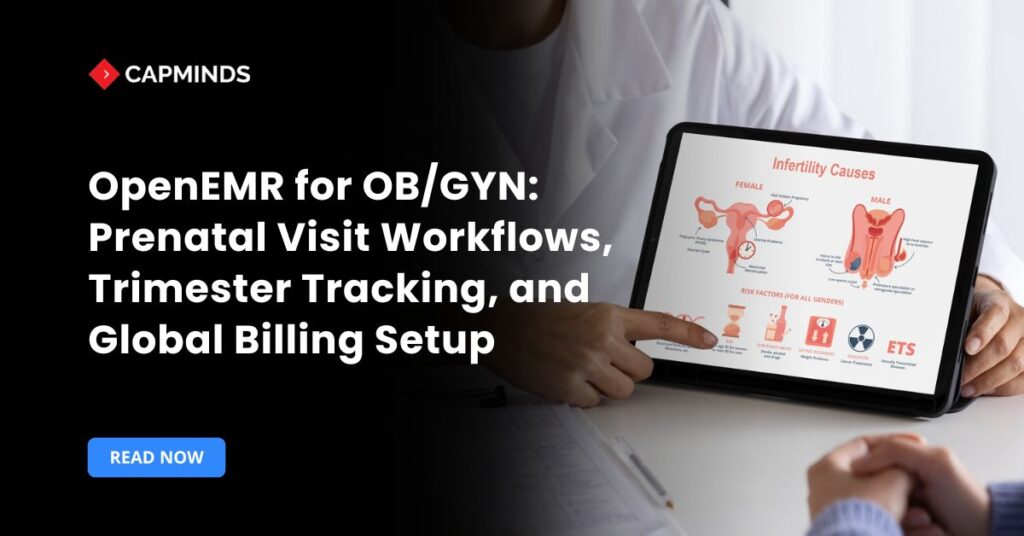
OpenEMR for OB/GYN: Prenatal Visit Workflows, Trimester Tracking, and Global Billing Setup
Most OB/GYN practices running OpenEMR are operating at a fraction of the platform’s clinical and financial capability. Not because OpenEMR lacks the functionality. No, it doesn’t. OpenEMR […]