Healthcare Product Engineering Services
Build Healthcare Products That Scale Without Rebuilding the Foundation
Bring AI, digital platforms, patient and provider experiences, modernization, cloud architecture, middleware, data engineering, and connected-device software under one healthcare engineering model built for long-term product growth.





















Our Services
Engineer the Healthcare Product Around the Business You Need to Scale
Advanced Product Engineering Capabilities
Control What Determines Product Scalability
Product Architecture
Design modular technical foundations that support new features, customers, integrations, and workloads without repeated architectural rebuilds.
Healthcare Interoperability
Connect products with EHRs, payers, devices, and healthcare networks using FHIR, HL7, X12, DICOM, APIs, and integration engines.
Secure Engineering
Build identity, access, data protection, auditability, secure APIs, and security controls into the product engineering lifecycle.
Performance Engineering
Test and optimize applications, APIs, databases, infrastructure, and integrations around expected product scale and workload.
Quality Engineering
Validate functionality, workflows, integrations, performance, security, and regression before product changes reach production.
DevSecOps & CI/CD
Automate builds, testing, security checks, infrastructure, and deployment so teams can release product changes with greater consistency.
Product Observability
Monitor application health, APIs, integrations, infrastructure, user experience, failures, and production performance across the platform.
Architecture Governance
Keep technical standards, interfaces, dependencies, and architectural decisions aligned as product teams and capabilities expand.
Product Lifecycle Engineering
Support products from architecture and development through launch, optimization, modernization, and long-term platform evolution.
Business Outcomes
Turn Engineering Into Business Value
Case Studies
We’ve successfully implemented a range of solutions. See how healthcare organizations
like yours achieved measurable results with CapMinds.

End-to-End RCM Automation for UiPath Using a Custom EMR
- 100% automation of standard RCM processes
- 50% faster claim turnaround
- Zero errors in claim formatting and submission

Westside Behavioral Care with a Custom EMR Platform
- Centralized EMR with consolidated patient data.
- 100% paperless onboarding process
- 90% automation in scheduling and documentation

UDS Reporting for Ventura County Health Care Agency (VCHCA)
- Automated processing of 100,000+ records
- FHIR validation and HRSA mock submission in 10 weeks
- 100% HRSA compliance
Not Sure What’s Slowing Your Product Roadmap?
Tell us where architecture, technical debt, integrations, engineering capacity, or delivery quality is creating friction. We’ll help identify the constraint worth solving first and where engineering investment can create the strongest product impact.
Who Do We Serve?

Hospitals & Health Systems

Healthcare Payers & Health Plans

Digital Health Companies
Startup Companies

Healthcare Software Vendors
Medical Device Companies
Healthcare AI Companies

RCM Technology Companies

Care Management Organizations
Population Health Companies
Telehealth Companies
RPM & Connected-Care Companies
Healthcare Marketplaces
Life Sciences Technology Companies
Why Healthcare Organizations Choose CapMinds?
18+ Years in Healthcare Technology
Bring proven healthcare technology experience to complex decisions, workflows, risks, and long-term transformation goals confidently.

1300+ Completed Projects
Apply lessons from 1300+ completed projects to improve planning, execution, problem-solving, and delivery confidence consistently.
Trusted by 400+ Healthcare Organizations
Partner with a healthcare technology team trusted by 400+ organizations for accountable, dependable project delivery.
Flexible Healthcare Engineering Teams
Scale product delivery with healthcare architects, developers, project managers, AI, data, interoperability, DevOps, and QA specialists as roadmap priorities evolve.
Scalable Product Architecture
Build modular product foundations that support new users, integrations, workflows, and markets without repeated architectural redesign or costly rework.
Product Quality Engineering
Validate functionality, integrations, performance, security, and regression throughout development so every release reaches production with greater confidence.

What Our Clients Say
Hear from healthcare leaders who’ve transformed their operations with our services & solution.
What Makes US a Trusted
Healthcare Product Engineering Partner
CapMinds combines multidisciplinary healthcare engineering expertise with scalable architecture, secure development, rigorous quality engineering, and lifecycle support to build reliable products designed for long-term growth.

HIPAA
COMPLIANCE

ISO 9001:2015
CERTIFIED

GDPR
COMPLIANT
SOC 2 TYPE 2
CERTIFIED

HL7 FHIR
STANDARDS

SNOMED CT
COMPATIBLE

HITRUST
ALIGNED
Technology and Engineering Experience
Technologies Selected Around Your Product Architecture
Frontend Engineering ➜

Backend Engineering ➜

Healthcare Interoperability ➜
Interface & Integration Platforms ➜

AI & Machine Learning ➜

Data Engineering ➜

Databases ➜

Engineer the Product Around Where Your Business Is Going
Build a scalable product foundation that helps you release faster, reduce technical debt, and support long-term growth without unnecessary rework.
- Accelerate high-priority product development
- Reduce technical debt and engineering costs
- Build reusable AI, data, and integration foundations
- Scale products across users, customers, and markets
Frequently Asked Questions
What healthcare products can CapMinds engineer?
CapMinds can support healthcare AI applications, payer platforms, digital health platforms, marketplaces, patient and provider platforms, portals, care-delivery platforms, RPM/RTM solutions, CCM/PHM platforms, middleware, data platforms, modernized applications, and connected medical-device software.
Can you develop healthcare AI products?
Yes. We can help to develop healthcare AI products. Our healthcare AI engineering can include conversational AI, intelligent automation, clinical or operational AI capabilities, AI-enabled workflows, model integration, data pipelines, evaluation, monitoring, and integration with existing healthcare applications. The exact design depends on the intended use, data, risk, users, workflow, and production requirements.
Can CapMinds build patient and provider portals?
Yes. CapMinds patient and provider portal development can support identity, scheduling, communication, clinical information access, documents, forms, payments, referrals, care-management workflows, and integration with EHR or other healthcare systems. The functionality depends on the organization and intended users.
Can you develop CCM and population health platforms?
Yes. Our CCM and PHM platforms can support patient registries, cohort management, care plans, care gaps, risk segmentation, outreach, task management, care coordination, documentation, and analytics.
The underlying data architecture is especially important when information comes from multiple clinical or payer systems.
Can CapMinds integrate with existing EHR systems?
Yes. CapMinds can assist in integrating existing EHR systems. Depending on the EHR and available interfaces, products can connect through FHIR, SMART on FHIR, HL7 v2, C-CDA, vendor APIs, interface engines, or other supported integration methods.
The appropriate architecture depends on the data, workflow, access, and write-back requirements.
Can CapMinds develop software for connected medical devices?
Yes. CapMinds can develop software for connected medical devices. Scope can include embedded software, firmware, companion applications, device-to-cloud communication, backend services, device data pipelines, and healthcare system integration. Where software falls under FDA medical-device oversight, applicable requirements depend on the product’s intended use and regulatory status. FDA maintains current guidance covering device software and the digital-health lifecycle.
How do you improve healthcare product scalability?
Scalability starts at architecture, not infrastructure alone. We evaluate application boundaries, databases, caching, APIs, asynchronous processing, integration patterns, infrastructure, observability, and failure handling against expected users, transactions, data volume, and future product growth.
How long does healthcare product engineering take?
Healthcare product engineering typically takes around 3 to 12 months for basic digital products. But for longer and more complex product engineering might take up to 18 to 24 months. Timing depends on the product scope, existing architecture, integrations, regulatory considerations, data requirements, security, team model, testing, and deployment environment. A bounded capability can move faster than a new enterprise platform or multi-year modernization program.
Can CapMinds work with our internal product and engineering teams?
Yes. CapMinds can provide an accountable end-to-end engineering team or work alongside your existing product, architecture, engineering, security, data, QA, DevOps, clinical, and interoperability teams. The delivery model can be structured around the capabilities and ownership your organization already has.
Can you develop healthcare payer platforms?
Yes. CapMinds can help to develop healthcare payer platforms. Our payer platform engineering can support member experiences, provider workflows, claims-related processes, prior authorization, care management, data exchange, analytics, and integration with existing payer systems. Architecture should reflect the specific business model, user groups, regulatory environment, and interoperability requirements.
Can CapMinds develop RPM and RTM platforms?
Yes. Our RPM and RTM platform engineering can include patient enrollment, device connectivity, data ingestion, monitoring workflows, alerts, clinician review, patient engagement, documentation, operational dashboards, and integration with clinical systems. Billing-related functionality should be designed around applicable program and payer requirements.
Can CapMinds develop FHIR-based healthcare products?
Yes. CapMinds can develop FHIR-based healthcare products. FHIR can be used for standards-based healthcare information exchange and API-driven product integration where it fits the use case and participating systems. ONC uses standardized FHIR APIs within U.S. certified health IT requirements, reinforcing FHIR’s importance for modern interoperable applications.
Can CapMinds build AI-ready healthcare data platforms?
Yes. AI-ready data foundations may combine clinical, administrative, financial, or product data with ingestion pipelines, standardized models, terminology normalization, data quality, access controls, lineage, and retrieval capabilities. The exact architecture depends on the intended AI workloads and governance requirements.
Can CapMinds use our existing AWS, Azure, or Google Cloud environment?
Yes. CapMinds can use the existing AWS, Azure, or Google Cloud Environment. Product architectures can be designed around existing cloud infrastructure, identity, security, data, integration, DevOps, monitoring, and platform investments when those technologies meet the product’s functional and operational requirements.
Where should we start with healthcare product engineering?
Start with the business constraint. Bring the roadmap, architecture, technical debt, integrations, engineering capacity, product growth goals, and operational requirements together. Then determine whether the priority is new product development, modernization, platform engineering, AI, data, middleware, architecture, or a combination.
What happens after the product launches?
Product engineering continues after launch. Teams should monitor reliability, performance, security, adoption, user feedback, integrations, infrastructure cost, technical debt, and product metrics while planning and delivering the next capabilities required by the business.
Resources
Insights for Healthcare Technology Teams.
How to Build a Disconnected Environment System Using OpenEMR
For the past decade, enterprise healthcare IT operated on a single, unquestioned assumption: the cloud is always reachable. Multi-campus hospital networks, Management Services Organizations, and specialty medical […]
What 200+ OpenEMR Deployments Taught Us About Healthcare Software Engineering
When CapMinds deployed our first OpenEMR instances nearly two decades ago, the US healthcare landscape was fighting a completely different war. Back in the OpenEMR 3.x and […]
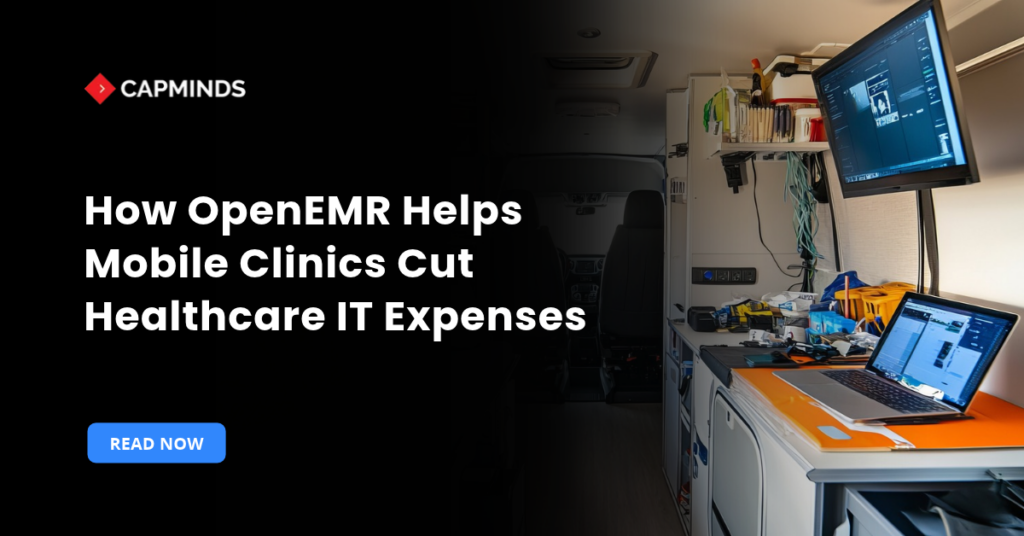
How OpenEMR Helps Mobile Clinics Cut Healthcare IT Expenses
More than 3,600 mobile clinics function in the United States and provide approximately 10 million health care visits annually. As they grow, they face healthcare IT costs, […]