Family Medicine
Support Whole-Family Care with an EHR Built for Family Medicine
Manage preventive care, acute visits, and long-term conditions across all age groups without breaking workflow continuity. CapMinds Family Medicine EHR is designed to support complete patient histories, improve coordination, and keep care consistent across every stage of life.





















Why Family Medicine Practices Face EHR Challenges & How to Solve Them
What Family Medicine practices commonly struggle with in EHR systems:
How CapMinds Family Medicine EHR services solve these challenges:
Keeps complete patient history connected across all visits.
Handles documentation across all age groups in one structure.
Keeps screenings and follow-ups consistent and visible.
Supports different visit types without disrupting documentation flow.
Core Services for Family Medicine EHR
Custom Family Medicine EHR Development
Our team provides custom EHR development for family medicine practices that need a system built around broad, continuous patient care. We develop workflows for preventive care, chronic condition tracking, SOAP notes, medication management, referrals, lab coordination, care plans, and patient communication. The outcome is faster documentation, fewer workflow gaps, and a system that supports both clinical quality and business growth.
Key capabilities:
- Family medicine clinical templates
- Preventive care workflows
- Chronic care management modules
- Provider and admin dashboards
EHR/EMR Customization
Many family practices already use an EHR, but the system may not fully match their visit types, documentation habits, or care coordination needs. We provide family practice EMR customization to refine templates, forms, dashboards, alerts, reporting views, and role-based workflows. These improvements help reduce charting time, improve documentation consistency, and make the system easier for staff to use every day.
Key capabilities:
- Custom SOAP note templates
- Visit-specific documentation forms
- Role-based dashboard customization
- Clinical alert and reporting setup
EHR Implementation & Deployment
We provide family medicine EHR implementation services covering system configuration, workflow mapping, user setup, testing, training, and go-live support. Our implementation process aligns the EHR with provider schedules, front-desk workflows, clinical documentation, billing processes, and reporting needs before launch. This helps reduce adoption issues, avoid rework, and speed up time-to-value after deployment.
Key capabilities:
- EHR setup and configuration
- Family medicine workflow mapping
- User role and access setup
- Testing, training, and go-live support
Healthcare API & System Integrations
Family medicine clinics rely on connected data across labs, pharmacies, billing platforms, patient portals, referral networks, and external care teams. We support HL7 FHIR integration for family medicine clinics to enable secure data exchange and reduce duplicate entry. These integrations help providers access the right information faster, improve care coordination, and reduce operational delays across the practice.
Key capabilities:
- HL7 and FHIR integration
- Lab and eRx connectivity
- Patient portal integration
- Referral and billing system integration
EHR Migration & Data Transfer
Moving from a legacy EHR, outdated system, or disconnected process requires careful handling of patient demographics, clinical history, medications, allergies, lab records, referrals, appointments, and billing data. We provide family medicine EHR migration services with structured data mapping, secure transfer, validation, and post-migration review. This helps protect data accuracy while reducing disruption during transition.
Key capabilities:
- Legacy EHR migration
- Patient record transfer
- Data mapping and validation
- Post-migration quality checks
Workflow Automation
Family medicine teams manage repeated tasks across appointment scheduling, patient reminders, intake forms, lab follow-ups, prescription renewals, referrals, care gaps, and billing handoffs. We deliver family medicine workflow automation solutions that reduce manual work and keep daily operations moving with fewer missed steps. This improves staff productivity, supports better patient follow-up, and gives providers more time for care.
Key capabilities:
- Appointment reminder automation
- Digital intake workflows
- Referral and follow-up automation
- Task routing for care teams
Billing & RCM Optimization
Family medicine billing includes preventive visits, chronic care services, annual wellness visits, lab-related claims, payer rules, denials, and recurring follow-ups. We support family medicine billing and RCM optimization by improving claim workflows, coding support, denial tracking, payment posting, and revenue reporting. The goal is to reduce avoidable delays, improve claim accuracy, and give leadership clearer financial visibility.
Key capabilities:
- Claims workflow optimization
- Denial management support
- Payment posting improvements
- RCM reporting and revenue visibility
Managed Support & Maintenance
After implementation, family medicine practices need reliable support to keep the EHR stable, secure, and aligned with changing clinical and business needs. Our managed support covers issue resolution, performance monitoring, workflow updates, user support, and ongoing optimization. This helps protect uptime, improve adoption, and ensure the system continues to support growth without creating extra operational burden.
Key capabilities:
- Ongoing system monitoring
- Technical support and fixes
- Performance optimization and maintenance
- Workflow updates and enhancements
Key Features of CapMinds Family Medicine EHR
Whole Family Health Records
Easy linking of family members with shared history, genetics, and hereditary risk visibility while maintaining individual privacy.
Multi-Problem Visit Efficiency
Smart templates that let you document acute, chronic, and preventive issues in a single visit without duplication.
Preventive Health Engine
Age, gender, and risk-based screening schedules with automated reminders and wellness visit templates.
Chronic Disease Cockpit
Unified dashboard to manage diabetes, hypertension, asthma, and obesity with trend graphs and care gap alerts.
Point-of-Care Rapid Testing
Integrated documentation and tracking for in-house labs, rapid strep, flu, COVID, and other point-of-care tests.
Telehealth & Home Monitoring
Smooth virtual visits combined with remote monitoring for blood pressure, glucose, and weight management.
School & Work Form Automation
One-click generation of school physicals, sports clearances, and work return forms with pre-filled patient data.
What Makes CapMinds a Trusted OpenEMR Partner
CapMinds supports OpenEMR for solo practitioners with the workflow understanding, technical depth, and security-focused approach smaller teams need. From setup to long-term support, we help practices improve usability and system reliability while supporting HIPAA readiness, role-based access, audit trails, secure data handling, and stronger day-to-day safeguards.






Integration Services We Support
Costs of Family Medicine EHR Development
Family Medicine EHR development typically ranges from $120,000 to $2,000,000+, depending on workflow complexity, integrations, and customization level.
Need a precise estimate for your practice?
Get a tailored cost breakdown based on your clinic’s requirements.
Family Medicine EHR Implementation Roadmap
Estimated Timeline: 8–10 weeks
Phase 1: Assessment & Planning (Week 1–2)
Understand workflows, patient mix, and care processes.
Phase 2: Customization & Setup (Week 3–4)
Configure templates, workflows, and system structure.
Phase 3: Data Migration & Integrations (Week 4–6)
Migrate data and integrate systems.
Phase 4: Training & Validation (Week 6–7)
Train staff and test workflows.
Phase 5: Go-Live & Support (Week 8–10)
Launch system and refine workflows.
Why Family Medicine Practices Choose CapMinds
CapMinds vs Generic EHR Systems
| Comparison Area | CapMinds Family Medicine EHR | Generic EHR |
|---|---|---|
| Patient Scope | Multi-age support | Limited flexibility |
| Workflow | Family medicine-focused | Generic |
| Documentation | Visit-specific | Basic templates |
| Billing | Mixed visit support | General |
| Control | Customizable | Vendor controlled |
| Scalability | Built for growth | Limited |
Case Studies
We’ve successfully implemented a range of solutions. See how healthcare organizations
like yours achieved measurable results with CapMinds.

End-to-End RCM Automation for UiPath Using a Custom EMR
- 100% automation of standard RCM processes
- 50% faster claim turnaround
- Zero errors in claim formatting and submission

Westside Behavioral Care with a Custom EMR Platform
- Centralized EMR with consolidated patient data.
- 100% paperless onboarding process
- 90% automation in scheduling and documentation

UDS Reporting for Ventura County Health Care Agency (VCHCA)
- Automated processing of 100,000+ records
- FHIR validation and HRSA mock submission in 10 weeks
- 100% HRSA compliance
What Our Clients Say
Hear from healthcare leaders who’ve transformed their operations with our service & solution.
Make Daily Patient Care More Structured and Consistent
Consult with our team and get a complimentary workflow assessment tailored to your family medicine practice.
- Secure patient care workflows
- Protected clinical and billing data
- Reliable tracking across all visit types
- Better coordination across care teams
FAQs
What is Family Medicine EHR and how does it work?
A Family Medicine EHR is electronic health record software designed to manage care for patients across all ages, from pediatrics to adults and seniors.
It helps family medicine practices handle charting, preventive care, chronic disease tracking, immunizations, lab results, referrals, e-prescriptions, billing, and patient communication in one connected workflow. The system gives providers a complete view of each patient’s clinical history, helping improve care continuity and daily practice efficiency.
Why do family medicine practices need specialized EHR software?
Family medicine practices need specialized EHR software because they manage high patient volume, wide age groups, recurring visits, chronic conditions, and preventive care programs.
A tailored EHR reduces charting time, improves patient flow, supports accurate coding, tracks care gaps, and helps providers manage everything from annual wellness visits to diabetes follow-ups without relying on disconnected tools or manual reminders.
How long does it take to build a Family Medicine EHR system?
A basic Family Medicine EHR can take 3–5 months to build, while a more complete platform with billing, integrations, patient portal, telehealth, and analytics usually takes 6–12 months.
Timelines depend on workflow complexity, third-party integrations, data migration, provider templates, compliance review, testing, and deployment planning. Practices modernizing an existing EHR may move faster than teams building a full system from the ground up.
Can Family Medicine EHR software integrate with existing healthcare systems?
Yes, Family Medicine EHR software can integrate with existing healthcare systems such as labs, imaging platforms, pharmacies, billing systems, clearinghouses, patient portals, telehealth tools, HIEs, and hospital networks.
Common integration standards include HL7, FHIR, APIs, CCD/C-CDA, X12, and eRx connections. Strong interoperability helps reduce duplicate entry, improve referral coordination, speed up billing, and keep patient data consistent across care settings.
What are the must-have features in a Family Medicine EHR platform?
A strong Family Medicine EHR should include patient registration, clinical charting, family medicine templates, e-prescribing, lab and imaging integration, immunization tracking, chronic care management, referral management, patient portal, telehealth, billing, claims support, reporting, and secure messaging.
For growing practices, role-based access, analytics dashboards, care gap alerts, automated reminders, and multi-location support are also important for scalability and operational control.
How is a Family Medicine EHR different from a general EHR system?
A Family Medicine EHR supports broader, longitudinal care than a basic general EHR. Family practices manage preventive visits, acute care, chronic conditions, pediatric records, adult medicine, women’s health, geriatrics, and follow-ups in the same system.
A specialized platform includes family medicine templates, immunization tracking, care gap alerts, health maintenance reminders, chronic care workflows, and billing support for common primary care services.
How much does Family Medicine EHR development cost?
Custom Family Medicine EHR development usually costs $50,000–$300,000 for small to mid-sized practices. More advanced platforms with interoperability, billing, patient portal, telehealth, analytics, and multi-location workflows can range from $300,000–$750,000.
The main cost drivers are feature scope, integrations, compliance requirements, UI complexity, data migration, reporting needs, and whether the system is built from scratch or customized using an existing EHR framework like OpenEMR.
What are the benefits of custom Family Medicine EHR development?
Custom Family Medicine EHR development gives practices software that fits their clinical, billing, and operational workflows instead of forcing teams to adapt to rigid templates.
Benefits include faster documentation, better chronic care tracking, improved preventive care management, smoother billing workflows, stronger interoperability, role-based access, custom reporting, and easier scalability for multi-provider or multi-location family medicine groups.
How do I choose the right Family Medicine EHR development company?
Choose a Family Medicine EHR development company with proven healthcare software experience, EHR workflow knowledge, interoperability expertise, and U.S. compliance understanding.
Look for experience with HIPAA, HL7, FHIR, OpenEMR, billing integrations, patient portal development, cloud hosting, data migration, and post-launch support. The right partner should understand both clinical operations and the business impact of poor EHR performance.
How can Family Medicine EHR help increase clinic productivity?
Family Medicine EHR software increases clinic productivity by reducing manual charting, duplicate data entry, appointment delays, billing errors, and follow-up gaps.
Providers can document faster using specialty templates, front-desk teams can manage scheduling and eligibility more efficiently, and billing teams get cleaner claims data. Better workflow visibility also helps practices improve patient throughput without adding unnecessary administrative burden.
CapMinds Resources
Take a look at our latest blogs.
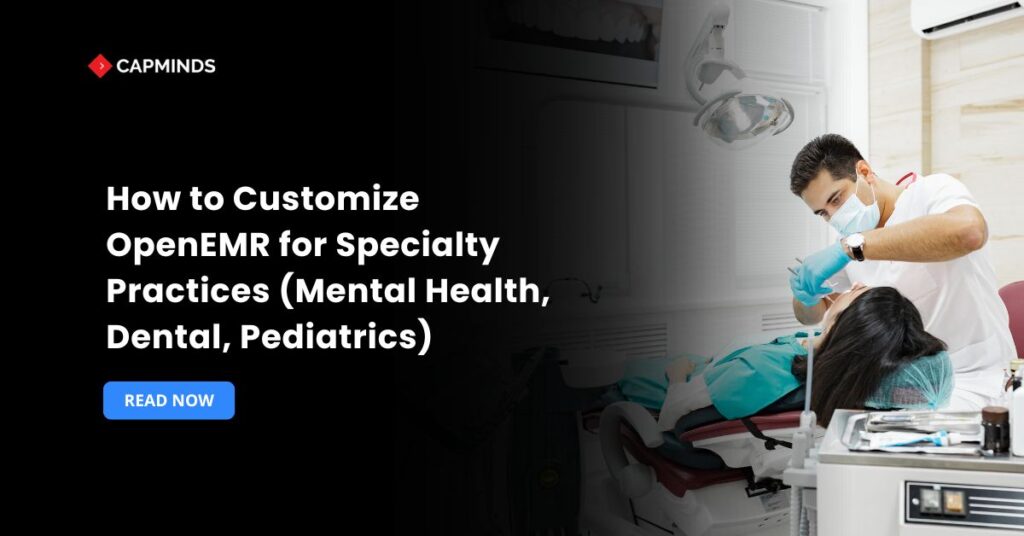
OpenEMR Customization for Specialty Practices: Mental Health, Dental & Pediatrics
OpenEMR is an advanced open-source EHR system with significant configurability to fulfill the workflow and documentation requirements of specialized clinics. While its default configuration caters to general […]
![OpenEMR for Multispecialty Hospitals [Configuring Modules for Different Departments]](https://www.capminds.com/wp-content/uploads/2024/11/Blog-Featured-Images-2024-11-04T130950.240-1024x536.jpg)
OpenEMR for Multispecialty Hospitals: Configuring Departments and Workflows
OpenEMR is the most popular open-source EMR system and continues to gain traction among multispecialty hospitals across the U.S. With over 4,000 monthly downloads, healthcare organizations are […]

AI and HL7 Exploits: Tightening Cyber Security for Oncology Specialty
In today’s digitized healthcare landscape, the use of artificial intelligence (AI) and Health Level Seven (HL7) protocols has revolutionized the field of oncology.