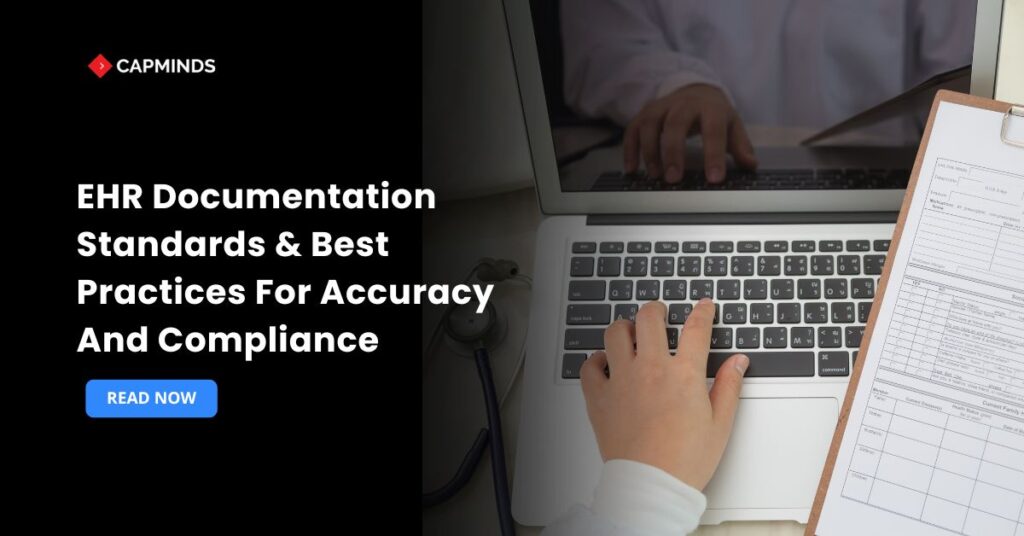
EHR Documentation Standards & Best Practices For Accuracy And Compliance
EHR documentation is an important component of the modern digital healthcare ecosystem that is effective and ensures the correct and secure access to patient health records.
Due to the growing use of EHRs by healthcare organizations, proper documentation standards have become critical to care coordination, compliance, and clinical decision-making.
This blog describes the concept of EHR documentation, its main advantages, and the best practices needed to achieve documentation integrity and accuracy in modern health care facilities.
What Is EHR Documentation?
EHR documentation is the structured mechanism of documenting, updating, and managing the clinical data of a patient in an electronic health record system.
It is a major means of communication between healthcare workers, as it allows them to record clinical experiences, diagnoses, treatments, drugs, and outcomes in a unified and digital format that is straightforward to retrieve and read.
Proper EHR documentation can guarantee that the patient data is in real time, continuity of care, and preventive healthcare, with providers providing quality and safe care.
Advantages of EHR Documentation
- Better coordination of care – Can allow access to patient records in the care team with speed and security.
- Correct billing and coding – Aids in a compliant reimbursement through the execution of documentation and clinical services congruency.
- Latest patient records – Supplies onsite clinical information.
- Secure data transfer – Supports a secure flow of health information among authorized providers.
- Less medical error – Enhances clinical quality and patient safety.
- Increased privacy and security – Increases adherence to HIPAA and data protection rules in healthcare.
Features of EHR Documentation Tools
Modern EHR documentation tools are aimed at enhancing the quality as well as usability of clinical documentation. These characteristics maintain the standards of documentation and allow implementing the new technologies in healthcare.
There is the risk of data impact when documentation tools like uncontrolled auto-populated fields are used improperly to achieve data integrity.
In order to prevent inaccuracies, health organizations should make sure that all the recorded information on health is valid, complete, and patient-specific.
Best Practices for EHR Documentation
1. Protecting Documentation Integrity
Documentation integrity means the accuracy, completeness, and reliability of a health record.
It involves identifying the patient, the origin of data, corrections in the records, the audit trail, and validation of documentation to be reimbursed.
Although using templates to simplify documentation is possible with EHR systems, incorrect use may result in inaccurate or biased records.
Providers have to read and review the auto-filled fields attentively so that only the information related to the visit and specific to the visit is recorded.
2. Finding Solutions to Template Documentation Problems
Documentation templates enhance efficiency by organizing the necessary clinical aspects in an organized format. Nevertheless, templates do not necessarily represent a patient and the situation of the visit.
Templates may cause poor documentation or a lack of complete documentation when they are not clinically relevant.
The templates must be tailored or overridden by the providers when it is needed to reflect the state and services of the patient correctly.
3. Avoiding Patient Identification Mistakes
The errors in patient identification include recording the information on the wrong patient record. These malpractices may adversely affect patient safety, clinical judgment, confidentiality, and healthcare expenses.
To mitigate this risk, healthcare organizations are advised to have in place a patient identity integrity program that tracks the rates of errors and duplicate records in the electronic master patient index (EMPI).
4. Enhancing Compliance Education
Continuous learning is necessary to eliminate legal and compliance risks related to EHR documentation.
Healthcare organizations must invest in organized EHR training programs, which should focus on documentation standards, regulatory requirements, and best practices.
Employee training can be aimed at preserving the integrity of health records, learning the requirements of compliance, and preventing documentation-related problems that could result in audits or fines.
Related: Mobile-First Healthcare: Smarter Scheduling, Routing, and Clinical Documentation
Frequently Asked Questions
1. What are EHR documentation standards?
EHR documentation standards are the guidelines that specify how health information about a patient must be properly documented, maintained, and/or updated in computer-based health record systems so as to remain consistent, retain continuity of care, and ensure data integrity.
2. Why is accurate EHR documentation important in healthcare?
Proper documentation of EHR enables sound clinical decision-making, minimization of medical errors, regulatory compliance, and appropriate billing and reimbursement.
3. What are common EHR documentation challenges?
Common challenges include improper template usage, auto-populated data errors, patient identification mistakes, and a lack of documentation compliance training.
4. How can healthcare providers improve EHR documentation accuracy?
The accuracy can be enhanced by the review of auto-filled fields, template customization, checking of patient identity, and adhering to the best practices of standard documentation by the providers.
EHR Documentation Optimization Services by CapMinds
CapMinds provides end-to-end digital health solutions, which assist healthcare organizations in making EHR documentation more accurate, compliant, and efficient.
Our services are built to support clinical teams, compliance officers, and IT leaders across the full EHR lifecycle from implementation to long-term optimization.
Our EHR-focused service offerings include:
- EHR Documentation Services to improve data integrity, template governance, audit readiness, and clinical accuracy
- EHR Integration Services for seamless interoperability across labs, billing systems, HIEs, and third-party platforms
- Clinical Workflow Optimization Services to reduce documentation burden and improve care coordination
- Compliance & Audit Readiness Services aligned with HIPAA, regulatory standards, and payer requirements
- EHR Customization & Training Services tailored to provider roles and specialty-specific documentation needs
Modernizing documentation processes, enabling compliance, and scaling your digital health infrastructure? CapMinds offers service-driven solutions with healthcare IT experience.
Collaborate with CapMinds to transform EHR documentation into a care-enabling, efficient, and compliant asset.