How to Prioritize Healthcare Interoperability for Better Clinical Outcomes
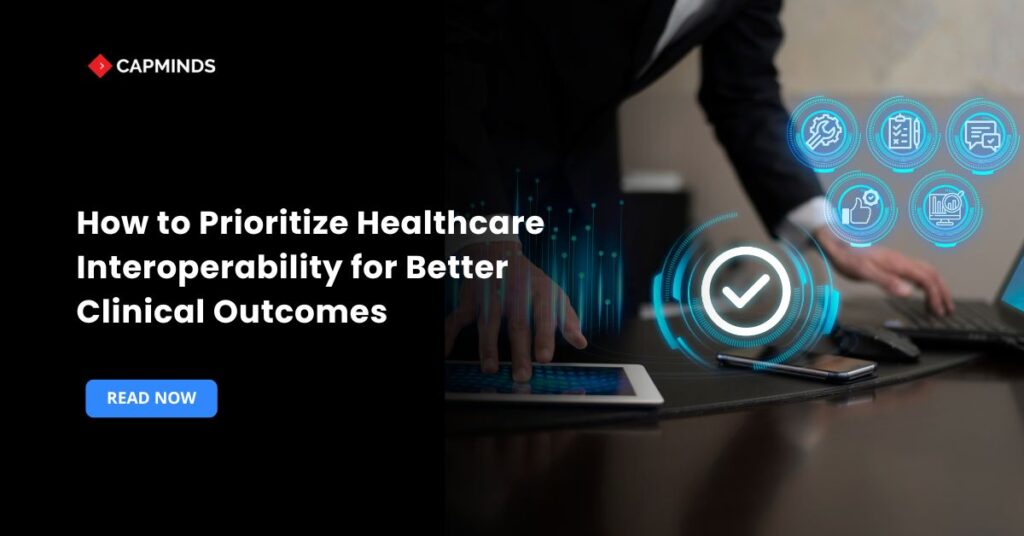
The potential of various information systems, devices, and applications to access data, share data, integrate, and collaborate in a coordinated fashion for healthcare interoperability is no longer a luxury but rather a necessity in the rapidly changing healthcare landscape.
Organizations with a robust data exchange capability are in a better position to provide better patient care, improve operations, and attain a higher clinical outcome. This in-depth examination examines the importance of interoperability and provides practical plans to health care executives.
What is Healthcare interoperability?
Healthcare interoperability will go beyond data exchange. It is the smooth and safely shared exchange of electronic health data among dissimilar IT systems in healthcare, providers, and even patients, without any extraordinary effort on the part of the user.
This will allow a doctor in one clinic to have all the medical history of a patient in a hospital in another town, or have a wearable device that can safely relay vital signs directly into an electronic health record.
The objective is to have a holistic, real-time perspective of the health journey of a patient and make informed and timely clinical decisions.
Why Interoperability is Critical for Better Clinical Outcomes
The fact that strong healthcare interoperability is directly related to better clinical outcomes is a fact that cannot be disputed. When information about patients circulates unhindered and without insecurity within the care settings, some vital advantages arise:
1. Comprehensive Patient View
Clinicians obtain instant access to a complete medical history, including past diagnoses, medications, allergies, and treatment plans, irrespective of the origin point of the care. This overall picture eliminates duplicative testing, negative drug interactions, and continuity of care.
2. Quicker and More Precise Diagnoses
When all the pertinent data is at their fingertips, providers are able to make more reliable and prompt diagnoses, and the interventions can be established earlier, and the prognoses can be better.
3. Improved Care Coordination
Interoperability facilitates easier movement of care among primary care specialists, hospitals, and post-acute care centers. This enhances better coordination of care to improve fragmentation and provide patients with high-quality care throughout the process.
4. Fewer Medical Errors
Incomplete data on patients leads to the probability of medical errors, which are dramatically decreased by access to real-time and accurate patient data.
5. Empowered Patients
As patients gain greater access to their health information, they become more active participants in their health care and, therefore, more effective in following treatment regimes and leading healthier lifestyles.
Related: Healthcare EHR Interoperability in 2025: How to Choose the Right Solution
Key Barriers to Effective Interoperability
Although it has clear advantages, interoperability in healthcare still has considerable obstacles on its way. The challenges cited should be understood first to overcome them.
Technical Silos
The increase of technical silos is one of the long-running problems. Most healthcare institutions have a patchwork of various systems that were not intended to be integrated with one another.
Various data standards, coding schemes, and terminologies are also commonly used in these systems; hence, the smooth flow of information is extremely complicated.
Legacy EHR Systems
Another considerable challenge is the extensive use of old EHR systems. Although these systems have been sufficient, numerous older platforms are not modern in terms of interoperability and may be inflexible and expensive to change to newer systems.
Organizations are often discouraged from making the required changes because of the cost and the complexity of data migration or upgrade of such systems.
Best Practices to Build an Interoperable Organization
Data Formats (FHIR, HL7) Standards
It is important to adopt data formats that are standard in the industry. The HL7 standard has always been established, yet the Fast Healthcare Interoperability Resources (FHIR) standard is rapidly becoming popular.
Interoperability based on FHIR provides a more flexible, API-oriented, and web-based applications and mobile health have a more modern approach.
Making the transition to or fully using FHIR to make new integrations is one of the areas that should be included in an EHR interoperability roadmap that organizations should develop.
Integrating EHR Systems with Telehealth
The recent years have demonstrated the necessity of seamless EHR system integration due to the increase in telehealth use. Isolated telehealth systems result in data siloes and obstruct holistic patient care.
This means that by embedding telehealth solutions in the EHR, the data of virtual visits, notes, and prescribed drugs can be instantly incorporated into the centralized record of the patient, enhancing the integration of patient data and facilitating workflow.
Enhancing Care Coordination Processes
In addition to technology, organizations need to look at and streamline their care coordination processes.
This involves finding areas where there is currently an inefficient exchange of information, but where the exchange is critical and therefore establishing solutions, both technological and procedural, to close the gap.
This can be facilitated by the use of a secure health information exchange platform that offers a reliable and compliant means of data sharing between various providers on patient data.
Advanced Interoperability Services for Future-Ready Healthcare
CapMinds empowers healthcare organizations to eliminate silos, integrate systems, and unlock real-time clinical insights with our comprehensive Digital Health Tech Services designed to strengthen interoperability and elevate patient outcomes.
With CapMinds, you gain access to end-to-end Healthcare Interoperability Services, including:
- FHIR Integration Services
- HL7 FHIR Services
- EHR Integration & API Development
- Telehealth–EHR Integration services
- Secure Health Information Exchange (HIE) Solutions
- Interoperability Consulting & Workflow Optimization
Our expert team ensures seamless data flow, enhanced care coordination, and improved clinical decision-making while helping you navigate compliance and modernize legacy systems.
Whether you need to adopt FHIR, integrate telehealth platforms, or optimize care coordination, CapMinds delivers scalable and future-proof solutions tailored to your needs.
Partner with CapMinds to build an interoperable, efficient, and clinically powerful healthcare ecosystem designed for today and ready for tomorrow.